Ultrafast Laser Shock Straining in Chiral Chain 2D Materials: Mold Topology-Controlled Anisotropic Deformation
Xingtao Liu, Danilo de Camargo Branco, Licong An, Mingyi Wang, Haoqing Jiang, Ruoxing Wang, Wenzhuo Wu, Gary J. Cheng

TL;DR
This paper explores how ultrafast laser shocks can deform 2D tellurene in different ways depending on crystal orientation and mold shape, enabling precise nanostructuring.
Contribution
The study is the first to demonstrate ultrafast laser shock imprinting on chiral chain tellurene, revealing orientation-sensitive deformation mechanisms and strain localization.
Findings
Parallel strain to tellurene's helical chains causes gliding and rotation without breaking bonds.
Transverse strain leads to shear-driven distortions, altering lattice structure and electronic properties.
Sharp-edged molds induce localized shear and dislocations more effectively than smooth molds, preserving single-crystal regions.
Abstract
Realized ultrafast laser shock imprinting on chiral chain tellurene: Reveals crystallographic orientation-dependent deformation in 2D tellurium via laser shock imprinting.Dual deformation regimes: Identifies two distinct strain response modes—parallel strain enables chain gliding and rotation, while transverse strain induces multimodal shear-driven deformations, dramatically altering lattice structure and properties.Mold topology enabled strain localization and single-crystal retention—sharp edges generate localized shear, forming dislocations more effectively than smooth molds. Asymmetric strain achieves dense deformation while preserving single-crystal zones, enabling precise optoelectronic nanostructuring. Realized ultrafast laser shock imprinting on chiral chain tellurene: Reveals crystallographic orientation-dependent deformation in 2D tellurium via laser shock imprinting. Dual…
Genes, proteins, chemicals, diseases, species, mutations and cell lines named across the full text — each resolved to its canonical identifier and authoritative record.
Click any figure to enlarge with its caption.
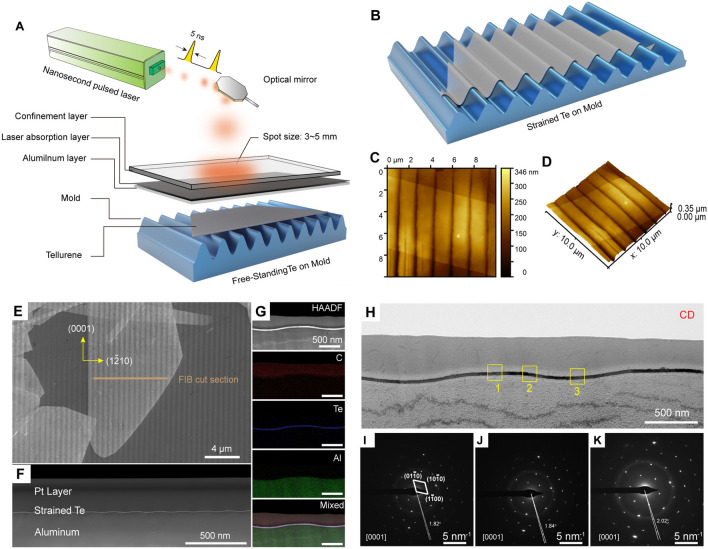 Figure 1
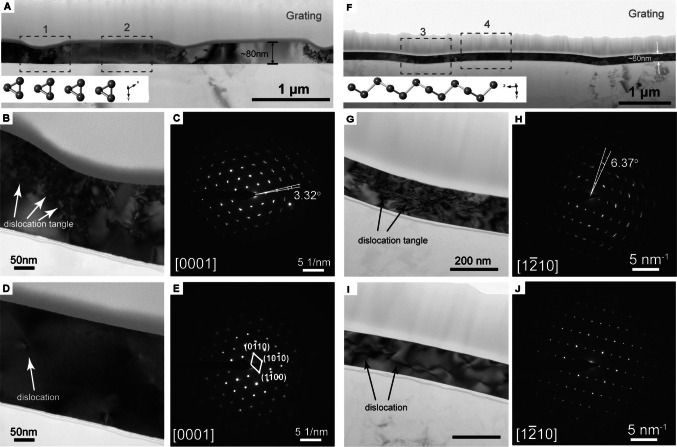 Figure 2
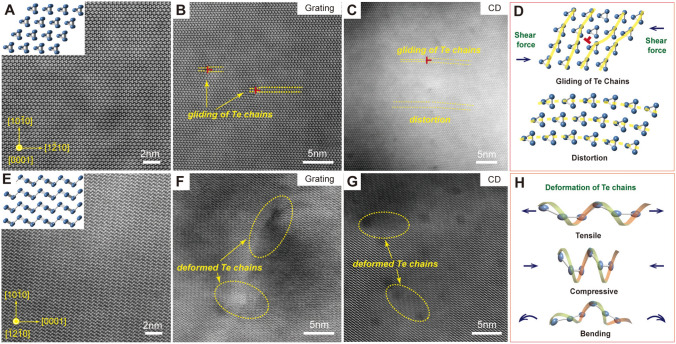 Figure 3
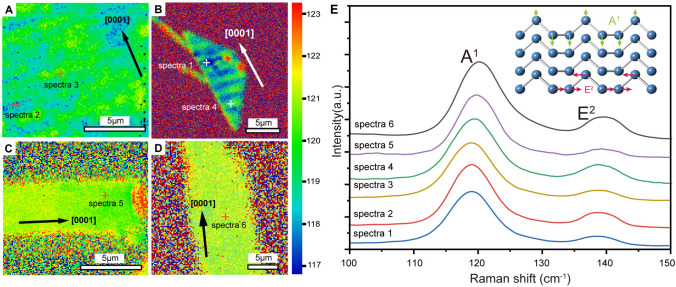 Figure 4
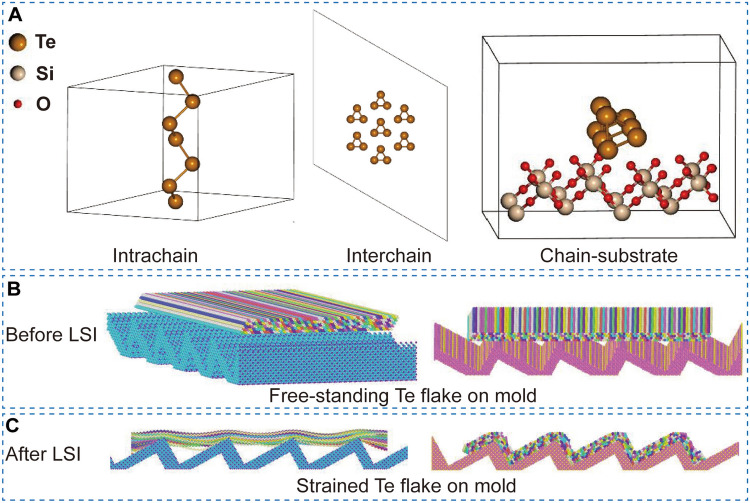 Figure 5
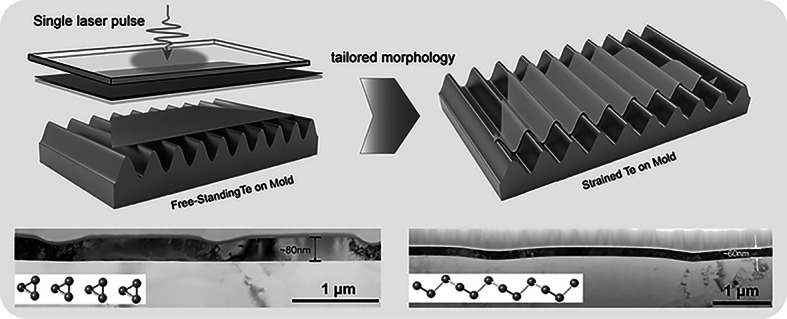 Figure 6
Peer Reviews
No public reviews on file for this paper yet. If you reviewed it on a platform where reviews are public (OpenReview, ICLR, NeurIPS, ICML), you can paste yours below so the community can read it here.
Videos
No videos yet. Explain this paper in a talk, walkthrough, or lecture? Add one.
Taxonomy
Topics2D Materials and Applications · Laser Material Processing Techniques · Nonlinear Optical Materials Studies