Intuitive Thinking is Associated with Stronger Belief in Physiognomy and Confidence in the Accuracy of Facial Impressions
Bastian Jaeger, Anthony M. Evans, Mariëlle Stel, Ilja van Beest

TL;DR
This paper explores how common it is for people to believe that facial features reveal personality traits and finds that such beliefs are widespread and linked to trusting intuition.
Contribution
The study identifies intuitive thinking as a key psychological correlate of physiognomic belief across diverse populations.
Findings
About 50% of participants in a representative Dutch sample endorsed physiognomic beliefs.
Physiognomic belief is strongly associated with trust in intuitive thinking across multiple countries.
Belief in physiognomy is consistent across gender, age, education, and income groups.
Abstract
Physiognomy, the idea that a person’s character is reflected in their facial features, has a long history in scholarly thought. Although now widely regarded as pseudoscience in academic circles, recent work suggests that laypeople hold physiognomic beliefs and that belief endorsement is associated with support for facial profiling technology and other outcomes. Here, we build on previous work and investigate who believes in physiognomy. In four studies (three preregistered), we (1) assess the prevalence of physiognomic beliefs across different sociodemographic groups, and (2) investigate its psychological correlates. In a large, representative sample of the Dutch population (Study 1, n = 2624), about 50% of participants at least somewhat endorsed physiognomic beliefs. Endorsement of physiognomic beliefs varied little as a function of gender, age, education, and income. Across different…
Genes, proteins, chemicals, diseases, species, mutations and cell lines named across the full text — each resolved to its canonical identifier and authoritative record.
Click any figure to enlarge with its caption.
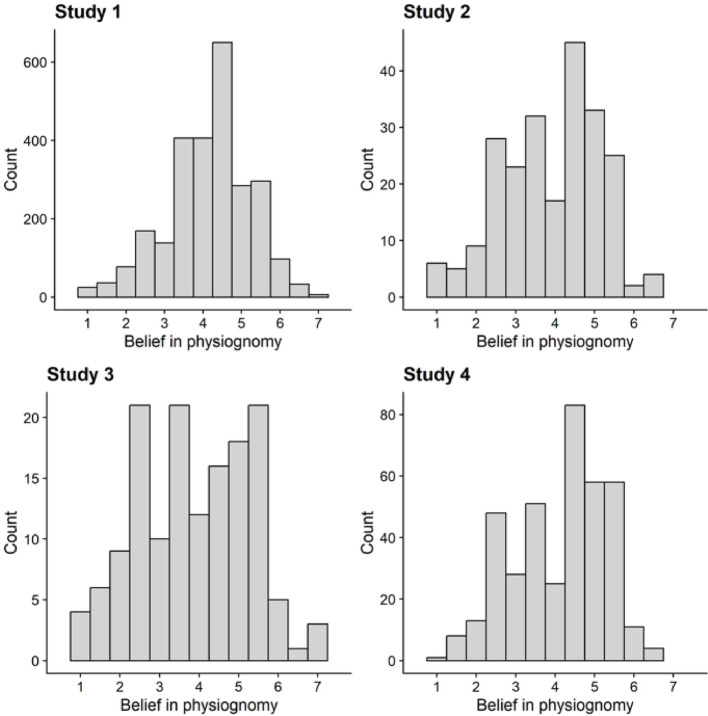 Figure 1
Peer Reviews
No public reviews on file for this paper yet. If you reviewed it on a platform where reviews are public (OpenReview, ICLR, NeurIPS, ICML), you can paste yours below so the community can read it here.
Videos
No videos yet. Explain this paper in a talk, walkthrough, or lecture? Add one.
Taxonomy
TopicsPsychology of Moral and Emotional Judgment · Evolutionary Psychology and Human Behavior · Psychology of Social Influence