Breaking down prefixed words is unaffected by morphological boundary opacity: Evidence from behavioral and MEG experiments
Dave Kenneth Tayao Cayado, Samantha Wray, Marco Chia-Ho Lai, Adam J. Chong, Linnaea Stockall

TL;DR
This study shows that the brain can break down words into their parts even when the boundaries between word parts are unclear.
Contribution
The research demonstrates that morphological decomposition is robust even with obscured morpheme boundaries, using behavioral and MEG data.
Findings
Behavioral masked priming data show decomposition of prefixed words with obscured boundaries.
MEG data reveal neural activity modulated by stem-to-whole word transition probability.
Decomposition remains unaffected by morphophonological changes in Tagalog prefixed words.
Abstract
Previous experiments support an initial stage of early, form-based visual word recognition, where morphologically complex words like adorable are segmented into morphemes {adore}+{-able}, despite an orthographic change in the stem. However, most experiments have focused on words with clear boundaries between the affix and stem, making decomposition more straightforward. We investigate whether obscured boundaries between the prefix and stem affect morphological decomposition. Using Tagalog as a test case, we compare the processing of prefixed words [1] without morphophonological changes (e.g., {mang}+{hila} becomes manghila “to pull”), [2] with nasal assimilation obscuring prefix identity (e.g., {mang}+{bulag} becomes mambulag “to blind”), and [3] with nasal substitution obscuring both prefix and stem identities and their morphological boundary at orthographic and phonological levels…
Genes, proteins, chemicals, diseases, species, mutations and cell lines named across the full text — each resolved to its canonical identifier and authoritative record.
Click any figure to enlarge with its caption.
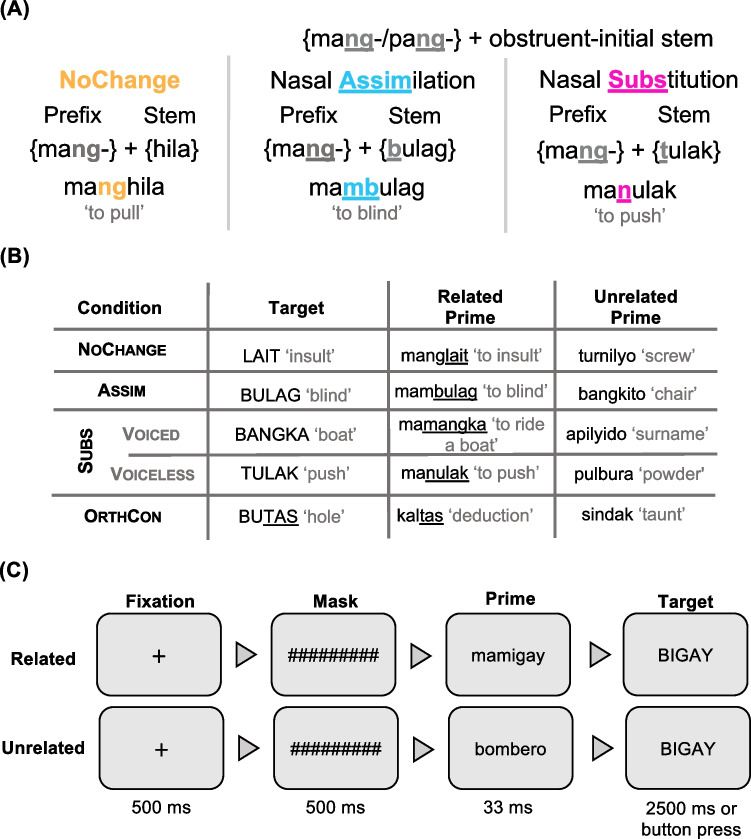 Figure 1
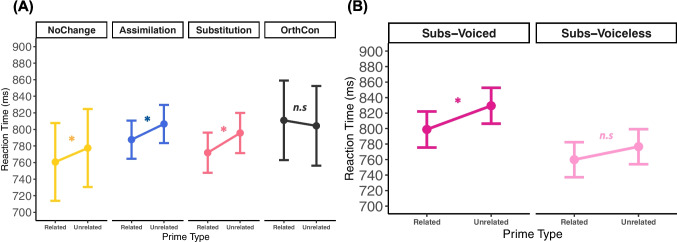 Figure 2
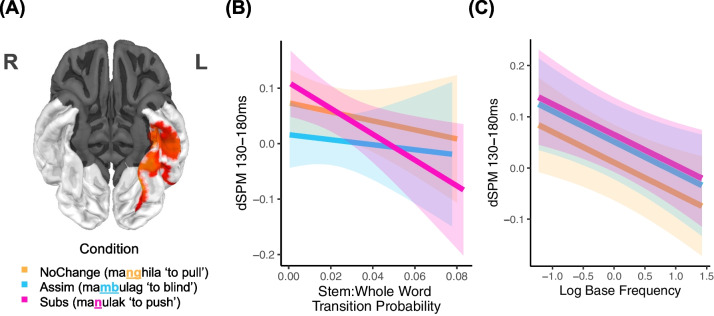 Figure 3
Peer Reviews
No public reviews on file for this paper yet. If you reviewed it on a platform where reviews are public (OpenReview, ICLR, NeurIPS, ICML), you can paste yours below so the community can read it here.
Videos
No videos yet. Explain this paper in a talk, walkthrough, or lecture? Add one.
Taxonomy
TopicsNeurobiology of Language and Bilingualism · Reading and Literacy Development · Language Development and Disorders