Liquid biopsy in orthopedic trauma: exosomes as functional mediators and mechanistic indicators in post-traumatic complications
Jinyu Gan, Shuangting Zhong, Juan Xie, Liqun Zou

TL;DR
This paper explores how exosomes, tiny cell messengers, could help detect and treat complications from severe bone injuries, offering new diagnostic and therapeutic possibilities.
Contribution
The paper introduces exosomes as active mediators in trauma complications, not just biomarkers, and proposes new mechanistic models for disease progression.
Findings
Trauma-derived exosomes transfer miR-155 and inflammatory proteins, altering cell behavior and causing endothelial dysfunction.
Mesenchymal stem cell-derived exosomes improve fracture healing in non-union models.
Exosomal biomarkers show potential for early detection of trauma complications through distinct molecular pathways.
Abstract
Severe orthopedic trauma initiates complex pathophysiological cascades that frequently lead to life-threatening complications including acute compartment syndrome, fat embolism syndrome, deep vein thrombosis, and fracture non-union. Traditional biomarkers provide only retrospective indicators of tissue damage, lacking the sensitivity and specificity needed for early complication detection. Exosomes, nanoscale extracellular vesicles carrying proteins, lipids, and nucleic acids, have emerged as critical mediators of intercellular communication that actively participate in trauma pathophysiology. This comprehensive review synthesizes accumulating evidence suggesting that exosomes may function as active mediators rather than passive biomarkers in orthopedic trauma complications. Studies demonstrate that trauma-derived exosomes transfer functional cargo including miR-155 and inflammatory…
Genes, proteins, chemicals, diseases, species, mutations and cell lines named across the full text — each resolved to its canonical identifier and authoritative record.
Click any figure to enlarge with its caption.
 Figure 1
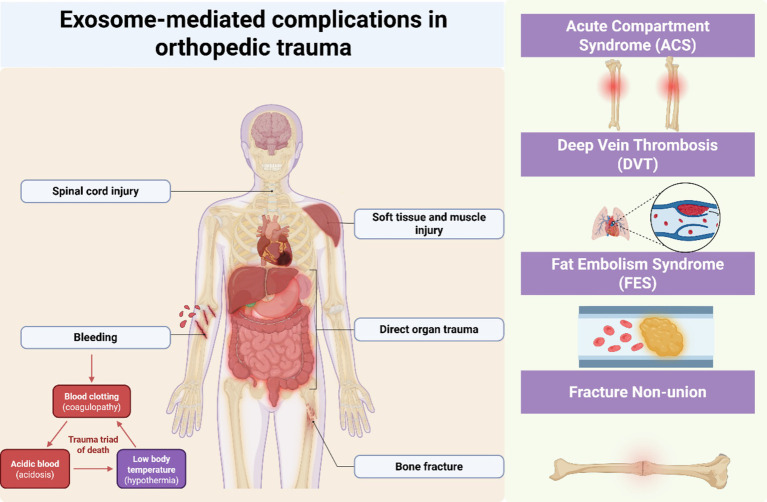 Figure 2
 Figure 3
Peer Reviews
No public reviews on file for this paper yet. If you reviewed it on a platform where reviews are public (OpenReview, ICLR, NeurIPS, ICML), you can paste yours below so the community can read it here.
Videos
No videos yet. Explain this paper in a talk, walkthrough, or lecture? Add one.
Taxonomy
TopicsExtracellular vesicles in disease · Heterotopic Ossification and Related Conditions · Bone fractures and treatments