Harnessing IgM for solid tumor therapy: biology, engineering advances, and translational challenges
Yuhui Wang, Bing Wang, Shuhan Liu, Yinuo Chen, Shimei Zhang, Lifang Bu, Wenjing Zhu, Xinlin Liu, Peng Sun

TL;DR
This paper explores how IgM antibodies could be used to treat solid tumors, highlighting their advantages and the challenges in developing them as therapies.
Contribution
The paper reviews recent engineering advances in IgM-based antibodies and outlines translational challenges for solid tumor therapy.
Findings
IgM antibodies show higher avidity and complement activation compared to IgG, making them effective in heterogeneous tumor environments.
Engineered IgM formats demonstrate antitumor potential in preclinical studies.
Key barriers include short serum half-life, poor tumor penetration, and production scalability.
Abstract
Immunoglobulin M (IgM) antibodies are gaining renewed attention as next-generation platforms for cancer immunotherapy. Compared with IgG, IgM exhibits distinct biological advantages, including higher avidity from multivalent binding, potent complement activation, and enhanced recognition of heterogeneous tumor antigens within immunosuppressive microenvironments. These attributes position IgM as a promising candidate for solid tumor therapy, despite the absence of currently approved IgM-based therapeutics. Recent advances in genetic engineering, antibody design, and protein manufacturing have enabled the generation of diverse IgM formats—ranging from monoclonal and bispecific constructs to engineered IgM derivatives—demonstrating substantial antitumor potential in preclinical and early translational studies. Nonetheless, clinical development faces persistent challenges, including short…
Genes, proteins, chemicals, diseases, species, mutations and cell lines named across the full text — each resolved to its canonical identifier and authoritative record.
Click any figure to enlarge with its caption.
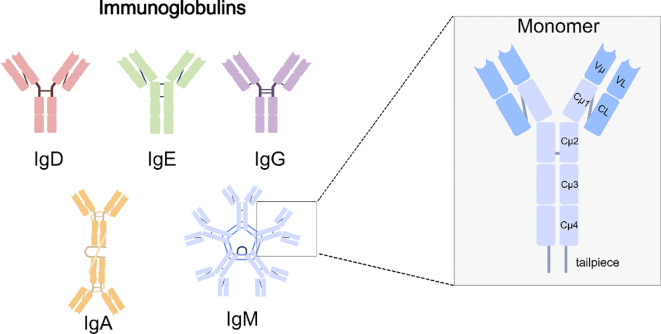 Figure 1
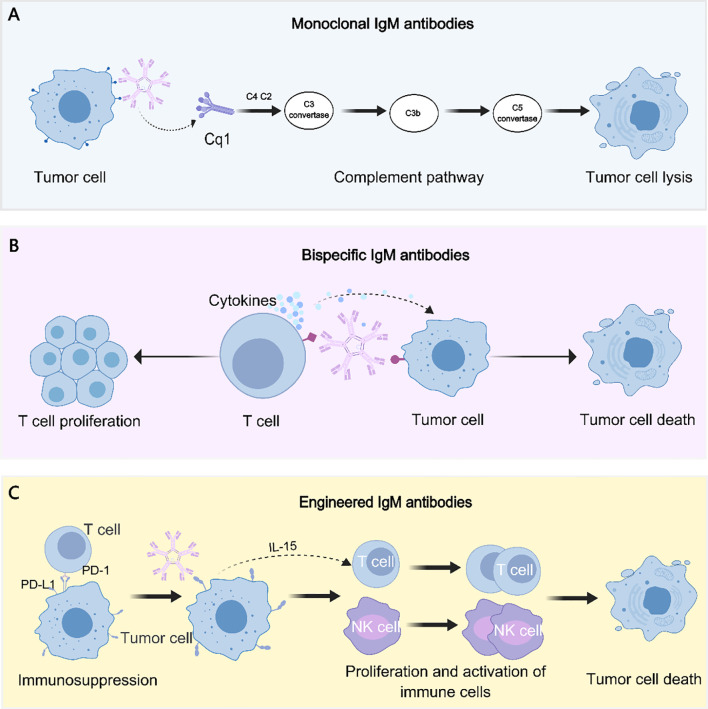 Figure 2
Peer Reviews
No public reviews on file for this paper yet. If you reviewed it on a platform where reviews are public (OpenReview, ICLR, NeurIPS, ICML), you can paste yours below so the community can read it here.
Videos
No videos yet. Explain this paper in a talk, walkthrough, or lecture? Add one.
Taxonomy
TopicsMonoclonal and Polyclonal Antibodies Research · HER2/EGFR in Cancer Research · Advanced Biosensing Techniques and Applications