Investigation of the effect of quercetin on experimental traumatic cardiac injury in rats
Muhammed Enes Taysi, Mustafa Enes Demirel, Ayhan Cetinkaya, Aslihan Saylan, Seyit Ali Kayis, Murat Alisik

TL;DR
This study finds that quercetin, especially at high doses, may protect rat hearts from trauma-induced injury by reducing oxidative stress and tissue damage.
Contribution
The novel finding is that quercetin at 40 mg/kg significantly reduces oxidative stress markers and histopathological damage in traumatic cardiac injury in rats.
Findings
Quercetin at 40 mg/kg significantly reduced malondialdehyde levels, indicating reduced oxidative stress.
Histopathological damage was mitigated in a dose-dependent manner, with the highest dose showing the most protection.
Quercetin's protective effects were not consistently observed in all biochemical markers like IL-1 and SOD.
Abstract
Cardioprotection is an important aspect of preventive medicine. Quercetin, a plant-derived flavonoid with antioxidant and anti-inflammatory properties, has been linked to reduced cardiovascular risk. To investigate the cardioprotective effects of quercetin in rats with traumatic cardiac injury (TCI). Fifty-two Wistar Albino rats were randomly divided into six groups: control (n = 7); TCI only (n = 9); TCI + DMSO (n = 6); and TCI + quercetin at 10, 20, or 40 mg/kg (n = 9 each). Quercetin or DMSO was given intraperitoneally at 0.5, 12, and 24 h after trauma. Cardiac trauma was induced by dropping a standardized weight on the chest. Serum biochemical parameters (GPx, SOD, IL-1, IL-33, sST2, MDA) were measured by ELISA, and histopathological damage was scored semiquantitatively. Data were analyzed using ANOVA or Kruskal–Wallis tests with p < 0.05 as significant. GPx elevation was…
Genes, proteins, chemicals, diseases, species, mutations and cell lines named across the full text — each resolved to its canonical identifier and authoritative record.
Click any figure to enlarge with its caption.
 Figure 1
 Figure 2
 Figure 3
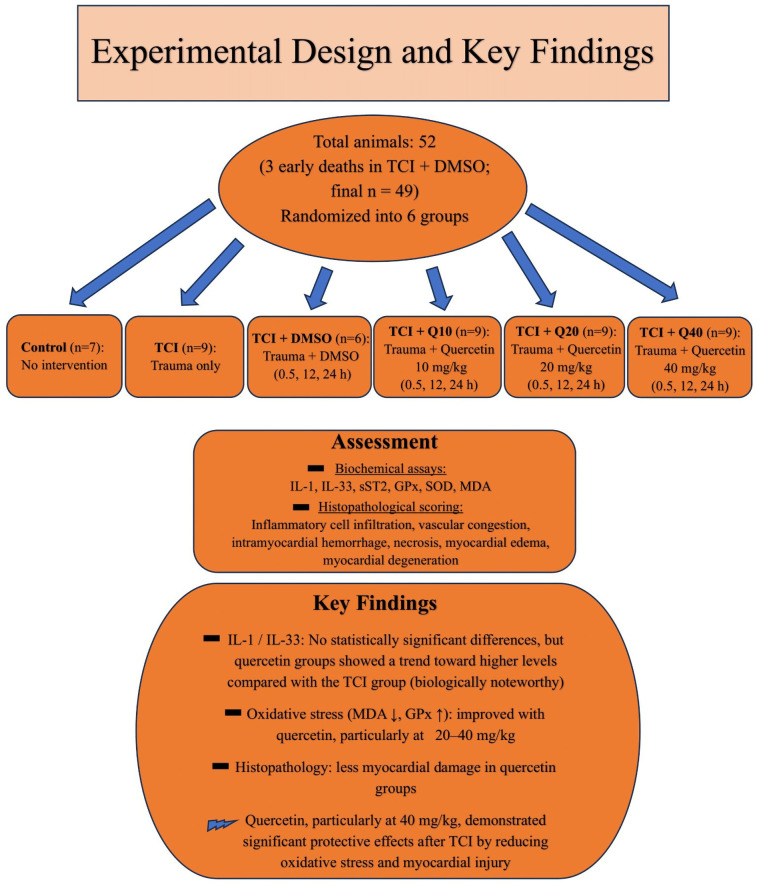 Figure 4
Peer Reviews
No public reviews on file for this paper yet. If you reviewed it on a platform where reviews are public (OpenReview, ICLR, NeurIPS, ICML), you can paste yours below so the community can read it here.
Videos
No videos yet. Explain this paper in a talk, walkthrough, or lecture? Add one.
Taxonomy
TopicsCardiac Ischemia and Reperfusion · Cell death mechanisms and regulation · Burn Injury Management and Outcomes