Variational quantum generative modeling by sampling expectation values of tunable observables
Kevin Shen, Andrii Kurkin, Adrián Pérez-Salinas, Elvira Shishenina, Vedran Dunjko, Hao Wang

TL;DR
This paper introduces a new quantum generative model that improves efficiency and performance by tuning observables and using classical training methods.
Contribution
The novel OT-EVS model enhances expressivity and reduces quantum resource demands through tunable observables and adversarial training.
Findings
OT-EVS achieves greater expressivity than standard EVS models.
Classical shadows measurement reduces sample complexity in OT-EVS.
Adversarial training prioritizes classical updates, minimizing costly quantum parameter updates.
Abstract
Expectation Value Samplers (EVSs) are quantum generative models that can learn high-dimensional continuous distributions by measuring the expectation values of parameterized quantum circuits. However, these models can demand impractical quantum resources for good performance. We investigate how observable choices affect EVS performance and propose an Observable-Tunable Expectation Value Sampler (OT-EVS), which achieves greater expressivity than standard EVS. By restricting the selectable observables, it is possible to use the classical shadows measurement scheme to reduce the sample complexity of our algorithm. In addition, we propose an adversarial training method adapted to the needs of OT-EVS. This training prioritizes classical updates of observables, minimizing the more costly updates of quantum circuit parameters. Numerical experiments, using an original simulation technique for…
Genes, proteins, chemicals, diseases, species, mutations and cell lines named across the full text — each resolved to its canonical identifier and authoritative record.
Click any figure to enlarge with its caption.
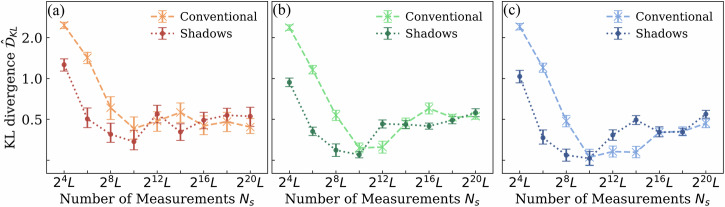 Figure 1
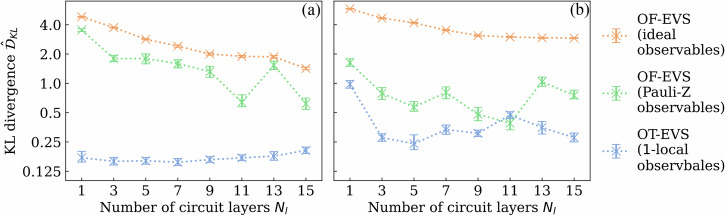 Figure 2
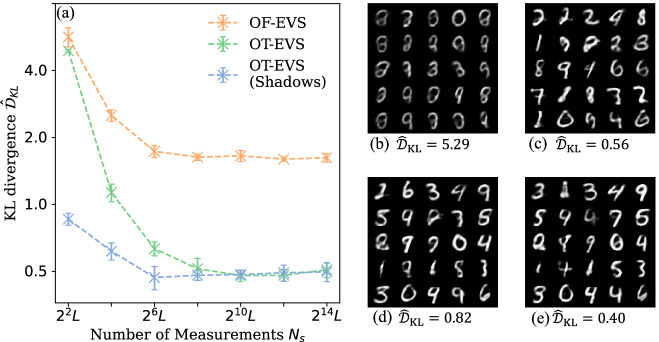 Figure 3
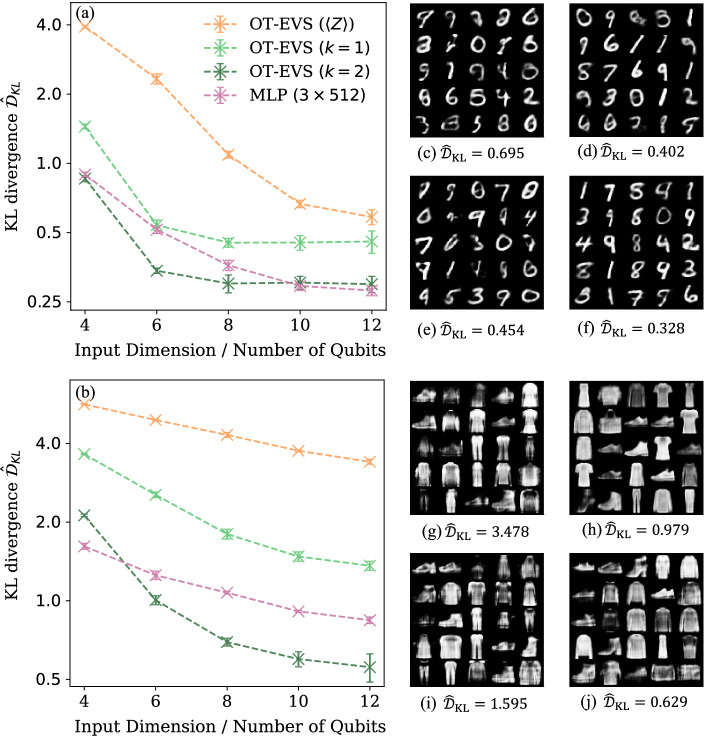 Figure 4
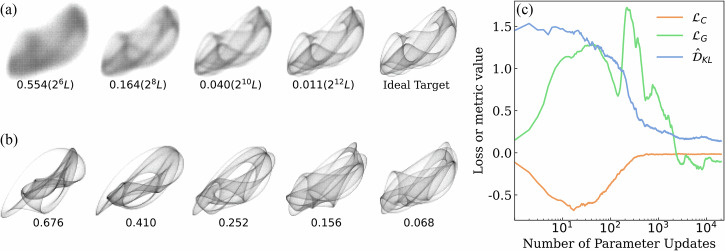 Figure 5
Peer Reviews
No public reviews on file for this paper yet. If you reviewed it on a platform where reviews are public (OpenReview, ICLR, NeurIPS, ICML), you can paste yours below so the community can read it here.
Videos
No videos yet. Explain this paper in a talk, walkthrough, or lecture? Add one.
Taxonomy
TopicsQuantum Computing Algorithms and Architecture · Quantum many-body systems · Machine Learning in Materials Science