The impact of social support on the quality of sports participation among individuals with disabilities: the chain mediating effects of psychological capital and self-esteem
Jiahui Peng, Li Cao, Feixuan Li, Deqiao Zhou

TL;DR
This study shows how social support improves sports participation quality for people with disabilities through psychological factors like confidence and self-esteem.
Contribution
The study introduces a chain mediation model showing how social support affects sports participation quality via psychological capital and self-esteem.
Findings
Social support directly predicts 49.87% of the quality of sports participation among individuals with disabilities.
Psychological capital and self-esteem together mediate 50.13% of the effect of social support on sports participation quality.
The strongest chain path is 'Social Support → Psychological Capital → Quality of Sports Participation,' contributing 37.41%.
Abstract
Individuals with disabilities possess the right to equally participate in cultural, recreational, and sporting activities. Enhancing the quality of sports participation among this population is therefore of significant importance for promoting social equity. Grounded in Conservation of Resources Theory and the Social Cognitive Framework, this study focuses on the sequential transmission pathway involving psychological capital and self-esteem. It aims to elucidate the chain mediation mechanism through which social support influences the quality of sports participation among individuals with disabilities, thereby providing a theoretical foundation and practical targets for optimizing sports policies for this group. Employing a stratified random sampling method, a cross-sectional questionnaire survey was conducted with 632 individuals with disabilities across 12 cities in 6 provinces…
Genes, proteins, chemicals, diseases, species, mutations and cell lines named across the full text — each resolved to its canonical identifier and authoritative record.
Click any figure to enlarge with its caption.
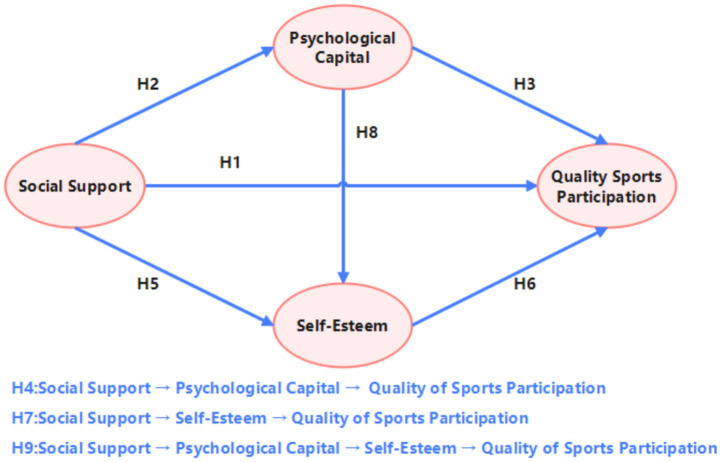 Figure 1
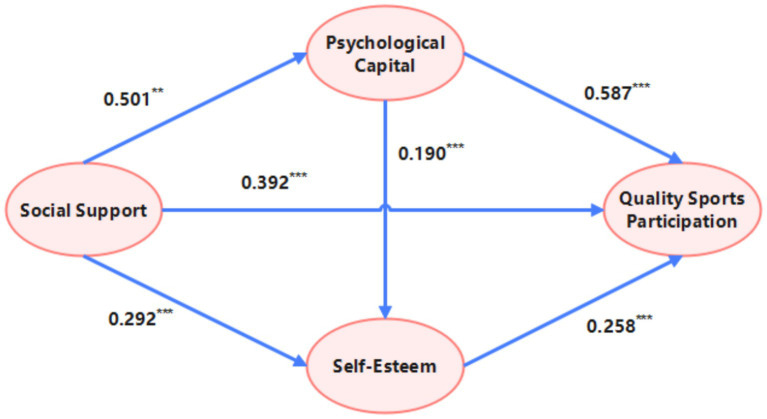 Figure 2
Peer Reviews
No public reviews on file for this paper yet. If you reviewed it on a platform where reviews are public (OpenReview, ICLR, NeurIPS, ICML), you can paste yours below so the community can read it here.
Videos
No videos yet. Explain this paper in a talk, walkthrough, or lecture? Add one.
Taxonomy
TopicsSport Psychology and Performance · Disability Education and Employment · Recreation, Leisure, Wilderness Management