Trends in Private Equity Acquisitions of Assisted Living Facilities
Jennifer N. Bunker, Yashaswini Singh, Gauri Gadkari, John Bowblis, Lindsey Smith, Paula Carder, Sean Huang, Momotazur Rahman, Kali S. Thomas

TL;DR
This study explores how private equity has acquired assisted living facilities in the US over time.
Contribution
The paper provides new insights into the growing role of private equity in the assisted living sector.
Findings
Private equity acquisitions of assisted living facilities have increased significantly in recent years.
The study identifies geographic and temporal patterns in these acquisitions.
Abstract
This cross-sectional study examines trends in private equity acquisitions of assisted living facilities across the US.
Genes, proteins, chemicals, diseases, species, mutations and cell lines named across the full text — each resolved to its canonical identifier and authoritative record.
Click any figure to enlarge with its caption.
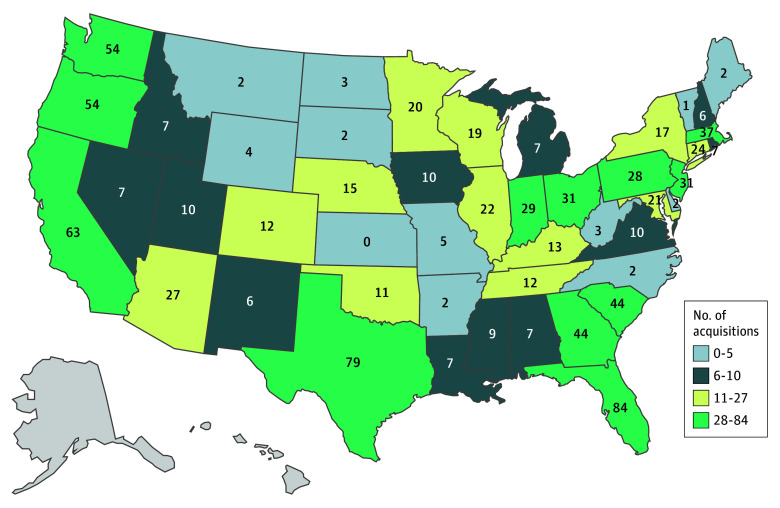 Figure 1
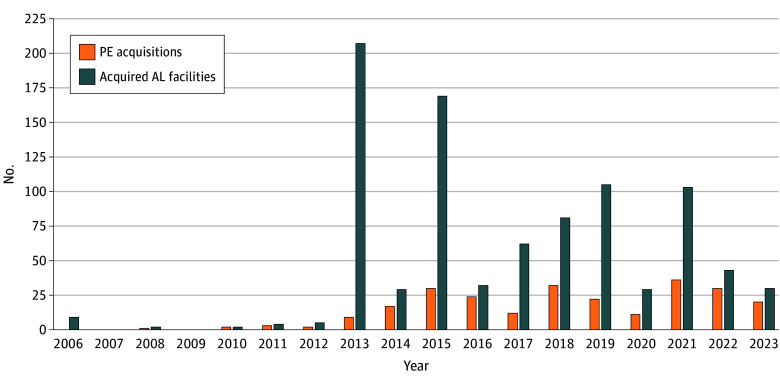 Figure 2
Peer Reviews
No public reviews on file for this paper yet. If you reviewed it on a platform where reviews are public (OpenReview, ICLR, NeurIPS, ICML), you can paste yours below so the community can read it here.
Videos
No videos yet. Explain this paper in a talk, walkthrough, or lecture? Add one.
Taxonomy
TopicsMigration, Aging, and Tourism Studies · Geriatric Care and Nursing Homes · Community Development and Social Impact
Introduction
Assisted living (AL) is a widely used long-term care option, serving nearly 1 million older adults across more than 32 000 US facilities.^1^ While growing private equity (PE) investment in nursing homes raises concerns about staffing^2^ and quality of care,^3^ the role of PEs in AL is unknown. As demand for long-term care grows,^4^ understanding who is acquiring AL facilities is critical. This study examines trends in PE acquisitions of AL facilities.
Methods
Per the Common Rule, this cross-sectional study did not require ethics review because it constituted non–human participant research. We followed the STROBE reporting guideline.
We used LevinAssociates’ LevinPro LTC acquisitions database to source AL acquisitions, relying on LevinAssociates’ identification of the majority or controlling buyer as PE (eMethods in Supplement 1). We defined AL as any state-licensed facility that houses older adults and provides at least 2 meals per day, 24-hour supervision, and assistance with activities of daily living.
We identified 3044 senior housing acquisitions through 2023, of which 320 involved PE and AL. We used a stepwise approach to remove duplications, supplement missing information, and match data to a national directory of licensed AL facilities for 2017 to 2023^5^ (eTable in Supplement 1). Nonmatching facilities that were acquired before the directory period were confirmed as AL using the Internet Archive. We report PE acquisition trends from 2006 to 2023, including counts, locations, and inflation-adjusted transaction values. Data were analyzed from January 8, 2024, to May 3, 2025.
Results
We identified 252 PE acquisitions involving 912 AL facilities. A majority of deals (172 [68.2%]) involved a single AL; only 20 acquisitions (7.9%) included more than 5 AL facilities. PE-acquired AL facilities were in 47 states, but more than one-third (n = 334 [36.6%]) were in Florida (n = 84), Texas (n = 79), California (n = 63), Washington (n = 54), and Oregon (n = 54) (Figure 1). The transaction dollar value was reported for 170 acquisitions (67.5%), representing 81.4% (n = 742) of all acquisitions. The total reported transaction value of AL acquisitions was $17.3 billion in inflation-adjusted 2023 dollars.
Number of Private Equity Acquisitions of Assisted Living Facilities by State
Yearly PE acquisitions involving AL facilities were low from 2006 to 2012 but increased between 2013 and 2023 (Figure 2), with the highest adjusted values in 2019 ($2.84 billion). Total acquisitions were highest in 2021, with 36 transactions involving 103 facilities.
Number of Private Equity (PE) Acquisitions of Assisted Living (AL) Facilities and Number of Acquired Facilities by Year
Discussion
This cross-sectional study is, to our knowledge, the first to report trends in PE acquisition of AL facilities. The rise in acquisitions during the past decade parallels trends in other care settings and likely reflects anticipated growth in long-term care demand driven by the aging population.^4^ We provide new insights by addressing challenges related to reporting PE investment in AL facilities. Because states license, certify, and refer to AL differently, no public national list of facilities exists. Additionally, states may not require licensees to report ownership information. We addressed these challenges by compiling a national directory of licensed facilities^5^ via a uniform definition of AL applied across states^6^ and linking mergers and acquisitions data with other information sources to identify PE acquisitions of this growing long-term care setting.
Because documentation of PE acquisitions of AL facilities is opaque, these results likely underestimate the actual number of acquisitions. Our dataset did not include AL facilities developed with PE capital, acquisitions not captured by LevinAssociates, or transactions occurring before the database’s coverage; additionally, we could not determine the extent of PE influence on operations.
This study provides a foundation for further inquiry into PE in AL facilities. With the aging population driving demand for long-term care and the lack of public financing options for AL, future research should investigate the influence and nuances of PE involvement on access to AL and residents’ experiences.
The reference list from the paper itself. Each links out to its DOI / PubMed record.
- 1Residential care communities. National Center for Health Statistics. Accessed December 19, 2024. https://www.cdc.gov/nchs/fastats/residential-care-communities.htm
- 2Gandhi A, Song YJ, Upadrashta P. Private equity, consumers, and competition: evidence from the nursing home industry. October 2025. Accessed October 28, 2025. https://www.nber.org/papers/w 34306
- 3Braun RT, Jung HY, Casalino LP, Myslinski Z, Unruh MA. Association of private equity investment in US nursing homes with the quality and cost of care for long-stay residents. JAMA Health Forum. 2021;2(11):e 213817. doi:10.1001/jamahealthforum.2021.3817 35977267 PMC 8796926 · doi ↗ · pubmed ↗
- 4Thomas KS, Bowblis JR, Carder P, Private equity investment in assisted living: distinct impacts and policy considerations. Health Affairs Forefront. June 18, 2024. Accessed April 2, 2025. https://www.healthaffairs.org/content/forefront/private-equity-investment-assisted-living-distinct-impacts-and-policy-considerations
- 5Thomas KS, Smith L, Gadkari G, Hua C, Cornell P. Identifying a national cohort of Medicare beneficiaries residing in assisted living settings: an updated method. J Am Med Dir Assoc. 2023;24(10):1513-1517.e 3. doi:10.1016/j.jamda.2023.04.023 37268016 · doi ↗ · pubmed ↗
- 6Smith L, Carder P, Bucy T, . Connecting policy to licensed assisted living communities, introducing health services regulatory analysis. Health Serv Res. 2021;56(3):540-549. doi:10.1111/1475-6773.13616 33426637 PMC 8143694 · doi ↗ · pubmed ↗