Electrophysiological and behavioral responses of fourth instar spotted lanternfly nymphs to hexanal
Raghav Bharadwaj, Qi Xue, Gale E. Ridge, Claire E. Rutledge, Hany K. M. Dweck

TL;DR
Fourth instar spotted lanternfly nymphs have an olfactory organ that detects hexanal, which could help in managing these invasive insects.
Contribution
Identification of an olfactory organ in spotted lanternfly nymphs and its response to hexanal.
Findings
Fourth instar nymphs possess an olfactory organ with two placoid sensilla.
Hexanal strongly attracts spotted lanternfly nymphs.
Olfactory receptor neurons in the organ are tuned to hexanal and methyl salicylate.
Abstract
The spotted lanternfly ( Lycorma delicatula ) is an invasive, polyphagous planthopper. We previously identified an olfactory organ on the labium in adults; here, we show that fourth instar nymphs possess a similar organ. This organ consists of two placoid sensilla, each housing two olfactory receptor neurons: one tuned to hexanal and the other to methyl salicylate. We also found that 10 µl of pure hexanal elicits strong attraction in nymphs. These results highlight the olfactory capabilities of SLF nymphs and identify hexanal as a potential attractant that could aid in monitoring and management of this insect.
Genes, proteins, chemicals, diseases, species, mutations and cell lines named across the full text — each resolved to its canonical identifier and authoritative record.
Click any figure to enlarge with its caption.
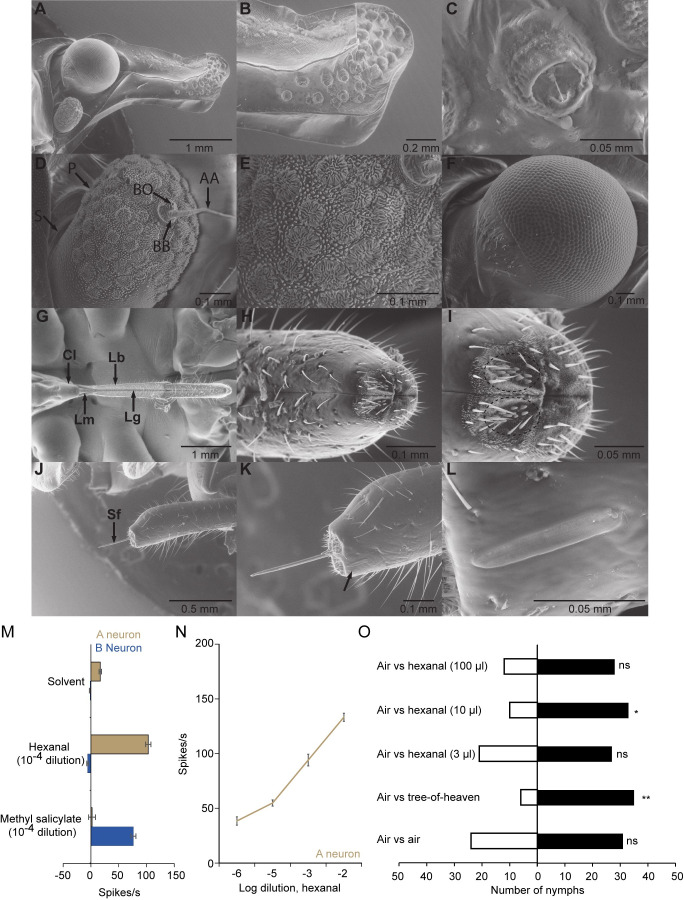 Figure 1
Peer Reviews
No public reviews on file for this paper yet. If you reviewed it on a platform where reviews are public (OpenReview, ICLR, NeurIPS, ICML), you can paste yours below so the community can read it here.
Videos
No videos yet. Explain this paper in a talk, walkthrough, or lecture? Add one.
Taxonomy
TopicsHemiptera Insect Studies · Insect-Plant Interactions and Control · Neurobiology and Insect Physiology Research
Description
Adults and nymphs (four instar stages) of SLF pose a serious threat to agriculture, forestry, and urban landscapes (Urban and Leach, 2023). While research and control efforts have largely focused on adults (Urban and Leach, 2023), nymphs particularly fourth instars, which share similar host plant preferences with adults (Liu, 2019), remain understudied.
Here, we examined the head and mouthparts of fourth instar SLF nymphs using scanning electron microscopy to identify sensory structures and potential functions. On the head, we observed more than 20 sensory pits on each side of the anterior region of the frons ( Figure 1A, B). Each pit possessed a single horizontal hair opposite a raised rim ( Figure 1C ). Similar structures with the same location but variable hair morphology have been described in other hemipteran species (Bräunig et al., 2012). Based on their lateral position and asymmetric arrangement between the left and right sides, these hairs are likely involved in detecting wind direction.
On the antennae (composed of scape, pedicel, and flagellum), we found many various shaped plate organs on the pedicel, as well as several other sensory structures ( Figure 1D, E). Plate organs are commonly found in hemipterans. These are multi-porous and believed to serve an olfactory function (Bourgoin and Deiss, 1994; Stroiński et al., 2011; Wang et al., 2018).
On the labium, we observed both apical and subapical sensory organs on the fourth segment. The apical sensory organ consists of two fields, each with ~10 sensory pegs on the dorsal surface, along with additional sensory hairs ( Figure 1G –I). In adult SLF, some of these pegs are multi-porous and are proposed to serve an olfactory function, while others possess an apical pore and are thought to have a gustatory role (Brożek and Bourgoin, 2013; Hao et al., 2016). The subapical sensory organ is located laterally near the tip of the segment and contains two placoid sensilla ( Figure 1J –L).
Placoid sensilla of the subapical labial sensor organ in fourth instar nymphs
The presence of a subapical sensory organ on the fourth labial segment of fourth instar nymphs led us to test whether it serves an olfactory function. In adults, the two placoid sensilla of this organ are structurally identical and each has two olfactory receptor neurons (Dweck and Rutledge, 2024). One of these neurons responds selectively to a limited set of chemical compounds, with hexanal eliciting the strongest excitatory response while the second neuron responds to many compounds, among which methyl salicylate is the most potent activator.
To determine whether the same functional organization exists in the nymphs, we performed single sensillum recordings on their two placoid sensilla using a range of hexanal dilutions and a single dilution of methyl salicylate. Our recordings revealed that, as in adults, each sensillum contains two neurons ( Figure 1M ). The neuron with larger spikes exhibited a dose-dependent response to hexanal but was unresponsive to methyl salicylate ( Figure 1M, N)). Conversely, the neuron with smaller spikes responded to methyl salicylate and showed no response to hexanal at any test dilution ( Figure 1M ). These results indicate the functional identity of these two neurons is conserved between nymphs and adults.
Hexanal elicits strong attraction in fourth instar nymphs
We assessed the behavioral responses of fourth instar nymphs to hexanal, which had not been tested previously, using a Y-tube glass olfactometer. First, we tested clean air versus clean air and observed no preference for either arm ( Figure 1O ). Next, we tested the odor of tree of heaven, the most preferred host for SLF, and confirmed it elicited strong attraction ( Figure 1O ). Finally, we tested three doses of pure hexanal and found that 10 µl elicited strong attraction, while 3 µl and 100 µl elicited neutral responses ( Figure 1O ).
Previous studies have emphasized the role of methyl salicylate as a key semiochemical for both adult and nymph stages of SLF (Booth et al., 2025; Cooperband and Murman, 2024; Cooperband et al., 2019; Derstine et al., 2020). Our results extend this by identifying hexanal as an additional volatile capable of influencing SLF nymph behavior. Hexanal is a well-characterized green leaf volatile released by host plants in response to mechanical injury or herbivory, and its emission levels typically increase with the intensity of feeding damage and infestation pressure (Matsui and Engelberth, 2022; Scala et al., 2013; ul Hassan et al., 2015). Such a pattern makes hexanal an ecologically reliable cue that could signal the presence of conspecific activity or suitable feeding sites. Importantly, we found that SLF nymphs exhibit attraction to a specific dose of hexanal, suggesting that this compound may function not only as a host-derived cue but also as a potential aggregation signal that promotes conspecific clustering.
Methods
Fourth instar nymphs
Fourth instar nymphs were collected daily from tree of heaven Ailanthus altissima (New Haven, CT) and transported to our research laboratories at The Connecticut Agricultural Experiment Station campus in New Haven, CT, in accordance with U.S. Department of Agriculture (USDA) permit 526-24-114- 68354. Fourth instar SLF nymphs used in the Y-tube behavioral experiments were selectively field collected from locations where there were no adults present, and the majority of the nymphs were in the fourth instar stage. In the laboratories, they were housed for one day in rearing cages (BugDorm-4M3030 Insect Rearing Cage) at 23°C and 40% relative humidity, with access to tree of heaven for feeding.
Scanning electron microscopy images
Scanning electron microscopy images were captured using a Hitachi Tabletop Microscope TM3030Plus from Hitachi High-Technologies Corporation, Tokyo, Japan. Three individuals were examined.
Odorants
Analytical standards of hexanal (catalog #18109) and methyl salicylate (catalog #76631) were purchased from Millipore Sigma. These odorants were dissolved in hexane (Millipore Sigma; catalog #139386).
Single sensillum recordings
Single sensillum recordings technique in SLF is described in detail in (Dweck, 2024).
Y-tube olfactometer behavioral bioassays
A Y-tube Pyrex glass olfactometer, custom-made at the Yale Sterling Chemistry Scientific Glassblowing Laboratory (New Haven, CT), was used to measure the behavioral responses of fourth instar SLF nymphs to different stimuli. The glass Y-tube was 5 cm in diameter, with a central main tube 23 cm long and two lateral arms 21 cm in length. Air from an air pump (WELCH Piston Air Compressor/Vacuum Pump: 0.033 hp, 1 Phase, 115V AC, 33 psi max continuous pressure) was passed through activated carbon filters, bubbled through water, and regulated with a flow meter (Analytical Research Systems, Gainesville, FL) before being split and directed into two 50-ml glass bottles. One bottle contained either the pure chemical or a leaf of the tree of heaven, while the other bottle was left empty as a control. Each bottle was connected to one of the lateral arms of the Y-tube via tubing (2.5 mm inner diameter). The airflow in each arm was maintained at 50 cm/s. Experiments were conducted between 0900 and 1600 hours under fluorescent red-light bulbs (60-Watt Equivalent) positioned in front of the Y-tube olfactometer to minimize visual cues and ensure that insect choices were guided primarily by olfactory stimuli. After every ten trials, a clean Y-tube olfactometer was used, and the stimulus was refreshed, and its side was switched.
For each trial, a single nymph was individually introduced into the central arm of the Y-tube. We recorded the initial choice of each nymph that walked into one of the lateral arms and remained there for at least 1 minute. If a nymph did not make a choice within 10 minutes of being released into the olfactometer, it was excluded from the analysis.
The doses of hexanal used in these experiments were 3, 10, and 100 µL of pure odorant, corresponding to 2.44 mg, 8.13 mg, and 81.3 mg, respectively. We were unable to test the 30 µL dose because, at the time it was scheduled for testing, the fourth instar nymphs had begun to molt into adults.
Each trial was conducted with a new individual, and the experiments were performed over several days.
Statistical analysis
The fisher exact test for each stimulus was calculated in GraphPad Prism 10.5.0 (774).
The reference list from the paper itself. Each links out to its DOI / PubMed record.
- 1Booth, E. G., Devine, S. M., Franzen, E. K. L., Murman, K. M., Cooperband, M. F. and Francese, J. A. (2025). Improving Survey Methods for the Spotted Lanternfly (Hemiptera: Fulgoridae): Influence of Collection Device, Tree Host, and Lure on Trap Catch and Detection. Forests 16 , 1128.
- 2Bourgoin, T. and Deiss, V. (1994). Sensory plate organs of the antenna in the Meenoplidae-Kinnaridae group (Hemiptera : Fulgoromorpha). International Journal of Insect Morphology and Embryology 23 , 159-168.
- 3Bräunig, P., Krumpholz, K. and Baumgartner, W. (2012). Sensory pits - Enigmatic sense organs of the nymphs of the planthopper Issus coleoptratus (Auchenorrhyncha, Fulgoromorpha). Arthropod Struct Dev 41 , 443-58. 10.1016/j.asd.2012.06.00122750128 · doi ↗ · pubmed ↗
- 4Brożek, J. and Bourgoin, T. (2013). Morphology and distribution of the external labial sensilla in Fulgoromorpha (Insecta: Hemiptera). Zoomorphology 132 , 33-65. 10.1007/s 00435-012-0174-z PMC 357076323420415 · doi ↗ · pubmed ↗
- 5Cooperband, M. F. and Murman, K. M. (2024). Spotted Lanternflies Respond to Natural Pheromone Lures for Mate-Finding and Oviposition. Insects 15 . 10.3390/insects 15060447 PMC 1120383938921162 · doi ↗ · pubmed ↗
- 6Cooperband, M. F., Wickham, J., Cleary, K., Spichiger, S.-E., Zhang, L., Baker, J., Canlas, I., Derstine, N. and Carrillo, D. (2019). Discovery of three kairomones in relation to trap and lure development for spotted lanternfly (Hemiptera: Fulgoridae). Journal of Economic Entomology 112 , 671-682. 10.1093/jee/toy 41230753676 · doi ↗ · pubmed ↗
- 7Derstine, N. T., Meier, L., Canlas, I., Murman, K., Cannon, S., Carrillo, D., Wallace, M. and Cooperband, M. F. (2020). Plant volatiles help mediate host plant selection and attraction of the spotted lanternfly (Hemiptera: Fulgoridae): a generalist with a preferred host. Environmental Entomology 49, 1049-1062. 10.1093/ee/nvaa 08032869830 · doi ↗ · pubmed ↗
- 8Dweck, H. K. M. (2024). Protocol for single sensillum recording from labial olfactory sensory fields in spotted lanternfly. STAR Protoc 5, 103469. 10.1016/j.xpro.2024.103469 PMC 1166416039643964 · doi ↗ · pubmed ↗