A network-based cross-sectional study of geographic access disparities to Medicare-participating dermatologists in the United States
Clayton Frazier, Congcong Miao, Sara Shalin, Hanna Jensen, Emily Frazier

Abstract
Genes, proteins, chemicals, diseases, species, mutations and cell lines named across the full text — each resolved to its canonical identifier and authoritative record.
Click any figure to enlarge with its caption.
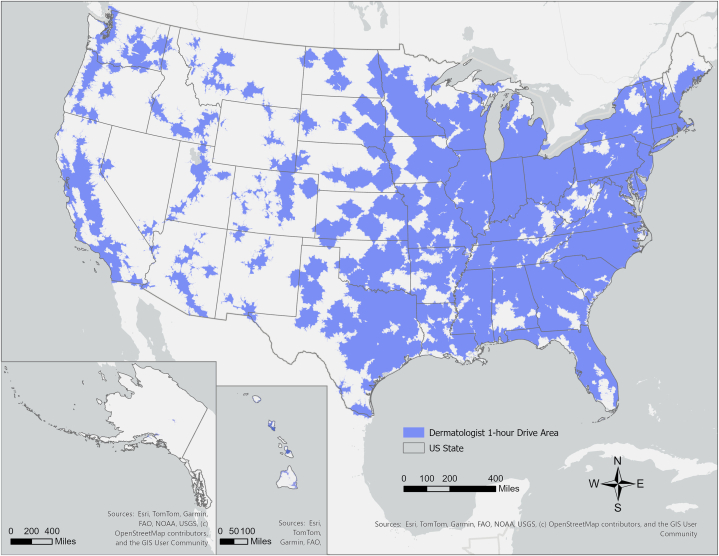 Figure 1
Peer Reviews
No public reviews on file for this paper yet. If you reviewed it on a platform where reviews are public (OpenReview, ICLR, NeurIPS, ICML), you can paste yours below so the community can read it here.
Videos
No videos yet. Explain this paper in a talk, walkthrough, or lecture? Add one.
Taxonomy
TopicsHealthcare Systems and Technology · Healthcare Policy and Management · Health Systems, Economic Evaluations, Quality of Life
To the Editor: The imbalanced U.S. geographic distribution of dermatologists exacerbates inequities surrounding patients’ access to care, particularly in rural areas.1^,^2 This national cross-sectional study employs geospatial mapping to investigate patient access to Centers for Medicare and Medicaid Services-participating dermatologists (CMSD). This study offers novel insights into accessibility by employing a 1-h drive service area network (OHSA) around each CMSD’s practice location to clearly define which communities can practically access a dermatologist. This approach addresses limitations in studies exploring accessibility using fixed “as the crow flies” distances from a dermatologist’s clinic or per-capita dermatological density1^,^3 by providing a pragmatic definition of access to care.
Clinic addresses for 11,831 actively practicing CMSDs were obtained from the 2022 Medicare Physician public database4 and mapped in ArcGIS Pro, and OHSAs around each clinic were created using existing road network infrastructures and speed limits. U.S. Census data were overlaid to identify the population within and outside each OHSA. A complete methodology Supplementary Supplement is available via Mendeley at https://data.mendeley.com/datasets/59mv5dfkym/1. Individuals living beyond the OHSA were deemed geographically disadvantaged in accessing a dermatologist.
Fig 1 maps OHSAs for U.S. CMSDs. Of the 331,636,180 people in the U.S., 11,381,025 (3.43%) live beyond the OHSA of any CMSD. There are clear regional distinctions between states in their provision of geographic access to a CMSD. Seven of the 10 states with the smallest percentage of their population living outside any CMSD OHSA are on the densely populated East Coast (NJ, RI, CT, NY, PA, MA, NC), while 8 of the 10 states with the highest percentage of their population outside the OHSA of any CMSD are found in the rural Mid- and Mountain West (WY, MT, ND, SD, NM, NE, IA) and Alaska. These 20 states are listed in Table I.Fig 1. Aggregated OHSAs around U.S. CMSDs.“One-hour drive-time service areas (OHSAs) around all CMS-participating dermatologists in the United States. Areas in white represent geographic gaps in access”. CMS, Centers for Medicare and Medicaid Services; CMSDs, Centers for Medicare and Medicaid Services-participating dermatologists.Table ITop 10 U S. states with the highest and lowest percentage of their population outside any OHSAStateTotal populationPopulation outside any OHSAPercentage of population outside any OHSATop 10 states with highest percentage of population outside any OHSA Wyoming579,761281,69348.6% Alaska733,971295,91340.3% Montana1,105,072323,32629.3% New Mexico2,114,768573,95227.1% North Dakota779,361209,83026.9% Maine1,377,400197,52214.3% South Dakota899,194126,33414.1% Nebraska1,965,926257,29313.1% Iowa3,195,937402,84112.6% West Virginia1,784,462211,81211.9%Top 10 states with lowest percentage of population outside any OHSA North Carolina10,584,340118,3981.12% Massachusetts6,992,39564,0140.915% Pennsylvania12,986,518114,4690.881% New York19,793,038131,1570.663% Illinois12,692,65365,0180.512% Connecticut3,598,34815,6560.435% Rhode Island1,095,37144920.410% New Jersey9,267,01437,3480.403% Ohio11,780,04626,0180.221% Indiana6,811,75259670.088% **U.S.A.331,636,18011,381,025****3.43%**OHSA, One-hour drive time service area.
Our OHSA approach reveals U.S. dermatologic care deserts. Although regional patterns are associated with access to a CMSD, exceptions exist. Maine, although located on the East coast, has the sixth highest percentage of its population (14.3%) residing beyond a dermatologist’s OHSA, while Mid-Western Indiana offers the greatest access, with just 0.088% of its population living beyond an OHSA. These outliers may arise from road network differences or the presence of academic medical centers.
This study’s novel use of the OHSA reveals although 96.6% of the U.S. population can reasonably access a dermatologist, geographic regions comprising over 11 million people remain underserved. Study limitations exist: other social vulnerability factors modulate geographic access beyond drive-time,5 and dermatologists may opt out of CMS participation, both which decrease access. Conversely, teledermatology, satellite clinics, and care provided by nondermatologist providers may increase access.
OHSA-identified care deserts provide advocates in medical education and within state and national specialty societies with a practical roadmap for improving access through rural residency tracks, recruitment and mentoring of rural dermatologists, and incentivizing practicing in OHSA-underserved areas. The OHSA technique can be applied to identify access barriers in other countries and specialties. Future studies should examine how satellite clinics extend dermatologic OHSAs across the U.S. and incorporate social vulnerability factors to holistically define access.
Conflicts of interest
None disclosed.
The reference list from the paper itself. Each links out to its DOI / PubMed record.
- 1Shah M.Burshtein J.Zakria D.Rigel D.Analysis of trends in US dermatologist density and geographic distribution J Am Acad Dermatol 912202433834110.1016/j.jaad.2024.03.03738574771 · doi ↗ · pubmed ↗
- 2Gronbeck C.Kodumudi V.Brodell R.T.Grant-Kels J.M.Mostow E.N.Feng H.Dermatology workforce in the United States - part I: overview, transformations, and implications J Am Acad Dermatol 891202311410.1016/j.jaad.2022.06.119135787408 · doi ↗ · pubmed ↗
- 3Afvari S.Collet D.A.Goyal A.Aifuwa E.La Chance A.H.Safai B.Geospatial analysis of dermatologist distribution and access among US seniors JAAD Int 182024414310.1016/j.jdin.2024.08.02339618918 PMC 11605397 · doi ↗ · pubmed ↗
- 4Centers for Medicare and Medicaid Services Medicare physician & other practitioners - by provider and service Publishedhttps://data.cms.gov/provider-summary-by-type-of-service/medicare-physician-other-practitioners/2022
- 5Centers for Disease Control and Prevention/Agency for Toxic Substances and Disease Registry CDC/ATSDR Social Vulnerability Index Database [U.S.]. Agency for Toxic Substances and Disease Registry ATSDR (.gov)2025 https://www.atsdr.cdc.gov/place-health/php/svi/index.html