Long-term control of refractory acrodermatitis continua of Hallopeau with subcutaneous spesolimab: A case report
Jan Nicolai Wagner, Franziska Zirkenbach, Brigtte Stephan, Carolin Grote, Matthias Augustin

Abstract
Genes, proteins, chemicals, diseases, species, mutations and cell lines named across the full text — each resolved to its canonical identifier and authoritative record.
Click any figure to enlarge with its caption.
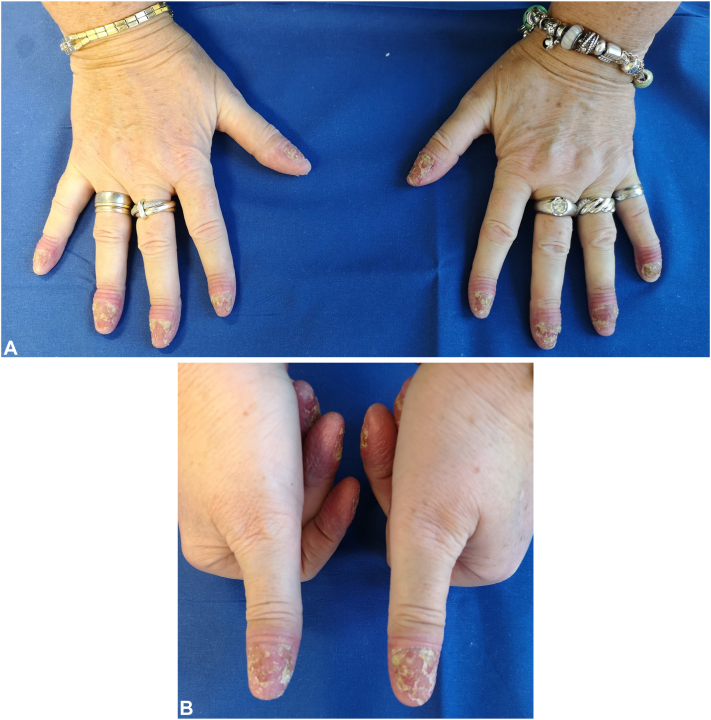 Figure 1
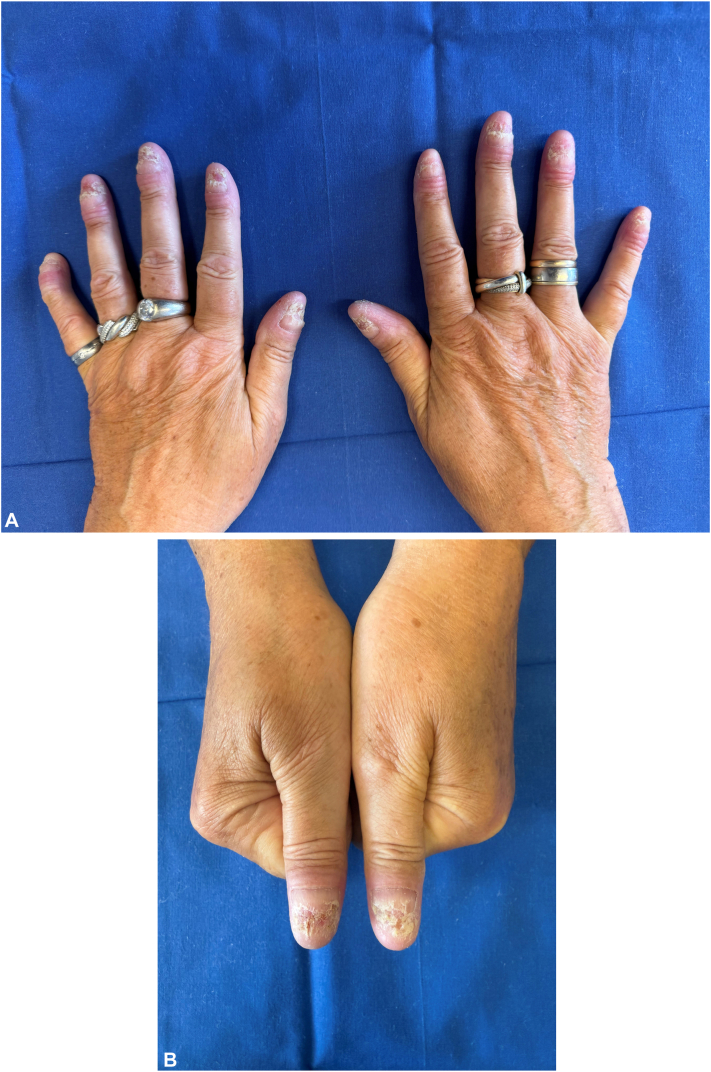 Figure 2
Peer Reviews
No public reviews on file for this paper yet. If you reviewed it on a platform where reviews are public (OpenReview, ICLR, NeurIPS, ICML), you can paste yours below so the community can read it here.
Videos
No videos yet. Explain this paper in a talk, walkthrough, or lecture? Add one.
Taxonomy
TopicsSkin Diseases and Diabetes · Nail Diseases and Treatments
Introduction
Acrodermatitis continua of Hallopeau (ACH) is a rare and challenging dermatological condition, characterized by recurrent sterile pustules, typically involving the digits.1 ACH often results in nail dystrophy and can progress to osteitis if inadequately treated. The treatment represents a clinical challenge, as there is a lack of approved drugs and of standards by treatment guidelines.2 Therapies such as methotrexate, cyclosporine, and acitretin often prove inadequate in providing sufficient relief. Increasingly, biologics targeting tumor necrosis factor-α, interleukin (IL)-17, IL-23, and IL-12/23, as well as small molecules, have been reported in case series. In response to the urgent need for more effective options, spesolimab, an IL-36 receptor antagonist, has gained attention.3, 4, 5
Case report
A 59-year-old female patient presented in our outpatient university clinic in 2023 with a severe refractory form of ACH, first diagnosed in 2014. The condition commenced with the formation of a minor subungual pustule located beneath the left thumb. Subsequently, pustular erythematous lesions emerged on both soles. Approximately 1.5 years later, there was extensive involvement of all fingernails and swelling of distal interphalangeal joints. At the first consultation, the patient showed a drumstick-like swelling of all fingertips, with the nail structures completely absent (Fig 1, A and B).Fig 1A, Patient’s hands: acrodermatitis continua of Hallopeau before starting spesolimab therapy. B, Patient’s thumbs: acrodermatitis continua of Hallopeau before starting spesolimab therapy.
Diagnostic workup included a biopsy in 2025 showing pustular psoriasis. A full oncological screening (mammography, colonoscopy, chest x-ray, and labs) was unremarkable. Multiple magnetic resonance imaging scans and conventional radiographs (X-rays) were performed. Imaging showed mild fasciitis and fibroostitis at the plantar fascia insertion bilaterally, evolving plantar enthesitis, and minimal erosive changes.
The patient underwent 20 systemic treatments, including conventional and biologic agents (Table I). These therapies were largely ineffective on skin lesions or limited by paradoxical reactions or side effects. The most recent treatment with bimekizumab resulted only in a partial improvement.Table ISystemic drug response and DLQI outcomes from 2014 to 2025YearSystemic drugDosageResponseSide effectsDLQI01/2014-06/2014Acitretin30 mg dailyNo responseNA06/2014-12/2014Fumaric acid ester120 mg dailyNo responseNA01/2015-11/2015Methotrexate25 mg s.c. once a wkNo responseDyspnea, coughNA11/2015-12/2016UstekinumabInduction: 45 mg s.c. wk 0 and 4 Maintenance: 45 mg s.c. every 12 wkNo responseWorsening of arthralgiaNA01/2016Systemic PUVAWorsening of ACHNA12/2016Prednisolone20 mg daily, tapered downPartial responseOral candidiasisNA01/2017-05/2017SecukinumabInduction: 300 mg s.c. wk 0, 1, 2, 3, and 4 Maintenance: 300 mg s.c. every 4 wkNo response805/2017-02/2018AdalimumabInduction: 80 mg s.c. wk 0 Maintenance: 40 mg s.c. wk 1, then every 2 wkNo responseParadoxical psoriasis1202/2018-05/2018IxekizumabInduction: 160 mg s.c. wk 0, 80 mg wk 2, 4, 6, 8, 10, and 12 Maintenance: 80 mg s.c. every 4 wkWorsening of ACH1405/2018-08/2018GuselkumabInduction: 100 mg s.c. wk 0 and 4 Maintenance: 100 mg s.c. every 8 wkNo response908/2018-12/2018Apremilast30 mg twice a dNo responseDiarrhea1412/2018-01/2019Anakinra100 mg s.c. dailyNo responseParadoxical psoriasisOral candidiasis1401/2019-02/2019Methotrexate10 mg s.c. once a wkNo response1402/2019-04/2019Infliximab5 mg/kg BW i.v. in wk 0 and 2No response805/2019-06/2019Tofacitinib and Risankizumab5 mg twice a d and 150 mg s.c. in wk 0 and 4 and every 12 wkNo response806/2019-08/2019Risankizumab and Cyclosporine150 mg s.c. every 12 wk Cyclosporin: 200-300 mg dailyPartial responseHypertension, creatinine increase808/2019-03/2021Guselkumab and CyclosporineInduction: 100 mg s.c. wk 0 and 4 Maintenance: 100 mg s.c. every 8 wk Cyclosporin: 250-350 mg dailyNo repsonse803/2021-12/2021Brodalumab and CyclosporineInduction: 210 mg s.c. wk 0, 1, and 2 Maintenance: 210 mg s.c. every 2 wkNo response1012/2021-02/2022BimekizumabInduction: 320 mg s.c. wk 0, 4, and 8Partial responseGenital candidiasis803/2022-05/2022Upadacitinib15-30 mg dailyNo response912/2022-03/2023TildrakizumabInduction: 100 mg s.c. wk 0No responseFirst onset of GPP 4 wk after application of tildrakizumab1403/2023-01/2025BimekizumabInduction: 320 mg s.c. wk 0, 4, 8, 12, and 16 Maintenance: 320 mg every 8 wkPartial response1001/2025-todaySpesolimabInduction: 900 mg i.v. wk 0, 2, 6, and 10 Maintenance: 300 mg s.c. every 4 wkResponseTelogen effluvium4ACH, Acrodermatitis continua of Hallopeau; BW, body weight; DLQI, Dermatologic Life Quality Index; GPP, generalized pustular psoriasis; i.v., intravenous; NA, not available; PUVA, psoralen and ultraviolet a therapy; s.c., subcutaneous.y; s.c., subcutaneous.
In January 2025, with a body mass index of 35.3 kg/m^2^, the patient presented with multiple pustules (Fig 1, A and B), a Generalized Pustular Psoriasis Area and Severity Index of 0 (range 0-72), and a Pustular Psoriasis Area and Severity Index of 8.8 (range 0-72). The modified Nail Psoriasis Severity Index and the static Physician Global Assessment for ACH were 32 (range 0-64) and 4 (range 0-4), respectively. Laboratory investigations, including complete blood count, liver function tests, and C-reactive protein, were within normal limits.
Following the approval of an individualized off-label treatment by the statutory health insurance, the patient received a single dose of 900 mg of spesolimab intravenously in January 2025. Given a partial but transient response, 3 additional intravenous doses were administered (weeks 2, 6, and 10). Telogen effluvium occurred after the third dose and was managed with 5% topical minoxidil applied once daily. The patient’s cutaneous symptoms improved substantially (Fig 2, A and B). Dermatologic Life Quality Index score decreased to 6 (range 0-30), modified Nail Psoriasis Severity Index to 8 (range 0-64), and Pustular Psoriasis Area and Severity Index to 0.8 (range 0-72). Maintenance therapy with 300 mg subcutaneous spesolimab every 4 weeks was initiated, with ongoing clinical remission reported through July 2025. Notably, she also reported significant improvement in joint pain and morning stiffness beginning approximately 5 weeks after initial treatment.Fig 2A, Patient’s hands: acrodermatitis continua of Hallopeau after starting spesolimab therapy. B, Patients thumbs: acrodermatitis continua of Hallopeau after starting spesolimab therapy.
Discussion
This case clearly demonstrates the significant therapeutic challenges and unmet needs in managing refractory ACH, especially when it is associated with PsA and extensive nail disease. Spesolimab was approved in the United States (Food and Drug Administration) and Europe (European Medicines Agency) in 2022 for use in the treatment of generalized pustular psoriasis (GPP) flares in adults. In Germany, the Federal Joint Committee (Gemeinsamer Bundesausschuss) concluded that the additional therapeutic benefit of spesolimab compared to the chosen comparator was not sufficiently proven. This assessment was based primarily on the EFFISAYIL 1 study,6 which the Gemeinsamer Bundesausschuss rated inadequate due to its short comparative analysis duration (8 days) and the appropriateness of treatment discontinuation prior to flare onset. While spesolimab is approved in the European Union and has undergone evaluation by the European Medicines Agency, it has been retracted from the German market and now necessitates supply from other EU countries.
Wen et al7 reported a case of a patient with ACH and GPP, noting a rapid regression of both skin and nail lesions. To date, there have been reports of 2 patients treated with spesolimab solely for ACH. Treatment effectiveness has been described in 3 other patients.8, 9, 10 Currently maintenance dosing for ACH is not yet defined. A significant aspect of the patient's treatment plan involved a transition from intravenous spesolimab to subcutaneous administration. This change was carefully considered to align with the prevention of flare-ups of ACH, given that there are no specific data available for its prophylaxis. We therefore based our approach on the dosing guidelines established for GPP prevention.4 While hair loss associated with spesolimab is not listed as a side effect in the drug information, it warrants acknowledgment as a potential newly discovered side effect.
To the best of our knowledge, our report is the first to document both sustained remission and transition to subcutaneous spesolimab for maintenance.
Our observations suggest that spesolimab may exert broader immunological effects beyond pustular resolution, improving nail involvement and joint symptoms as well. Although telogen effluvium has not been documented as an adverse event, clinicians should remain vigilant. Further studies are needed to explore optimal dosing, long-term safety, and efficacy in both skin and joint manifestations of ACH.
Conflicts of interest
Dr Augustin has served as a consultant, lecturer, or researcher and/or has received research grants from companies manufacturing drugs for psoriasis, including AbbVie, Almirall, Amgen, Biogen, BMS, Boehringer Ingelheim, Celgene, Centocor, Eli Lilly, Galderma, Hexal, Incyte, Janssen, Klinge, LEO, Medac, MSD, Mylan B.V., Novartis, Pfizer, Sandoz, Takeda, UCB, and Viatris. Dr Wagner has received payments/honoraria for lectures and presentations and/or received grants and/or participated in clinical trials from the following companies: AbbVie, AstraZeneca, Almirall, Beiersdorf, Boehringer-Ingelheim, Celltrion, Incyte, Johnson & Johnson, LEO Pharma, Lilly, Novartis, Moonlake, Sanofi, and UCB. Dr Stephan has received payments/honoraria for lectures and presentations and/or received grants and/or participated in clinical trials from the following companies: AbbVie, Almirall Hermal, Amgen, Beiersdorf, Boehringer Ingelheim, Bristol-Myers Squibb, Celgene, Celltrion, GlaxoSmithKline, Janssen-Cilag, LEO Pharma, Lilly, Medac, Novartis, Pierre Fabre, Sanofi Aventis, and UCB. Dr Grote received speaker fees from BMS and MSG and travel grants from Almirall, Sanofi, Celltrion, and Lilly. Dr Zirkenbach has no conflicts of interest to declare.
The reference list from the paper itself. Each links out to its DOI / PubMed record.
- 1Smith M.P.Ly K.Thibodeaux Q.Bhutani T.Liao W.Beck K.M.Acrodermatitis continua of hallopeau: clinical perspectives Psoriasis (Auckl)9201965723149752910.2147/PTT.S 180608 PMC 6691962 · doi ↗ · pubmed ↗
- 2Mengesha Y.M.Bennett M.L.Pustular skin disorders: diagnosis and treatment Am J Clin Dermatol 320023894001211364810.2165/00128071-200203060-00003 · doi ↗ · pubmed ↗
- 3Yang S.-F.Lin M.-H.Chou P.-C.Genetics of generalized pustular psoriasis: current understanding and implications for future therapeutics Genes (Basel)14202312973737247710.3390/genes 14061297 PMC 10297910 · doi ↗ · pubmed ↗
- 4Morita A.Okubo Y.Imafuku S.Terui T.Spesolimab, the first-in-class anti-IL-36R antibody: from bench to clinic J Dermatol 512024137913913937315210.1111/1346-8138.17449 · doi ↗ · pubmed ↗
- 5Sehgal V.N.Verma P.Sharma S.Acrodermatitis continua of hallopeau: evolution of treatment options Int J Dermatol 502011119512112195028610.1111/j.1365-4632.2011.04993.x · doi ↗ · pubmed ↗
- 6Bachelez H.Choon S.-E.Marrakchi S.Trial of spesolimab for generalized pustular psoriasis N Engl J Med 3852021243124403493673910.1056/NEJ Moa 2111563 · doi ↗ · pubmed ↗
- 7Wen P.Liu C.Wang T.Jiang X.Wang P.Wang S.Successful treatment of acrodermatitis continua of hallopeau coexisting with generalized pustular psoriasis with spesolimab: a case report Front Immunol 152024133828510.3389/fimmu.2024.1338285 PMC 1092028838464535 · doi ↗ · pubmed ↗
- 8Zheng J.Ding Y.Shi Y.Yi X.Case report: successful treatment with spesolimab of acrodermatitis continua of hallopeau in an older patient without IL 36RN mutations Front Immunol 152024144010210.3389/fimmu.2024.1440102 PMC 1177474239882245 · doi ↗ · pubmed ↗