Dataset on India’s imports of Penaeus vannamei brooders from the United States
M.C. Remany, Daly Cyriac, V. Shanmuga Arasu, Anup Mandal

TL;DR
This paper presents a dataset on India's imports of SPF broodstocks of Penaeus vannamei shrimp from the United States, highlighting trends and their impact on India's shrimp exports and biosecurity.
Contribution
The study provides a 16-year dataset on P. vannamei broodstock imports and analyzes import trends and patterns using statistical tools.
Findings
India's shrimp exports increased from 2000 metric tons in 2008 to 716,004 metric tons in 2024 following SPF broodstock imports.
The U.S. emerged as the primary supplier of SPF broodstocks to India, significantly influencing the shrimp sector's growth.
The dataset reveals import trends and offers insights into the sustainability and U.S.-India trade dynamics in shrimp farming.
Abstract
The introduction of the exotic Pacific whiteleg shrimp, scientifically known as Penaeus vannamei, revolutionised India’s shrimp sector and its export landscape since its incorporation into commercial farming in 2009. The cultivation of P. vannamei was allowed only with the Specific Pathogen Free (SPF) broodstocks, which were imported from approved overseas SPF broodstock suppliers. The United States, as a pioneer in developing SPF shrimp stocks and a major hub for broodstock companies gradually emerged as the primary supplier of SPF brooders to India. This development significantly contributed to the remarkable surge in shrimp exports from India, which soared from 2000 metric tons in 2008 to 716,004 metric tons in 2024. The consistent brooder importation by India also marked a transformative progression for SPF production companies operating overseas. To ensure biosecurity and provide…
Genes, proteins, chemicals, diseases, species, mutations and cell lines named across the full text — each resolved to its canonical identifier and authoritative record.
Click any figure to enlarge with its caption.
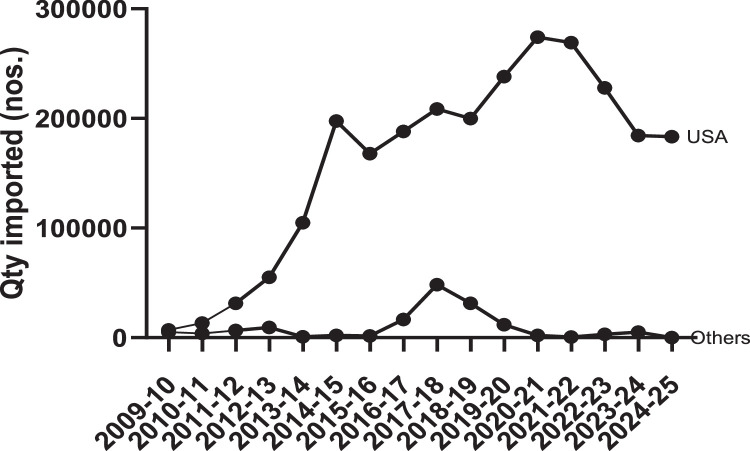 Figure 1
Peer Reviews
No public reviews on file for this paper yet. If you reviewed it on a platform where reviews are public (OpenReview, ICLR, NeurIPS, ICML), you can paste yours below so the community can read it here.
Videos
No videos yet. Explain this paper in a talk, walkthrough, or lecture? Add one.
Taxonomy
TopicsSilkworms and Sericulture Research · Agricultural Economics and Practices · Fish Biology and Ecology Studies
Specifications TableSubjectBiologySpecific subject areaAquacultureType of dataTableGraphRaw and analysed dataData collectionData was collected at the point of entry of the stocks into the country at AQF through physical enumeration and systematic categorization of the brooders based on the country of origin. The number of male and female brooders imported was counted immediately upon the arrival of each broodstock shipment at AQF and expressed in total quantities. The data spans a period of 16 years and has been systematically organized. Imports from broodstock suppliers in the U.S. have been categorized separately from those originating from countries outside the U.S.Data source locationInstitution: Aquatic Quarantine FacilityCity: ChennaiRegion: Tamil NaduCountry: IndiaLatitude and longitude: 12° N 57 24.0942′’ and 80° E 15 56.0664′’.Data accessibilityRepository name: MendeleyData identification number: 10.17632/vs679tgx8s.1Direct URL to data: https://data.mendeley.com/datasets/vs679tgx8s/1Related research articleNone
Value of the Data
1
- •The dataset provided is the only comprehensive source of information on the importation of P. vannamei broodstock into the country. The primary data is collected from the Aquatic Quarantine Facility, which is India’s sole entity responsible for the quarantine of imported shrimp species.
- •The dataset offers detailed insights into the extent to which India depends on imported broodstock. Such information is crucial for policymakers to make informed decisions that could shape the future of the shrimp sector in India.
- •The data is typically not made available to the general public, academic institutions, or the broader scientific community without direct inquiries to the responsible department. This lack of transparency can hinder collaborative efforts and innovative research.
- •Data allows the researchers to analyze the quality and performance of vannamei stocks particularly in terms of their adaptability and success in Indian farm and hatchery environments. Understanding these nuances can significantly influence breeding programs, farming practices, and overall industry standards.
- •The historical dataset, being accurate and realistic figures, provides a foundational understanding of vannamei seed production and its related farming practices in India.
- •By documenting the origins of these stocks, it enhances traceability, ensuring that stakeholders in the shrimp sector have crucial information that can foster better management practices, improve quality control, and ultimately drive the sector’s growth and sustainability.
Background
2
Prior to the introduction of P. vannamei culture in India, the country’s shrimp production relied on the native black tiger shrimp, P. monodon. This situation continued until a sharp decline in monodon production was witnessed in 1994, due to the outbreak of the White Spot Syndrome Virus (WSSV) and subsequent crop failures. During this period, several Southeast Asian countries including Thailand and Vietnam adopted vannamei culture, due to its advantageous culture attributes such as fast growth, short culture period, high fecundity and tolerance to high salinity and temperature [1]. This transition led to an exponential increase in their shrimp production. Further, the availability of domesticated SPF brooders in the market crucial for mitigating disease risks associated with the transboundary movement of live shrimps [2] urged the India Government to allow the import of SPF P. vannamei brooders. After a successful pilot scale culture trial in the country and the establishment of the AQF, commercial culture of P. vannamei was initiated. The requirement to exclusively use SPF P. vannamei broodstocks for seed production and farming in India [3] made the country overly dependent on international SPF broodstock suppliers. The majority of the stocks utilized for P. vannamei culture were imported from U.S based companies. Thus, the U.S which is the largest buyer of Indian shrimps and its value added products emerged as a vital supplier of the live SPF vannamei brooders for India. The expansion of P. vannamei culture in India further led the country to heavily rely on U.S for the stocks, although marginal imports from non-U.S. countries were recorded. In addition to live shrimp brooders, the U.S. exports a diverse range of products, including fish and shrimp feed, fresh and chilled shrimp, frozen fish, and artemia cysts to India.
The article presents a dataset on live shrimp imports, which are a critical commodity for the Indian seafood sector and exports. The information highlights the trends in importing shrimp brooders from the U.S. compared to other countries. The data was obtained from India’s sole shrimp quarantine centre, the Aquatic Quarantine Facility (AQF), where all imported shrimp are subjected to rigorous disease screening and quarantine procedures. Established in 2009, the AQF serves the commercial culture of the vannamei sector by providing essential quarantine services to shrimp hatcheries.
Hatcheries licensed to produce P. vannamei seeds must import Specific Pathogen Free (SPF) broodstock from designated suppliers empanelled by the Coastal Aquaculture Authority (CAA) with these suppliers located in various regions around the globe. Upon arrival in India, the broodstock is first received at the AQF, where their pathogen-free status is ascertained before handed over to the hatcheries. Over the past 16 years, imports of P. vannamei broodstock from diverse sources have been compiled, focusing on two primary categories: imports from the U.S. and imports from non-U.S.. Countries. The import trends for each period, from the two regions, are detailed in this article.
Data Description
3
A historical dataset detailing the imports of SPF P. vannamei brooders from the United States and other countries (non-U.S.) to India over a period of 16 years is presented. The data indicates the quantity of brooders imported by India from various sources. Shrimp stocks supplied from broodstock centers, including Shrimp Improvement Systems (Florida), Shrimp Improvement Systems (Hawaii), American Penaeid (Florida), BenchMark Genetics (Florida), Syaqua Pvt. Ltd. (Florida), Kona Bay Marine Resources (Hawaii), Molokkai Broodstock Company (Florida), Sea Products (later rebranded as Blue Genetics, Texas), and the Oceanic Institute (Hawaii), are categorized under imports from the USA. In contrast, stocks supplied by Shrimp Improvement Systems (Singapore), Blue Genetics (Mexico), Global Gen (Indonesia), Vannamei 101 (Thailand), Syaqua Siam (Thailand), and CP Foods Pvt. Ltd. (Thailand) fall under imports from other countries. Notably, imports from Southeast Asian countries have been banned in India since 2013 [4]; hence, the data from these regions (specifically Thailand-based suppliers) are only included for the years 2009 to 2013. The raw import dataset is available for access at https://data.mendeley.com/datasets/vs679tgx8s/1. Summary statistics of annual imports with Tukey’s Post hoc comparisons are provided in Table 1, Table 2 within the Excel file. The ANOVA summary of the dataset, which analyzes supplies from U.S. and non-U.S. countries, is presented in Table 3. Consolidated data on imports from the two major regions is illustrated in Fig. 1 in the Excel sheet.Table 1. Summary statistsics of P. vannamei broodstock supply from the U.S. to India.Table 1. Particulars2009–102010–112011–122012–132013–142014–152015–162016–172017–182018–192019–202020–212021–222022–232023–242024–25No: of shipments173170118210312248264283265347146371301297308Minimum qty supplied (nos.)5081280280120160140200200200200380200159150200Maximum qty supplied (nos.)10001100112084080015201600200016001400200012001272134414001200Range95010198405606801360146018001400120018008201072118512501000Mean387.5^a^434.9^a^448^a^468^a^499.2^a^633.2^b^679.9^b^720.5^b^737.5^b^754.3^b^686.2^b^744.2^b^725.2^b^690.7^b^620.6^b^595^a^Std. Deviation233.5227.6193.1176.9203.1292.2313.7346.2280.7274.8270.6268.3279.7293236.7189.1Std. Error of Mean56.6440.8823.0716.2814.0216.5419.9221.3116.6816.8814.5222.2114.5216.8913.7410.78Lower 95 % CI of mean267.5351.4402435.7471.6600.6640.7678.5704.6721657.6700.3696.6657.4593.6573.8Upper 95 % CI of mean507.6518.4494500.2526.9665.8719.1762.4770.3787.5714.8788.1753.7723.9647.6616.2Total qty imported (nos.)658813,48231,36055,220104,836197,558168,618190,206208,701199,880238,115108,650269,034207,890184,313183,266Note: Mean values superscripted with different letters differ significantly (α 0.05 level).Table 2. Summary statistsics of P. vannamei broodstock supply from Non-U.S. Countries to India.Table 2. Particulars2009–102010–112011–122012–132013–142014–152015–162016–172017–182018–192019–202020–212021–222022–232023–242024–25No: of shipments1481316133203481641560Minimum qty supplied (nos.)2102172802808004004004006002002004006384006000Maximum qty supplied (nos.)6005901000760800120080012008001200120060063880012000Range39037372048008004008002001000100020004006000Mean374^c^356^c^508^c^535^c^800^c^747^c^547^c^726^d^667^c^651^d^738^d^550^c^638^c^608^c^833^d^0^c^Std. Deviation143138229173041122020111521427010001912940Std. Error of Mean38.248.863.543.202371274566.730.967.650085.21200Lower 95 % CI of mean2912403694430−273−0.5966323805895933913715240Upper 95 % CI of mean45647164662701766109482095471388270984511420Total qty imported (nos.)52292847660085608002240164014,520200031,26011,8002200638304050000Note: Mean values superscripted with different letters differ significantly (α 0.05 level).Table 3ANOVA summary of dataset on P. vannamei broodstock supply from U.S. and Non-U.S. Countries.Table 3. ParticularsU.S.Non-U.SF23.824.349P value<0.0001<0.0001Significant diff. among means (P < 0.05)YesYesR square0.090930.3088Fig. 1Import of P. vannamei broodstock from the U.S and non-U.S. Countries to India.Fig 1
Experimental Design, Materials and Methods
4
Data was directly obtained from the AQF, established by the Marine Products Export Development Authority (MPEDA) under the Government of India. The AQF plays a vital role in mitigating the risks associated with the introduction of P. vannamei. As stated in the Indian Government Gazette [3], Chennai International Airport is designated as the sole authorized port of entry for shrimp broodstock in India. Additionally, all P. vannamei stocks imported by Indian hatcheries from approved overseas broodstock suppliers [5] must receive certification for their specific pathogen-free (SPF) status from the AQF before being released to the hatcheries. The diseases tested during quarantine include both WOAH-listed [6] and non-listed pathogens. To compile the dataset, broodstocks imported from various countries were systematically enumerated and documented. Mortalities occurring during transit or quarantine were not included in the data; only the total quantity imported over a period of 16 years was considered. The yearly imports were subjected to one-way ANOVA (Table 3) followed by Tukey’s Post hoc test to assess statistical significance. Data analysis was performed using GraphPad Prism version 10.1.0.
Limitations
Not applicable.
Ethics Statement
This statement confirms that the authors have read and followed the ethical requirements for publication in Data in Brief and confirms that the current work does not involve human subjects, animal experiments, or any data collected from social media platforms.
CRediT Author Statement
M. C. Remany: Conceptualization, writing and analysis. Daly Cyriac: Data collection. V. Shanmuga Arasu: Data collection. Anup Mandal: Editing and draft finalization.
Acknowledgements
The authors would like to thank Shri Venkataswamy IAS, Chairman of MPEDA, and Dr S. Kandan, Director of RGCA, for their support and encouragement in preparing this manuscript. They also extend their thanks to the Ministry of Fisheries, the Coastal Aquaculture Authority, the National Fisheries Development Board, and the Central Institute of Brackishwater Aquaculture, for their involvement in reviewing the operations of AQF.
This research did not receive any specific grant from funding agencies in the public, commercial, or not-for-profit sectors.
Declaration of Competing Interest
The authors declare that they have no known competing financial interests or personal relationships that could have appeared to influence the work reported in this paper.
The reference list from the paper itself. Each links out to its DOI / PubMed record.
- 1Wyban Jim Current trends, challenges, and genetic innovations in the SPF shrimp broodstock industry Crit. Insights Aquac.1120252508544
- 2Briggs M.Funge-Smith S.Subasinghe R.Introductions and Movement of Penaeus Vannamei and Penaeus Stylirostris in Asia and the Pacific 2004 FAO Regional Office for Asia and the Pacific Bangkok (Thailand)
- 3Department of Animal Husbandry, Dairying and fisheries, ministry of agriculture, government of India, 2009. Order No. 35029/13/2008-Fy (T&E). 2nd June 2009. Standard operating procedures for Aquatic Quarantine Facility for L. vannamei.
- 4Coastal Aquaculture Authority, 2023. List of approved suppliers for import of SPF broodstock of L.vannamei.https://caa.gov.in/uploaded/doc/CAA.