Do Striped Hyenas Have a Sweet Tooth? First Evidence of Honey Consumption by a Hyaenid
Francisca A. S. Virtuoso, Robert Milia Kaai, Yorick Liefting, Femke Broekhuis, Rebekah Karimi, James Kisau, Loontasati Lolari, Silole Tumaina, Soloomon Lekai, Gibson Lepilal, Richard Silamui, Oningoi Partayo, Purity Selelo, Joseph Sayiore, Noah Tingai, Wilson Ntitika

TL;DR
Scientists observed a striped hyena eating honey for the first time, showing these animals have a more varied diet than previously thought.
Contribution
This study provides the first documented evidence of honey consumption by a hyaenid species.
Findings
A striped hyena was photographed carrying a honeycomb, suggesting it consumed honey, beeswax, and bee larvae.
The finding highlights the dietary plasticity of striped hyenas and the limitations of traditional diet analysis methods.
Camera trapping proved valuable in capturing rare or unexpected feeding behaviors.
Abstract
Dietary flexibility in carnivores remains an underexplored aspect of their ecology, particularly the consumption of non‐meat foods. While striped hyenas ( Hyaena hyaena ) are primarily scavengers, they are known to occasionally consume plant material, insects and other alternative food sources. Here, we present the first documented evidence of honey consumption by a hyaenid species. During a community‐led camera trap survey in October 2024 at the Kwenia Vulture Sanctuary, Kenya, an adult striped hyena was photographed carrying a large honeycomb in its mouth. This observation suggests ingestion of honey, beeswax and bee larvae, providing nutritional, medicinal or hydration benefits. Our finding expands current knowledge of hyena dietary plasticity and highlights the limitations of conventional diet analysis methods in detecting rare food items such as honey. It underscores the value of…
Genes, proteins, chemicals, diseases, species, mutations and cell lines named across the full text — each resolved to its canonical identifier and authoritative record.
Click any figure to enlarge with its caption.
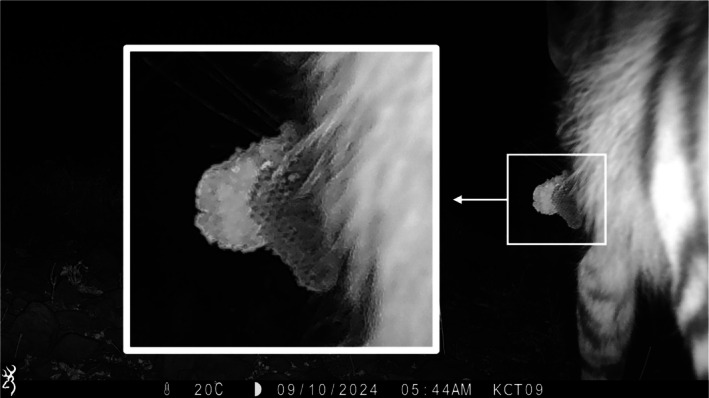 FIGURE 1
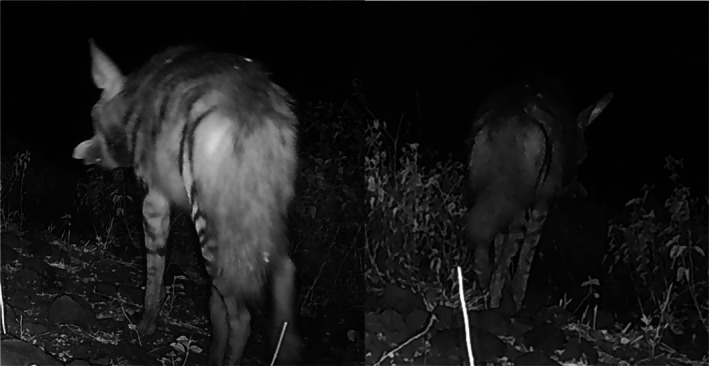 FIGURE 2
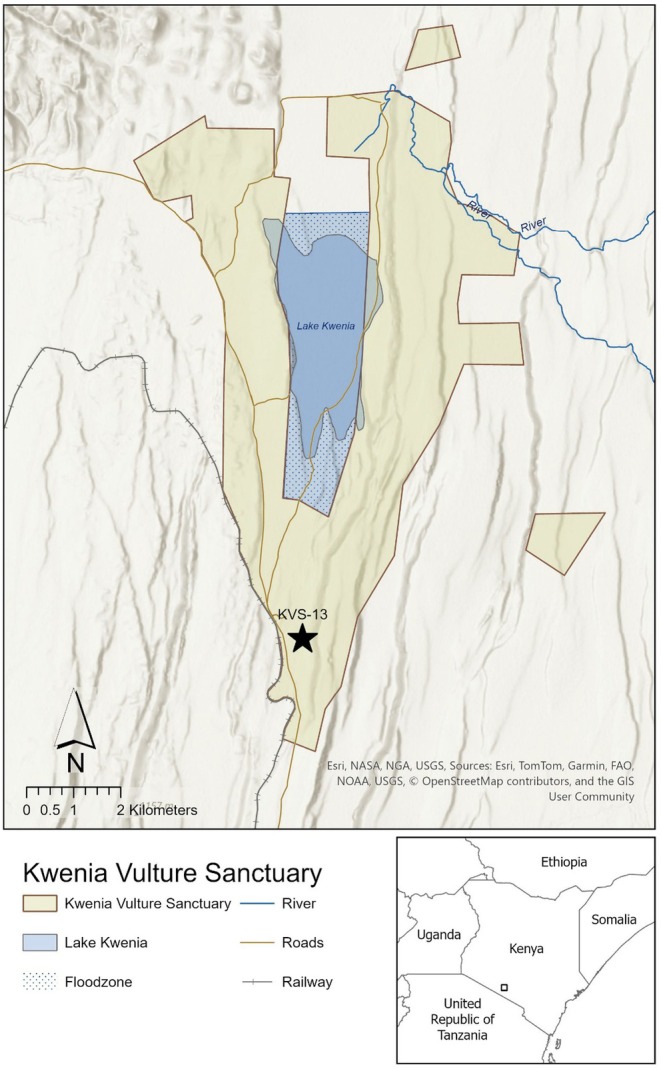 FIGURE 3
- —Basecamp Explorer Foundation ‐ Kenya
- —Wageningen University and Research10.13039/501100004890
- —BAND foundation10.13039/100019323
- —International Conservation Fund of Canada10.13039/501100023258
Peer Reviews
No public reviews on file for this paper yet. If you reviewed it on a platform where reviews are public (OpenReview, ICLR, NeurIPS, ICML), you can paste yours below so the community can read it here.
Videos
No videos yet. Explain this paper in a talk, walkthrough, or lecture? Add one.
Taxonomy
TopicsPrimate Behavior and Ecology · Wildlife Ecology and Conservation · Pleistocene-Era Hominins and Archaeology
Introduction
1
Diet is fundamental to the survival and fitness of species, shaping their physical and behavioural adaptations, as well as the ecological niche they occupy (Stephens 2019). For carnivores, adapted to consume animal flesh, meat provides a highly efficient energy source due to its similar chemical composition to the consumer (Day et al. 2022). Despite this, even obligate carnivores occasionally consume plant material or other non‐meat foods (Yoshimura et al. 2021). This behaviour, while unusual, has been observed in many carnivorous species, though the reasons remain unclear (Montalvo et al. 2020; Sueda et al. 2008; Yoshimura et al. 2021).
Hyaenids are a small yet diverse clade of carnivores comprised of five extant species whose diverse diets represent the adaptability and dietary flexibility of this guild (Wilkinson et al. 2024). More specifically, the most broadly distributed species of hyena, the striped hyena ( Hyaena hyaena ), frequently consumes a broad range of foods dominated by scavenged meat (Alam and Khan 2015; Bhandari et al. 2020; Mwebi et al. 2024). They have also been found to supplement their diet with alternative food sources that include fruits and vegetables; grasses and leaf material; insects; and eggs (Alam and Khan 2015; Kuhn 2005).
An alternative food source not currently known as part of the diet of striped hyena and hyaenids broadly, is honey. Honey consumption is a rarely reported alternative food for carnivores. To our knowledge, the only Carnivora species reported to consume honey includes the pine marten (* Martes martes *; Monterroso et al. 2016), the honey badger ( Mellivora capensis ; Begg et al. 2003) and the brown bear ( Ursus arctos ; Lalleroni et al. 2017).
Here, we contribute to the list of honey intake in the carnivore guild, by presenting the first evidence of honey consumption by striped hyena ( Hyaena hyaena ).
Field Record
2
We present a series of camera trap images capturing an adult striped hyena carrying a honeycomb, which we interpret as evidence of honey consumption by the individual or its offspring (Figure 1). The honeycomb is of significant size as it can be seen protruding from both sides of the striped hyena's mouth (Figure 2).
Camera trap image of an adult striped hyena at the Kwenia Vulture Sanctuary, Kajiado County, Kenya, carrying a honeycomb, likely for consumption. This photo was taken on 09 October 2024 at 5:44 am at −1.83646849, 36.49852795 with a Browning camera trap.
Two camera trap images showing an adult striped hyena at the Kwenia Vulture Sanctuary, Kajiado County, Kenya, carrying a large piece of honeycomb, visibly protruding from both sides of its mouth. These photos were taken on 09 October 2024 at 5:44 am at −1.83646849, 36.49852795 with a Browning camera trap.
This observation was made on 09 October 2024 at 5:44 am as part of a larger ongoing community conservation camera trap survey at the ~5140‐ha Kwenia Vulture Sanctuary in Kajiado County, Kenya (−1.809365, 36.498251; Figure 3). The images were taken by a Browning 2021 Recon Force Elite HP4 camera trap placed 30 cm above the ground, to maximise small‐ to medium‐sized mesocarnivore detectability.
Map of the Kwenia Vulture Sanctuary, highlighting location KVS‐13 (−1.83646849, 36.49852795), where the images in Figures 1 and 2 were captured.
The study area, Kwenia, is part of the Somali–Maasai biome, characterised by arid Acacia–Commiphora savannah. It is centred around a large seasonal lake and an extensive cliff line, which supports the largest known breeding colony of Rüppell's vulture (Gyps rueppelli) in southern Kenya. The region hosts a diverse mammalian community, including a robust population of striped hyena alongside other carnivores such as spotted hyena ( Crocuta crocuta ), leopard ( Panthera pardus ), cheetah ( Acinonyx jubatus ), African wild dog ( Lycaon pictus ), caracal ( Caracal caracal ), and serval ( Leptailurus serval ). This predator guild is sustained by a varied herbivore population, including Grant's gazelle ( Nanger granti ), Kirk's dik‐dik ( Madoqua kirkii ), lesser kudu ( Tragelaphus imberbis ), gerenuk ( Litocranius walleri ) and Maasai giraffe ( Giraffa tippelskirchi ). Depredation of livestock (goat, sheep, cattle, donkeys) by predators is common as well. Kwenia Vulture Sanctuary is owned and managed by the indigenous Maasai pastoralist community, who also graze their livestock in and around the sanctuary. Traditionally honey hunting has been common practice at Kwenia, which is now rapidly evolving towards beekeeping. Products derived from this practice, including honey, honeycombs, and bee larvae, are considered valued delicacies and are commonly shared within the community.
Discussion
3
To our knowledge, this is the first evidence of honey consumption by a hyaenid. Striped hyenas access the bulk of their diet (meat) mainly by scavenging and supplement it with alternative food sources, such as fruits or insects, in resource‐scarce environments (Alam and Khan 2015; Mwebi et al. 2024). Consumption of such foods has been hypothesised to be due to compensation for water scarcity, self‐medication against pathogens, aid digestion or simply due to added nutritional value (Day et al. 2022; Yoshimura et al. 2021).
Importantly, in our record, the striped hyena was carrying a honeycomb, which does not only contain honey but also beeswax and potentially bee larvae. The combination of these components may contribute to all these supplementary benefits. Honey is comprised mainly of water and sugars, making it a highly nutritious food source (Ajibola et al. 2012), providing energy and potentially serving as a substitute for water in scarce environments. Beeswax has antimicrobial and anti‐inflammatory properties, and its consumption could possibly be a form of self‐medication (Fratini et al. 2016). Finally, insect larvae have previously been recorded to be consumed by several carnivore species, as it is a highly nutritional source of protein (Finke 2002). Aside from these physiological benefits, perhaps there is simply an element of preference for something sweet.
Physiological studies have shown that several carnivores, although not all, have lost the taste receptor for sweetness (Jiang et al. 2012; Li and Zhang 2014). For example, although spotted hyenas have lost the ability to taste sweet foods, other hyena species, such as aardwolves, still have it (Jiang et al. 2012). Captive striped hyenas in the DierenPark ZieZoo in the Netherlands have a clear preference for consuming sugar‐rich fruits, such as bananas, pears and grapes (Patrick Rutjes, pers. comm, 2025), perhaps having developed a preference for sweet foods. In our study area, communities report that striped hyenas raid and consume watermelons from agricultural fields. It may be that striped hyenas have not lost this taste receptor, and that could be an additional reason for honey consumption. Other carnivores, such as bears, that have been reported to consume honey, also still have this receptor (Jiang et al. 2012).
Honey consumption in carnivores broadly is very difficult to detect. Diet studies usually focus on meat consumption, either by extracting prey hair from scats or by targeting vertebrate DNA. Unless the animal is physically observed eating or DNA primers targeting honeybees are used, it is simply not possible to detect honey consumption in traditionally used dietary analysis methods (Alam and Khan 2015; Monterroso et al. 2016; Mwebi et al. 2024). Currently, there have been no studies on striped hyena diet that have explored the possibility of them consuming honey. The closest finding has been insect remains in scats, which were not identified to the species level (Alam and Khan 2015). These biases in carnivore diet studies present a unique challenge.
Our findings suggest that honey, although rarely documented in carnivore diets, may be more common than previously thought. Given the limitations in current diet analysis methods and study focus, other instances may simply go undetected. For example, several studies have shown the consumption of bee larvae by carnivores, such as the honey badger (Begg et al. 2003), but this may be complemented with honey consumption, which is more difficult to detect than insects in diet studies. Fortunately, striped hyenas are well known for carrying food back to den sites for either self‐consumption or the provisioning of offspring (Hadad et al. 2023), which provides the opportunity to detect and understand the rare consumption of non‐meat components, which can be detected by non‐dietary focused methods, such as camera trapping.
This unexpected dietary choice by striped hyena aligns with sporadic reports of carnivores incorporating unconventional food sources into their diet (Montalvo et al. 2020; Sueda et al. 2008; Yoshimura et al. 2021). This observation adds to our understanding of hyena dietary plasticity, underscoring the species' resilience and adaptability in varying environmental conditions.
Author Contributions
Francisca A. S. Virtuoso: conceptualization (lead), visualization (equal), writing – original draft (lead). Robert Milia Kaai: methodology (equal), project administration (equal), resources (equal), writing – review and editing (equal). Yorick Liefting: conceptualization (equal), data curation (lead), methodology (equal), writing – review and editing (equal). Femke Broekhuis: conceptualization (equal), data curation (equal), methodology (equal), writing – review and editing (equal). Rebekah Karimi: methodology (equal), project administration (equal), resources (equal), writing – review and editing (equal). James Kisau: methodology (equal), resources (equal), writing – review and editing (equal). Loontasati Lolari: methodology (equal), resources (equal), writing – review and editing (equal). Silole Tumaina: methodology (equal), resources (equal), writing – review and editing (equal). Soloomon Lekai: methodology (equal), resources (equal), writing – review and editing (equal). Gibson Lepilal: methodology (equal), resources (equal), writing – review and editing (equal). Richard Silamui: methodology (equal), resources (equal), writing – review and editing (equal). Oningoi Partayo: methodology (equal), resources (equal), writing – review and editing (equal). Purity Selelo: methodology (equal), resources (equal), writing – review and editing (equal). Joseph Sayiore: methodology (equal), resources (equal), writing – review and editing (equal). Noah Tingai: methodology (equal), resources (equal), writing – review and editing (equal). Wilson Ntitika: methodology (equal), resources (equal), writing – review and editing (equal). Duncan Korongoro: methodology (equal), resources (equal), writing – review and editing (equal). Elvis Nemagai: methodology (equal), resources (equal), writing – review and editing (equal). Jesephat Njue: methodology (equal), resources (equal), writing – review and editing (equal). Kelvin Tajeu: methodology (equal), resources (equal), writing – review and editing (equal). Taiko Nanguyien: methodology (equal), resources (equal), writing – review and editing (equal). Patric Namusu: methodology (equal), resources (equal), writing – review and editing (equal). Richard Stratton Hatfield: conceptualization (equal), methodology (equal), project administration (equal), visualization (equal), writing – original draft (equal).
Ethics Statement
The authors have nothing to report.
Conflicts of Interest
The authors declare no conflicts of interest.
The reference list from the paper itself. Each links out to its DOI / PubMed record.
- 1Ajibola, A. , J. P. Chamunorwa , and K. H. Erlwanger . 2012. “Nutraceutical Values of Natural Honey and Its Contribution to Human Health and Wealth.” Nutrition & Metabolism 9, no. 1: 61. 10.1186/1743-7075-9-61.22716101 PMC 3583289 · doi ↗ · pubmed ↗
- 2Alam, M. S. , and J. A. Khan . 2015. “Food Habits of Striped Hyena ( Hyaena hyaena ) in a Semi‐Arid Conservation Area of India.” Journal of Arid Land 7, no. 6: 860–866. 10.1007/s 40333-015-0007-2. · doi ↗
- 3Begg, C. M. , K. S. Begg , J. T. Du Toit , and M. G. L. Mills . 2003. “Sexual and Seasonal Variation in the Diet and Foraging Behaviour of a Sexually Dimorphic Carnivore, the Honey Badger ( Mellivora capensis ).” Journal of Zoology 260, no. 3: 301–316. 10.1017/S 0952836903003789. · doi ↗
- 4Bhandari, S. , C. Morley , A. Aryal , and U. B. Shrestha . 2020. “The Diet of the Striped Hyena in Nepal's Lowland Regions.” Ecology and Evolution 10, no. 15: 7953–7962. 10.1002/ece 3.6223.32788952 PMC 7417253 · doi ↗ · pubmed ↗
- 5Day, L. , J. A. Cakebread , and S. M. Loveday . 2022. “Food Proteins From Animals and Plants: Differences in the Nutritional and Functional Properties.” Trends in Food Science & Technology 119: 428–442. 10.1016/j.tifs.2021.12.020. · doi ↗
- 6Finke, M. D. 2002. “Complete Nutrient Composition of Commercially Raised Invertebrates Used as Food for Insectivores.” Zoo Biology 21, no. 3: 269–285. 10.1002/zoo.10031. · doi ↗
- 7Fratini, F. , G. Cilia , B. Turchi , and A. Felicioli . 2016. “Beeswax: A Minireview of Its Antimicrobial Activity and Its Application in Medicine.” Asian Pacific Journal of Tropical Medicine 9, no. 9: 839–843. 10.1016/j.apjtm.2016.07.003.27633295 · doi ↗ · pubmed ↗
- 8Hadad, E. , A. Balaban , and R. Yosef . 2023. “Alloparenting by Helpers in Striped Hyena (Hyaena hyaena).” Animals 13, no. 12: 1914. 10.3390/ani 13121914.37370424 PMC 10294792 · doi ↗ · pubmed ↗