Parents’ Received and Expected Information About Their Child’s Radiation Exposure During Radiographic Examinations in Al Ahsa, Saudi Arabia
Salman S Albakheet, Batla S Al Battat, Asma s Al khofi, Fatimah S Alkhars, Rahaf T Almutairi, Noora R Bohlaiqah, Rawand A Alghannam

TL;DR
This study finds that most parents in Saudi Arabia lack information about radiation exposure during their child's medical imaging and have poor awareness of its risks.
Contribution
The study provides new insights into parental awareness gaps regarding pediatric radiographic exams in Al Ahsa, Saudi Arabia.
Findings
Only 7.8% of parents had good awareness of radiation exposure and its health effects on children.
Healthcare staff were the most common source of radiation information (36.3%).
Most parents (92.2%) had poor awareness of radiation risks despite undergoing radiographic exams.
Abstract
Background There is growing concern in the medical community that patients receive little or no information regarding scheduled exams and radiation. Healthcare providers did not initiate discussions about the benefits and risks of radiation from imaging tests, and most patients and parents obtained information by means of self-directed internet searches. Aim and objectives This study aimed to evaluate parents' awareness of radiation hazards and their experiences with the information they received from the referrer prior to their child's radiographic examination in Al Ahsa, Saudi Arabia. Methods A descriptive cross-sectional study included 492 parents of children who underwent radiological procedures. A self-administered survey designed and structured by researchers that was distributed to the participants online on different social media platforms, including WhatsApp (California,…
Genes, proteins, chemicals, diseases, species, mutations and cell lines named across the full text — each resolved to its canonical identifier and authoritative record.
Click any figure to enlarge with its caption.
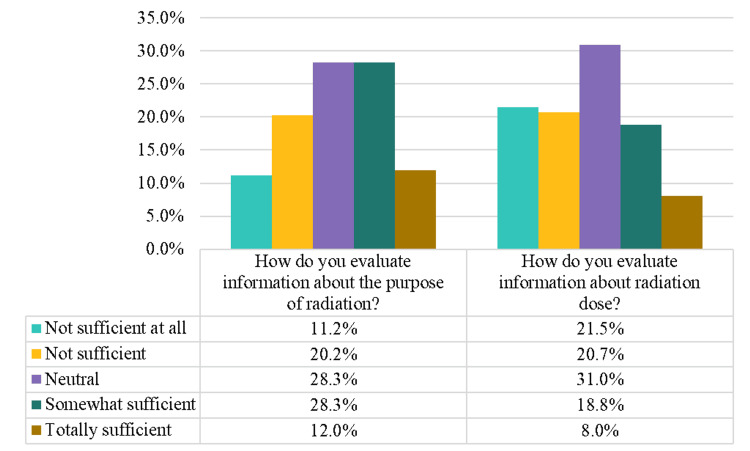 Figure 1
| Child / parents personal data | N | % |
| Respondent age in years | ||
| 19-25 | 101 | 24.6% |
| 25-40 | 165 | 40.2% |
| 40-60 | 130 | 31.7% |
| 61+ | 14 | 3.4% |
| Child age | ||
| 1-23 months | 79 | 19.3% |
| 2-5 years | 143 | 34.9% |
| 6-12 years | 119 | 29.0% |
| 13-18 years | 69 | 16.8% |
| Child gender | ||
| Male | 218 | 53.2% |
| Female | 192 | 46.8% |
| Respondent work | ||
| Not working | 94 | 22.9% |
| Student | 42 | 10.2% |
| Employed | 236 | 57.6% |
| Retired | 38 | 9.3% |
| Educational level | ||
| Below secondary | 30 | 7.3% |
| Secondary | 85 | 20.7% |
| University | 270 | 65.9% |
| Post-graduate | 25 | 6.1% |
| Received information | N | % |
| Source of information | ||
| Health care staff | 149 | 36.3% |
| Referring physician | 71 | 17.3% |
| Internet | 55 | 13.4% |
| Radiologists | 37 | 9.0% |
| Family / friends | 37 | 9.0% |
| TV / Radio | 14 | 3.4% |
| Others | 15 | 3.7% |
| None | 32 | 7.8% |
| Method of information delivery | ||
| Oral | 207 | 50.5% |
| Written | 57 | 13.9% |
| Both | 113 | 27.6% |
| None | 33 | 8.0% |
| Has your doctor (or nurse or physician's assistant) told you why your child needs a scan? | ||
| Yes | 284 | 69.3% |
| No | 76 | 18.5% |
| I don't know | 50 | 12.2% |
| Did the doctor (or nurse or physician's assistant) who told you that your child needs a scan tell you how much radiation is involved in the scan? | ||
| Yes | 100 | 24.4% |
| No | 184 | 44.9% |
| I don’t remember | 126 | 30.7% |
| How was the radiation dose explained to you? | ||
| Using numbers and scientific units | 52 | 12.7% |
| Using photos | 67 | 16.3% |
| Using comparisons | 23 | 5.6% |
| None of the above | 268 | 65.4% |
| Have you been offered any other diagnostic/treatment options that do not involve radiation exposure? | ||
| Yes | 120 | 29.3% |
| No | 190 | 46.3% |
| I don’t remember | 100 | 24.4% |
| Respondents' awareness of radiation | N | % |
| Based on your information, does the scan expose your child to radiation? | ||
| Yes | 218 | 53.2% |
| No | 109 | 26.6% |
| I don't know | 83 | 20.2% |
| How much radiation do you think your child will get from the scan compared to one year of background radiation? | ||
| Less than 1 year | 84 | 20.5% |
| Equal to 1 year | 45 | 11.0% |
| More than 1 year | 41 | 10.0% |
| I don't know | 240 | 58.5% |
| Do you think that exposure to radiation affects your child's health? | ||
| Yes | 198 | 48.3% |
| No | 100 | 24.4% |
| I don't know | 112 | 27.3% |
| If yes, what is the effects? | ||
| No effect | 50 | 19.8% |
| Skin change (dryness, itching, blistering) | 95 | 37.5% |
| Illness (vomiting, diarrhea, loss of appetite, fatigue) | 80 | 31.6% |
| Thyroid disorders | 78 | 30.8% |
| Hair loss | 73 | 28.9% |
| Leucopenia | 59 | 23.3% |
| Chromosomal damage | 53 | 20.9% |
| Renal problem | 53 | 20.9% |
| Cardiac problem | 43 | 17.0% |
| Sexual disorders | 24 | 9.5% |
| Overall awareness | N | % |
| Good | 32 | 7.8% |
| Poor | 378 | 92.2% |
| Factors | Awareness level | p-value* | |||
| Poor | Good | ||||
| N | % | N | % | ||
| Age in years | .327 | ||||
| 19-25 | 89 | 88.1% | 12 | 11.9% | |
| 25-40 | 154 | 93.3% | 11 | 6.7% | |
| 40-60 | 122 | 93.8% | 8 | 6.2% | |
| 61+ | 13 | 92.9% | 1 | 7.1% | |
| Child age | .104 | ||||
| 1-23 months | 71 | 89.9% | 8 | 10.1% | |
| 2-5 years | 137 | 95.8% | 6 | 4.2% | |
| 6-12 years | 105 | 88.2% | 14 | 11.8% | |
| 13-18 years | 65 | 94.2% | 4 | 5.8% | |
| Child gender | .996 | ||||
| Male | 201 | 92.2% | 17 | 7.8% | |
| Female | 177 | 92.2% | 15 | 7.8% | |
| Respondent work | .143 | ||||
| Not working | 89 | 94.7% | 5 | 5.3% | |
| Student | 38 | 90.5% | 4 | 9.5% | |
| Employed | 213 | 90.3% | 23 | 9.7% | |
| Retired | 38 | 100.0% | 0 | 0.0% | |
| Educational level | .046** | ||||
| Below secondary | 26 | 86.7% | 4 | 13.3% | |
| Secondary | 80 | 94.1% | 5 | 5.9% | |
| University | 252 | 93.3% | 18 | 6.7% | |
| Post-graduate | 20 | 80.0% | 5 | 20.0% | |
| Source of information | .417 | ||||
| Health care staff | 134 | 89.9% | 15 | 10.1% | |
| Referred physician | 66 | 93.0% | 5 | 7.0% | |
| Internet | 52 | 94.5% | 3 | 5.5% | |
| Radiologists | 32 | 86.5% | 5 | 13.5% | |
| Family / friends | 36 | 97.3% | 1 | 2.7% | |
| TV / Radio | 14 | 100.0% | 0 | 0.0% | |
| Others | 15 | 100.0% | 0 | 0.0% | |
| None | 29 | 90.6% | 3 | 9.4% | |
| Method of information delivery | .416 | ||||
| Oral | 191 | 92.3% | 16 | 7.7% | |
| Written | 55 | 96.5% | 2 | 3.5% | |
| Both | 101 | 89.4% | 12 | 10.6% | |
| None | 31 | 93.9% | 2 | 6.1% | |
| Has your doctor (or nurse or physician's assistant) told you why your child needs a scan? | .124 | ||||
| Yes | 257 | 90.5% | 27 | 9.5% | |
| No | 72 | 94.7% | 4 | 5.3% | |
| I don't know | 49 | 98.0% | 1 | 2.0% | |
Peer Reviews
No public reviews on file for this paper yet. If you reviewed it on a platform where reviews are public (OpenReview, ICLR, NeurIPS, ICML), you can paste yours below so the community can read it here.
Videos
No videos yet. Explain this paper in a talk, walkthrough, or lecture? Add one.
Taxonomy
TopicsRadiation Dose and Imaging · Radioactive contamination and transfer · Effects of Radiation Exposure
Introduction
Radiology's utilization has recently been a subject of worry due to several variables such as population dose, individual dose, budgetary and financial problems, and lastly whether the examinations or justifications are appropriate [1,2]. Ionizing radiation (IR) is a noninvasive way that may be employed by various methods, such as X-ray and computed tomography (CT), to assist the treating physician in reaching a diagnosis, guiding surgical procedures, and putting a therapy plan in place. Furthermore, its usage has become a crucial aspect of diagnostic and therapeutic processes in medical practice, despite the fact that it carries potential hazards to health by increasing the risk of cancer, particularly among children [3]. CT scans have a greater radiation dosage than other imaging modalities (e.g., X-ray, fluoroscopy), and their usage has expanded in Western nations in recent years; therefore, protection is an issue [4,5]. Radiation protection in medicine is founded on the concept of justification, which seeks to ensure that the patient's benefits outweigh any short- or long-term hazards [6]. Some studies have found an increase in unnecessary CT scans among children, and the risk of getting cancer from IR exposure is greater in children than in adults, including leukemia, thyroid malignancies, and brain tumors [4,5,7]. The reason for this might be due to the growing bodies of children, the longer life expectancy after exposure to ionizing radiation (IR), and having a higher sensitivity to radiation, emphasizing the need for special attention after exposure, whether for diagnostic or therapeutic purposes. The Food and Drug Administration (FDA) recommends using potassium iodide (KI) as a radioiodine protective agent to reduce the risk of thyroid cancer following exposure [5,7]. Literature showed that the majority of parents were unaware of radiation concerns, as per the studies in Australia [8], Serbia [5], and Saudi Arabia [3]. Radiological medical practitioners (e.g., radiologists, interventional cardiologists) and other members of the radiology team (e.g., medical physicists, radiographers/radiological technicians) share responsibilities for communicating with parents. This process of teaching parents can be facilitated by the use of printed and/or electronic informational materials, and the examination's advantages and hazards should be thoroughly discussed [9-11]. There is rising concern in the medical community that patients receive little or no information regarding scheduled exams and radiation [12]. Previous research found that healthcare personnel did not initiate discussions regarding the advantages and hazards of radiation from imaging procedures, and that the majority of patients and parents learned about them through self-directed online searches [13].
The objective of this study is to assess the received and expected information of parents about their child’s radiation exposure during radiographic examinations in Al-Ahsa, Saudi Arabia.
Materials and methods
Study design and area
This is a descriptive cross-sectional study that was conducted to assess parental knowledge regarding radiation hazards and their experience regarding information obtained from the referrer prior to their child’s radiographic examination in Al Ahsa Health Cluster, Al Ahsa, Saudi Arabia, 2022.
Study population and sample
This study investigated parents of children who underwent radiological procedures in Al Ahsa, Saudi Arabia, and had an estimated sample size of 385, based on a 0.05% marginal error and a 95% confidence interval. To enhance reliability and reduce bias, the final sample size was increased to 410. The inclusion criteria were parents of children aged 0-18 years who had undergone plain X-rays and both plain and contrast-enhanced CT scans. Conversely, the exclusion criteria were parents of patients who refused and those whose children had undergone ultrasound or MRI examinations.
Data collection tools
A self-administered online survey, created and structured by researchers. It was non-randomly distributed to participants via various social media platforms, including WhatsApp, Twitter, and Telegram. Data were collected during October and November 2022. The survey consisted of four sections: sociodemographic characteristics (such as age, gender, and region), information received about radiation exposure and dose, respondents' awareness of radiation exposure and its health effects, and their attitude and perception of the information they received (Appendix 1, Table 6). All data was securely saved in a password-protected Google database, with access restricted to investigators. A backup file was also used to ensure data preservation.
Validation and pilot study
Before the questionnaire was distributed, it underwent validation and reliability checks. Three radiologists and a biostatistician reviewed the tool to ensure content validity. Following this, a pilot study was conducted with 20 individuals who met the inclusion criteria. The results of the pilot study showed a Cronbach's alpha of more than 0.7, which confirmed the survey instrument's clarity, accuracy, and overall reliability.
Statistical analysis
The data were collected, reviewed, and then fed to IBM Corp. Released 2015. IBM SPSS Statistics for Windows, Version 21. Armonk, NY: IBM Corp. The chi-square test was employed to assess the factors associated with parents' awareness of radiation exposure and its health effects on children. All statistical methods used were two-tailed with an alpha level of 0.05, considering significance if the P value is less than or equal to 0.05. Regarding parents' awareness, each correct answer was given a 1-point score. Overall knowledge level regarding radiation dose and exposure was assessed by summing up discrete scores for different correct knowledge items. If the total score was 60% or more of the total possible score, the level of awareness was considered to be good, and scores less than 50% were considered poor. Descriptive analysis was done by prescribing frequency distribution and percentage for study variables, including parents' and children's data, source of information, and received information.
Results
A total of 410 respondents completed the study questionnaire. Respondents' ages ranged from 19 to 65 years, with a mean age of 27.2 ± 13.9 years. Exactly 236 (57.6%) respondents were employees, while 94 (22.9%) were not working, 42 (10.2%) were students, and 38 (9.3%) were retired. As for education, 270 (65.9%) were university graduates, and 85 (20.7%) had secondary school education. As for children, the age ranged from 1 month to 18 years, with a mean age of 5.6 ± 4.8 years old. As for gender, 218 (53.2%) children were males (Table 1).
As for the received information regarding radiation exposure and dose in Al Ahsa, Saudi Arabia (Table 2), the most reported source of information was health care staff (36.3%), followed by referring physicians (17.3%), the internet (13.4%), and radiologists (9%), while 7.8% reported that they did not receive information from anyone. For the method of learning, 50.5% of participants received information orally, 27.6% received information via oral and written methods, and 13.9% received information via the written method. Regarding received knowledge about radiation, 69.3% of participants learned about the indication of radiographic examination, and 29.3% were offered other diagnostic/treatment options that do not involve radiation exposure. (24.4%) learned sufficient information about the dose of radiation involved in the scan, and it was explained using photos among 16.3% of the respondents, by numbers and scientific units among 12.7%, and using comparisons among 5.6%, while 65.4% did not use any of these methods.
In the assessment of respondents' awareness regarding radiation exposure and health effects (Table 3), 58.5% of participants didn’t know how much radiation the child would get from the scan, 53.2% expected that the test would expose the child to radiation, and 48.3% expected that radiation would affect the child's health.
Regarding expected radiation health impacts, 37.5% think it’ll cause skin change (dryness, itching, blistering), followed by illness (vomiting, diarrhea, loss of appetite, fatigue) (31.6%), thyroid disorders (30.8%), hair loss (30.8%), and leucopenia (28.9%), while 19.8% think that there is no bad effect.
Only 32 (7.8%) parents had an overall good awareness regarding radiation exposure and its health-related effects on their children (Table 4). For the factors associated with parents' awareness (Table 5), only parents' education was significantly associated with their awareness level regarding radiation, as 20% of parents with a postgraduate degree had good awareness levels versus 5.9% of others with a secondary level of education (p=.046).
For parents' attitude and perception of received information on radiation exposure (Figure 1). A total of 40.2% of parents think that they have sufficient information about the purpose of radiation, while 26.8% think that they have sufficient information about radiation dose.
Parents' attitude and perception of received information of radiation exposureThe image is created by the author.
Discussion
Most radiological modalities use ionizing radiation, including radiography, fluoroscopy, CT, and radionuclide studies [14]. Radiation has potential biological drawbacks, such as cellular damage, and children who are radiosensitive have a higher hazard of developing certain types of cancer due to radiation exposure [9,15-17]. Hence, the term “radiation” might cause worry among the public, and events such as the Chernobyl accident further aggravate fear among them [18-21].
The current study aimed to assess the received information about the health effects of radiation exposure, the received information about the dose (amount) of radiation, and the parents’ concerns about X-ray exposure, if any, to know the source of information, and to assess the received information about the purpose of the examination. The study results showed that the most reported source of information was healthcare staff, which was reported by nearly one-third of the study parents, followed by referral physicians and the internet, while radiologists were not a common source of parents' information. Oral information was the dominant method for delivering data (nearly half of the parents), while about one-fourth received radiation information orally and in written format. Also, about two-thirds of the parents were told by their doctor (or nurse or physician's assistant) about the cause of the scan, but only one-third reported they were told about the dose of radiation, which was explained using numbers and scientific units, photos, and comparisons. Also, less than one-third of the respondents were offered other diagnostic/treatment options that do not involve radiation exposure. Similar findings were reported by Oikarinen HT et al. [22], where 83% of their study parents reported that they received satisfactory information on the purpose of the examination, 23% on other options, and 7% were told about the radiation dose. On the other hand, a study showed that radiologists explained the purpose of radiation scans, but less information was provided regarding the risks or options [9]. In a third study, the vast majority of the participants, including three parents of children with malignancy, reported that the medical staff did not initiate benefit-risk discussions [13].
As for parents' awareness of radiation exposure and associated health risks, the current study showed that parents had very poor overall awareness regarding radiation exposure and its health-related effects on their children. Nearly half of the parents think that exposure to radiation affects the child's health, such as skin change (dryness, itching, blistering), illness (vomiting, diarrhea, loss of appetite, fatigue), thyroid disorders, hair loss, and leucopenia, while 19.8% think that there is no bad effect. None of the respondents correctly reported all possible risks. A better level of parental awareness was reported by Ng CG et al. [23], where more than 40% of the respondents achieved acceptable knowledge scores by correctly answering at least six out of eleven knowledge-based questions [23]. An experimental study revealed that 66% believed CT uses radiation before reading the handout, compared to 99% afterward. Also, before reading the handout, 13% believed CT increases the lifetime risk of cancer compared to 86% afterward [24]. Hartwig HD et al. showed that 60% of caregivers did not know about the long-term negative effects of medical imaging. However, about half of the participants who did express a perceived risk from medical imaging radiation exposure could specify a known undesirable effect from exposure [12]. As compared to our study, 48.3% expected that radiation affects a child's health and were able to identify some of the potential health hazards, including thyroid disorders, leucopenia, and chromosomal damage.
Overall, only 7.8% of participants had good awareness regarding radiation exposure and its health-related effects on their children, with parents' education being the only factor that has a significant association with their awareness level regarding radiation, as 20% of parents with a postgraduate degree had good awareness levels versus 5.9% of others with a secondary level of education (p=.046).
Study limitations
This study has several limitations. Its reliance on a self-administered online survey may have introduced selection bias, targeting only parents active on social media. The cross-sectional design prevents establishing causality, and the self-reported data are subject to recall and social desirability biases. Furthermore, since the responding parent may not have been the one present during the actual clinical communication, the data may not accurately reflect the direct experience. Lastly, the findings are specific to Al Ahsa and may not be generalizable to other regions.
Conclusions
The awareness level of parents about radiation hazards and health-related issues among children is very poor. Health personnel should thoroughly explain both risks and benefits of radiation before diagnostic procedures, either orally or in written format. In addition, community education programs should be held to raise the level of population awareness.
The reference list from the paper itself. Each links out to its DOI / PubMed record.
- 1Report of a consultation on justification of patient exposures in medical imaging Radiat Prot Dosimetry 13714413520091958988210.1093/rpd/ncp 107 · doi ↗ · pubmed ↗
- 2National Council on Radiation Protection: NCRP report no. 160: ionizing radiation exposure of the population of the United States 8 2025 2009 https://ncrponline.org/publications/reports/ncrp-report-160-2/.10.1097/01.HP.0000356672.44380.b 719509507 · doi ↗ · pubmed ↗
- 3Knowledge and attitude towards ionizing radiation among patients attending the King Khalid Hospital Najran, Saudi Arabia Jr Bio Med Almatared MG Almansour AM Alquidaihi AE 758552017
- 4Radiation exposure from pediatric CT scans and subsequent cancer risk in the Netherlands J Natl Cancer Inst Meulepas JM Ronckers CM Smets AM 25626311120193002049310.1093/jnci/djy 104PMC 6657440 · doi ↗ · pubmed ↗
- 5Ionizing radiation in pediatric radiology: Do medical staff and parents know enough - a regional study in Serbia Nuc Tech Rad Pro Lovrenski J Zahorjanski S Strahinic M 9342019
- 6Justification of diagnostic medical exposures: some practical issues. Report of an International Atomic Energy Agency Consultation Br J Radiol Malone J Guleria R Craven C 5235388520122134331610.1259/bjr/42893576 PMC 3479887 · doi ↗ · pubmed ↗
- 7Pediatric exposures to ionizing radiation: carcinogenic considerations Int J Environ Res Public Health Kutanzi KR Lumen A Koturbash I Miousse IR 13201610.3390/ijerph 13111057 PMC 512926727801855 · doi ↗ · pubmed ↗
- 8Parental knowledge and attitudes towards dental radiography for children Aust Dent J Chiri R Awan S Archibald S Abbott PV 1631695820132371363510.1111/adj.12041 · doi ↗ · pubmed ↗