Familial 22q11.2 Duplication/Deletion Syndrome: A Testament to the Long‐Standing Clinical Utility of FISH
Laura M. Bryant, Rose Hokanson, Scott E. Hickey, Bianca Zapanta, Jesse Hunter, Shalini C. Reshmi

TL;DR
This paper discusses the importance of using FISH for diagnosing 22q copy number disorders when there is a family history of such conditions.
Contribution
The paper emphasizes the clinical utility of FISH in recurrence risk assessment for 22q11.2 duplication/deletion syndrome.
Findings
FISH can accurately localize allelic copy number in cases with family history of 22q11.2 disorders.
Chromosomal microarray is standard, but FISH is crucial for recurrence risk assessment.
Abstract
While the standard diagnostic test for suspected 22q copy number disorders is by chromosomal microarray, this case highlights the importance of utilizing FISH to localize allelic copy number when there is a family history of deletion/duplication syndrome for accurate recurrence risk assessment.
Genes, proteins, chemicals, diseases, species, mutations and cell lines named across the full text — each resolved to its canonical identifier and authoritative record.
Click any figure to enlarge with its caption.
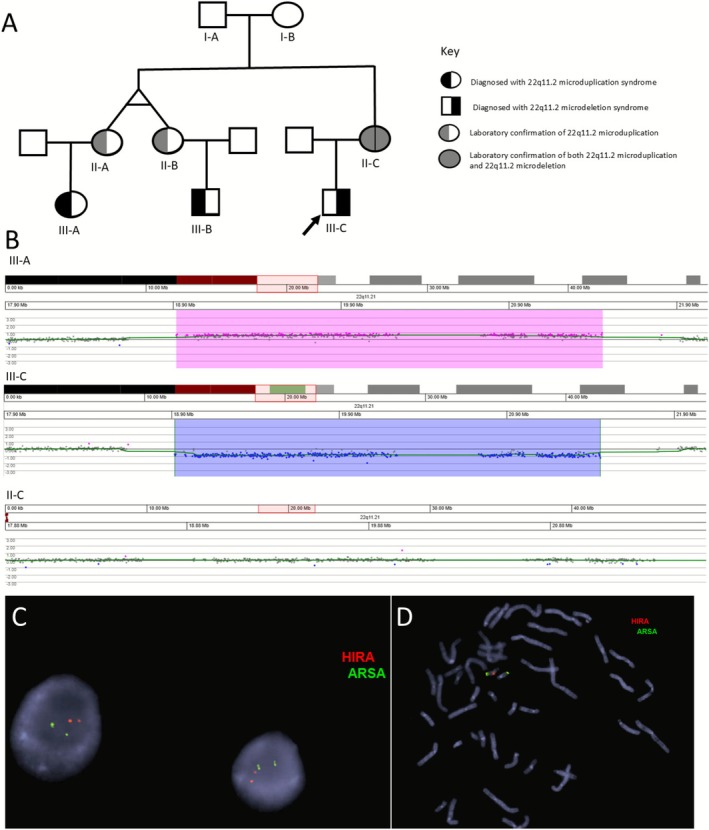 Figure 1
Peer Reviews
No public reviews on file for this paper yet. If you reviewed it on a platform where reviews are public (OpenReview, ICLR, NeurIPS, ICML), you can paste yours below so the community can read it here.
Videos
No videos yet. Explain this paper in a talk, walkthrough, or lecture? Add one.
Taxonomy
TopicsCongenital heart defects research · Genomic variations and chromosomal abnormalities · Congenital Ear and Nasal Anomalies