In vitro Antiplasmodial and Molecular Docking Studies of Chemical Constituent Isolated from the Bark of Diospyros lanceifolia (Ebenaceae)
Ibrahim Dankane Bafarawa, Muhammad Solehin Abd Ghani, Arba Pramundita Ramadani, Shofiatul Fuadah, Sista Werdyani, Unang Supratman, Muhammad Bisyrul Hafi Othman, Mohamad Nasir Mohamad Ibrahim, Khalijah Awang, Marc Litaudon, Mohammad Tasyriq Che Omar, Habibah A. Wahab

TL;DR
This study identifies compounds from a plant that show strong anti-malaria activity and bind well to a key malaria protein, suggesting potential for new drugs.
Contribution
The study reports the isolation and evaluation of new antiplasmodial compounds from Diospyros lanceifolia with strong in vitro and in silico activity.
Findings
Five compounds showed strong antiplasmodial activity with IC50 values below 10 μM.
Compounds 5 and 3 were more potent than artemisinin and chloroquine in vitro.
Molecular docking showed good binding affinity of active compounds to PfATP6, supporting their potential as drug leads.
Abstract
The phytochemical investigations of the ethyl acetate bark extract of Diospyros lanceifolia have led to the isolation of eight compounds, namely lupeol (1), betulin (2), β-sitosterol (3), oleic acid (4), α-amyrin acetate (5), glyceryl trilinoleate (6), β-amyrin (7) and shinanolone (8). The structures of all compounds were established using various spectroscopic techniques such as 1D and 2D-NMR, FT-IR and HRESIMS, which were then compared with reported literature for validation. All compounds isolated from this plant were screened for an in vitro study against Plasmodium falciparum FCR3 followed by an in silico molecular docking study with the PfATP6 protein. The in vitro results revealed that five compounds exhibited strong to good activity (IC50 < 10 μM). In order of potency, these compounds include 5, 3, 6, 1 and 4 with IC50 values of 0.3 ± 0.3 μM, 0.3 ± 0.3 μM, 1.9 ± 2.2 μM, 4.4 ±…
Genes, proteins, chemicals, diseases, species, mutations and cell lines named across the full text — each resolved to its canonical identifier and authoritative record.
Click any figure to enlarge with its caption.
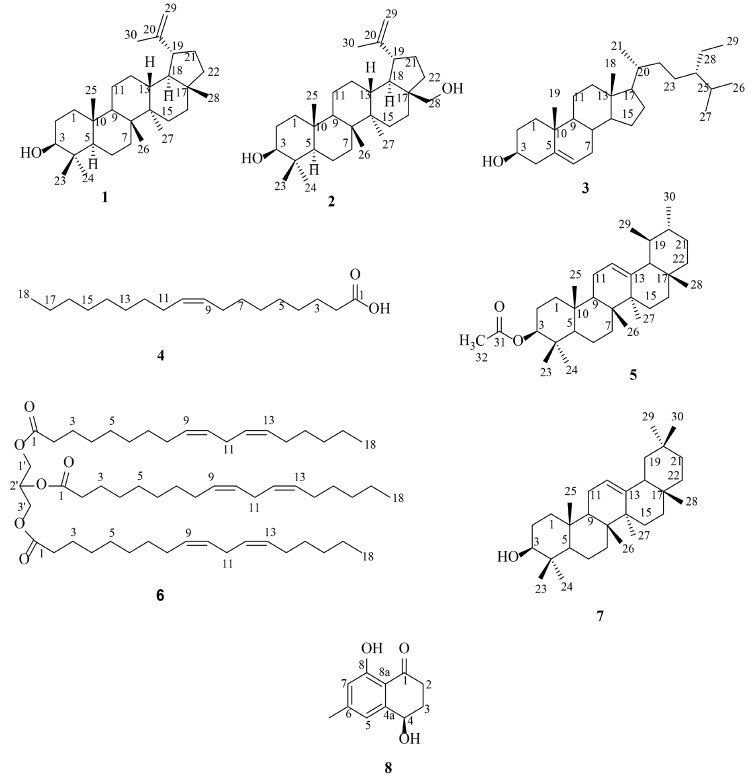 Figure 1
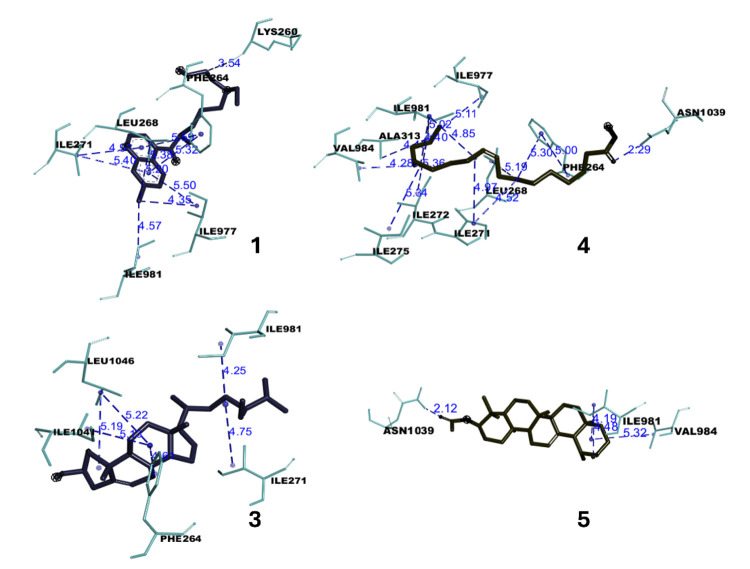 Figure 2
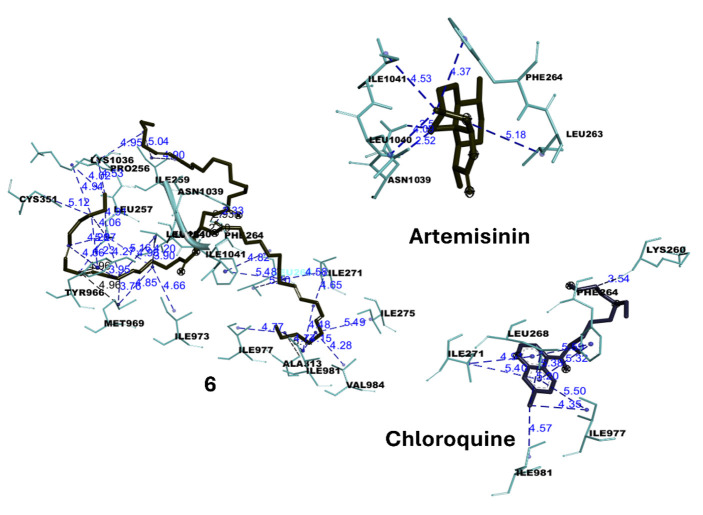 Figure 3
Peer Reviews
No public reviews on file for this paper yet. If you reviewed it on a platform where reviews are public (OpenReview, ICLR, NeurIPS, ICML), you can paste yours below so the community can read it here.
Videos
No videos yet. Explain this paper in a talk, walkthrough, or lecture? Add one.
Taxonomy
TopicsPhytochemistry and Biological Activities