Physicians’ Use of Electronic Health Record Data Elements and Decision Support Tools in Heart Failure Management: User-Centered Cross-Sectional Survey Study
Mohamed S Ali, Bruna Oewel, Kaitlyn M Greer, Sabah Ganai, Mark W Newman, Kelly Murdoch-Kitt, Scott L Hummel, Michael P Dorsch

TL;DR
This study explores how cardiologists and general medicine physicians use EHR data and decision support tools in managing heart failure, revealing differences in their priorities and underutilization of certain tools.
Contribution
The study identifies specific EHR elements and tools prioritized by cardiologists and general medicine physicians in heart failure care, offering insights for future EHR design.
Findings
Both physician groups rely heavily on medication lists, lab results, diagnostic tests, and problem lists.
Cardiologists emphasize diagnostic tests more than general medicine physicians in both inpatient and outpatient settings.
Use of standardized questionnaires and predictive models is low across both groups.
Abstract
The management of heart failure (HF) requires complex, data-driven decision-making. Although electronic health record (EHR) systems and clinical decision support (CDS) tools can streamline access to essential clinical information, it remains unclear which EHR elements and tools cardiologists and general medicine physicians prioritize when caring for patients with HF. This study aims to identify these elements and tools to improve the user interface design of future EHR applications. This study used a user-centered design research approach to understand physician workflows and decision-making needs in HF care. A cross-sectional online survey was administered to 302 physicians, comprising 150 cardiologists (including 15 HF specialists) and 152 general medicine physicians. Respondents reported their use of EHR variables (eg, medication lists, laboratory results, diagnostic tests, problem…
Genes, proteins, chemicals, diseases, species, mutations and cell lines named across the full text — each resolved to its canonical identifier and authoritative record.
Click any figure to enlarge with its caption.
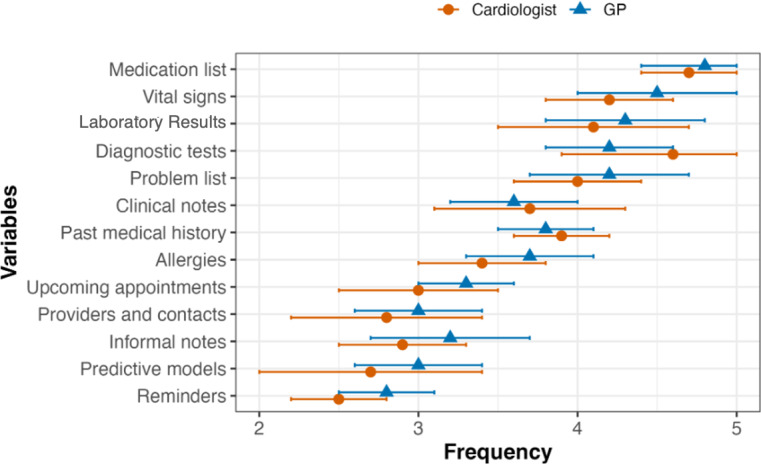 Figure 1
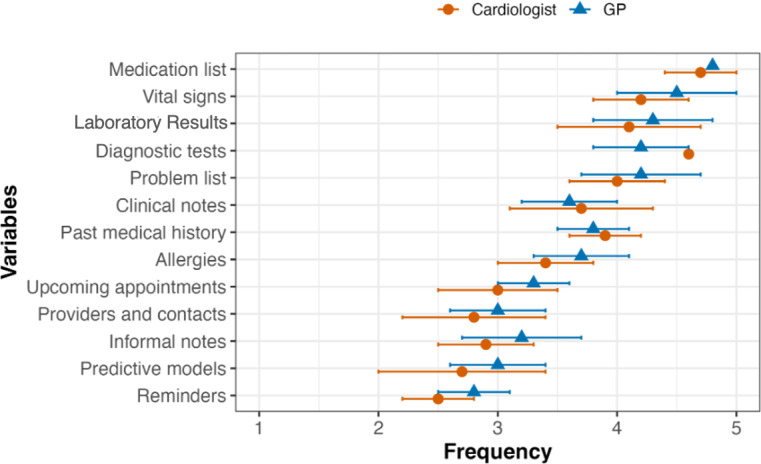 Figure 2
Peer Reviews
No public reviews on file for this paper yet. If you reviewed it on a platform where reviews are public (OpenReview, ICLR, NeurIPS, ICML), you can paste yours below so the community can read it here.
Videos
No videos yet. Explain this paper in a talk, walkthrough, or lecture? Add one.
Taxonomy
TopicsElectronic Health Records Systems