Inhomogeneous broadening in the time domain: Gauss–Lorentz, Gauss–Drude and Gauss–Debye material models
Ludmila J. Prokopeva, Alexander V. Kildishev

TL;DR
This paper introduces a new theoretical framework for modeling material responses with non-Lorentzian broadening, enabling accurate simulations in various wave propagation fields.
Contribution
A causal and physically consistent framework for inhomogeneous broadening using spectral diffusion and a novel semi-analytical approximation method (MiMOSA).
Findings
The framework accurately models lineshapes from multiple broadening mechanisms.
MiMOSA generates efficient numerical stencils for time-domain Maxwell solvers.
The models are applicable to diverse fields like acoustics, magnonics, and quantum technologies.
Abstract
Forty-five years after the initial attempts – first by Efimov–Khitrov in 1979, then by Brendel–Bormann in 1992 – we present a comprehensive, causal, and physically consistent framework for modeling the dielectric function with inhomogeneous (non-Lorentzian) broadening, where scattering becomes frequency- or time-dependent. This theoretical framework is based on spectral diffusion, described in the frequency domain by a complex probability density function and in the time domain by a matching characteristic function. The proposed approach accurately models the lineshapes resulting from multiple broadening mechanisms and enables the retrieval of intrinsic homogeneous linewidths as well as inhomogeneous disorder-controlled material dispersion features. To implement the new general dispersion function in time-domain Maxwell solvers, we have designed a constrained minimax-based…
Genes, proteins, chemicals, diseases, species, mutations and cell lines named across the full text — each resolved to its canonical identifier and authoritative record.
Click any figure to enlarge with its caption.
 Figure 1
 Figure 2
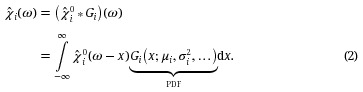 Figure 3
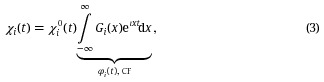 Figure 4
 Figure 5
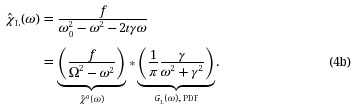 Figure 6
 Figure 7
 Figure 8
 Figure 9
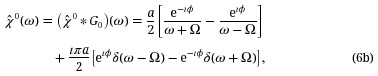 Figure 10
 Figure 11
 Figure 12
 Figure 13
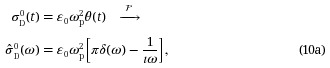 Figure 14
 Figure 15
 Figure 16
 Figure 17
 Figure 18
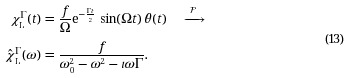 Figure 19
 Figure 20
 Figure 21
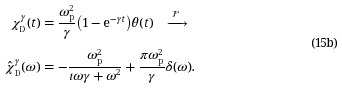 Figure 22
 Figure 23
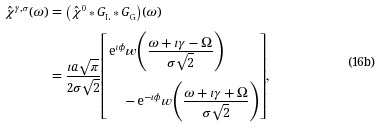 Figure 24
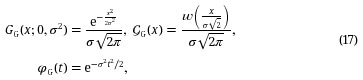 Figure 25
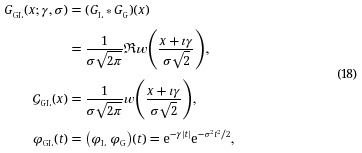 Figure 26
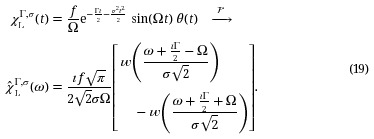 Figure 27
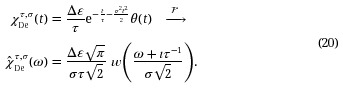 Figure 28
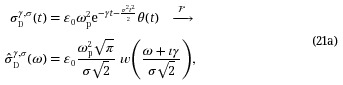 Figure 29
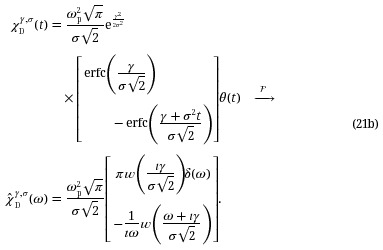 Figure 30
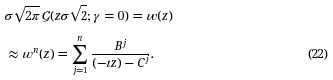 Figure 31
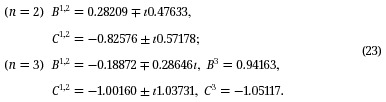 Figure 32
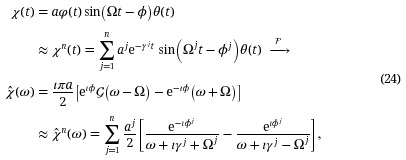 Figure 33
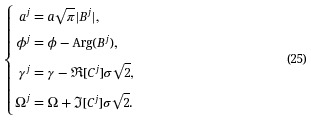 Figure 34
 Figure 35
 Figure 36
 Figure 37
 Figure 38
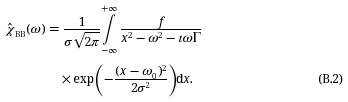 Figure 39
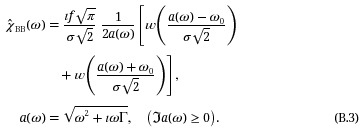 Figure 40
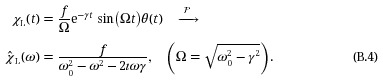 Figure 41
 Figure 42
 Figure 43
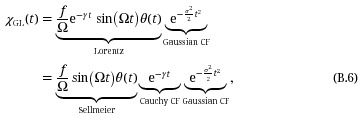 Figure 44
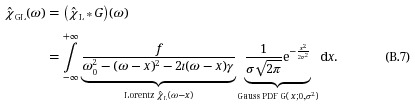 Figure 45
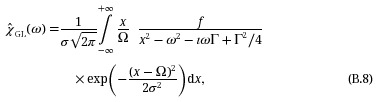 Figure 46
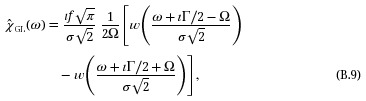 Figure 47
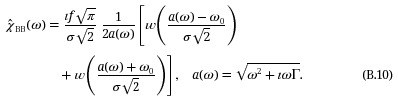 Figure 48
 Figure 49
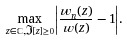 Figure 50
Peer Reviews
No public reviews on file for this paper yet. If you reviewed it on a platform where reviews are public (OpenReview, ICLR, NeurIPS, ICML), you can paste yours below so the community can read it here.
Videos
No videos yet. Explain this paper in a talk, walkthrough, or lecture? Add one.
Taxonomy
TopicsSeismic Waves and Analysis · Electromagnetic Simulation and Numerical Methods · Lightning and Electromagnetic Phenomena