Disentangling eye movement desensitization and reprocessing mechanisms of action: The impact of eye movements in the eye blink conditioning task
Daniel Folch‐Sanchez, Chrysanthi Blithikioti, Laura Nuño, Pablo Barrio, Roger Borràs, Laura Blanco, Flavia Piazza, Mercè Balcells‐Oliveró, Laia Miquel

TL;DR
This study shows that horizontal eye movements during an eye blink conditioning task help people learn to reduce fear responses faster, which may explain part of how EMDR therapy works.
Contribution
The study provides new evidence that horizontal eye movements accelerate fear extinction learning in a classical conditioning task.
Findings
The EM group showed an 18.2% probability of conditioned response occurrence in the first extinction block.
The control group had a 40.9% probability of conditioned response occurrence in the same block.
Horizontal eye movements were associated with accelerated extinction learning in the EBC task.
Abstract
Eye movement desensitization and reprocessing (EMDR) is an effective evidence‐based treatment for post‐traumatic stress disorder. However, the therapeutic mechanisms underlying eye movements (EM) remain unclear. This study aimed to investigate the effect of horizontal EM on fear extinction learning in healthy individuals, using an Eye Blink Conditioning (EBC) task. This experimental paradigm has been widely used to explore associative fear learning and memory as a form of classical conditioning. Healthy participants were included to the study protocol and divided randomly into two groups. The EM group (n = 20) were asked to follow horizontally the experimenter's moving finger at the beginning of the extinction phase and the control group (n = 19) did not engage in any specific task. Sociodemographic and clinical information was collected. Percentage of conditioned response (CR)…
Genes, proteins, chemicals, diseases, species, mutations and cell lines named across the full text — each resolved to its canonical identifier and authoritative record.
Click any figure to enlarge with its caption.
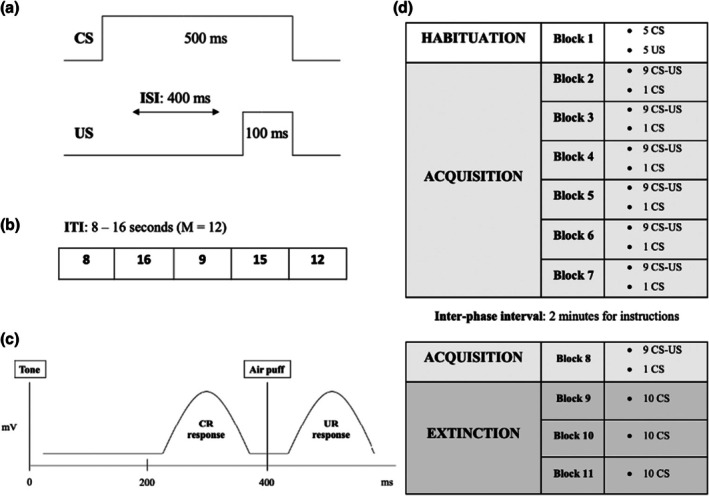 Figure 1
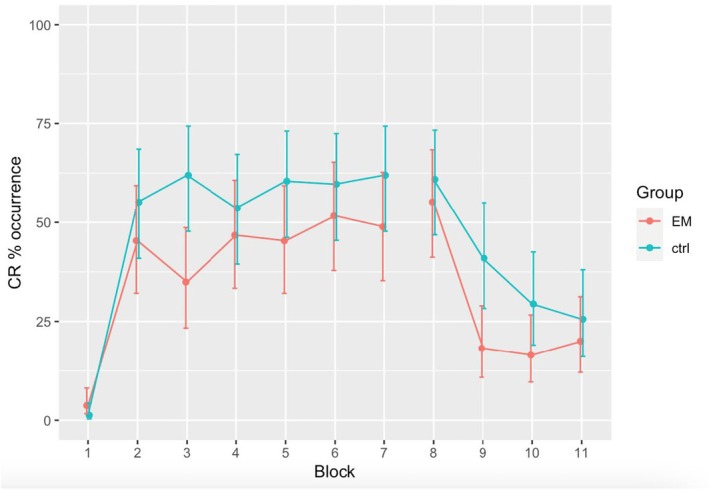 Figure 2
Peer Reviews
No public reviews on file for this paper yet. If you reviewed it on a platform where reviews are public (OpenReview, ICLR, NeurIPS, ICML), you can paste yours below so the community can read it here.
Videos
No videos yet. Explain this paper in a talk, walkthrough, or lecture? Add one.
Taxonomy
TopicsStress Responses and Cortisol · Memory and Neural Mechanisms · Posttraumatic Stress Disorder Research