Randomised controlled field trial to assess the safety and efficacy of a killed autologous vaccine against Streptococcus dysgalactiae subspecies dysgalactiae in a sheep flock
Joseph W. Angell, Naseem Ahmed, Louise P. Jackson, Konstantina Kasiora, Keith Ballingall, Jennifer S. Duncan

TL;DR
A sheep vaccine trial found no reduction in joint-ill in lambs, but vaccinated ewes and their offspring had higher antibodies against a bacteria causing the disease.
Contribution
A blinded randomized trial evaluated a killed autologous SDSD vaccine's safety and efficacy in sheep, revealing antibody increases but no disease reduction.
Findings
Vaccinated ewes had higher SDSD antibody titres compared to unvaccinated ewes.
Lambs from vaccinated ewes had higher SDSD antibody titres than those from unvaccinated ewes.
No significant reduction in joint-ill cases was observed in lambs from vaccinated ewes.
Abstract
Joint‐ill in neonatal lambs, primarily caused by Streptococcus dysgalactiae subspecies dysgalactiae (SDSD), results in increased mortality and morbidity. An effective vaccine is needed to prevent the disease. A blinded randomised controlled trial was carried out using an autologous SDSD vaccine in a commercial sheep flock in the UK. Two doses of vaccine were administered to 481 pregnant ewes, with 509 ewes left unvaccinated. The SDSD antibody titres of the ewes and their lambs were then measured. Any adverse effects or cases of joint‐ill were also reported. Ten cases of joint‐ill occurred, with five of these lambs born to vaccinated ewes and five to unvaccinated ewes. Serum from 85 vaccinated ewes and 88 control ewes was analysed using an SDSD antibody ELISA, with higher titres found in vaccinated ewes. Higher SDSD titres were observed in lambs from vaccinated ewes (n = 87) than in…
Genes, proteins, chemicals, diseases, species, mutations and cell lines named across the full text — each resolved to its canonical identifier and authoritative record.
Click any figure to enlarge with its caption.
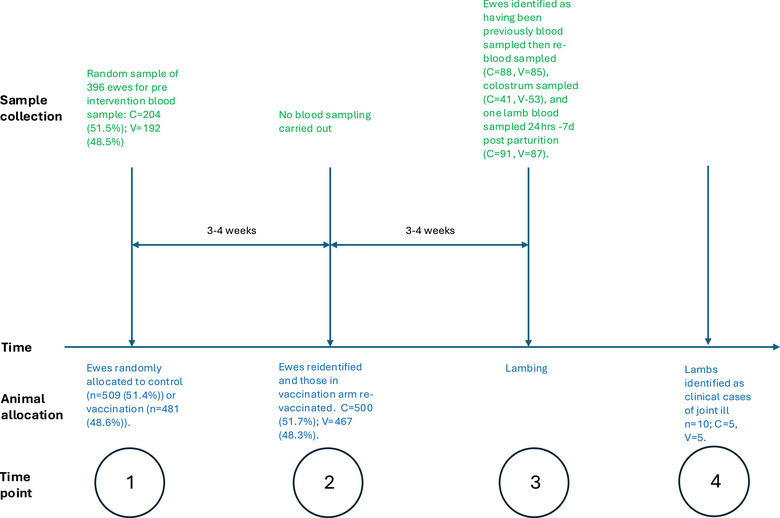 Figure 1
Peer Reviews
No public reviews on file for this paper yet. If you reviewed it on a platform where reviews are public (OpenReview, ICLR, NeurIPS, ICML), you can paste yours below so the community can read it here.
Videos
No videos yet. Explain this paper in a talk, walkthrough, or lecture? Add one.
Taxonomy
TopicsStreptococcal Infections and Treatments · Diphtheria, Corynebacterium, and Tetanus · Clostridium difficile and Clostridium perfringens research