Low positive and borderline negative transglutaminase antibody levels are frequently associated with a coeliac disease diagnosis
Rakel Nurmi, Celina Turunen Beteta, Kalle Kurppa, Heini Huhtala, Katri Lindfors, Laura Kivelä, Katri Kaukinen, Saana Paavola

TL;DR
Low and borderline transglutaminase antibody levels often indicate coeliac disease, especially when combined with other markers like EmA.
Contribution
The study clarifies the clinical significance of low and borderline TGA levels in diagnosing coeliac disease.
Findings
Low positive TGA values are frequently associated with coeliac disease diagnosis.
Borderline negative TGA values may indicate early-stage coeliac disease.
EmA positivity strongly correlates with coeliac disease in these TGA ranges.
Abstract
Due to the expanding screening of coeliac disease (CeD), low positive and borderline negative serum transglutaminase 2 antibody (TGA) values are causing increasing confusion in clinical practice. To investigate the significance of these findings in a well‐defined patient cohort. Altogether 311 IgA‐competent adults, with clinical suspicion or family history of CeD, underwent duodenal sampling and testing for TGA (ImmunoCAP EliA, cut‐off 7.0 U/mL) and endomysial antibodies (EmA). TGA values 7.0–14.0 U/mL were defined as low positive and 3.0–6.9 U/mL as borderline negative. Besides conventional histology, small bowel mucosal TGA‐targeted IgA deposits and γδ+ intraepithelial lymphocytes (IELs) were determined as CeD‐specific markers. Twenty‐eight (9%) individuals had low positive TGA, and 22 (79%) were also positive for EmA. Among those with low positive TGA, all EmA positive and 50% of…
Genes, proteins, chemicals, diseases, species, mutations and cell lines named across the full text — each resolved to its canonical identifier and authoritative record.
Click any figure to enlarge with its caption.
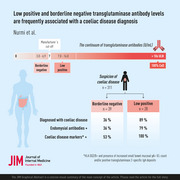 Figure 1
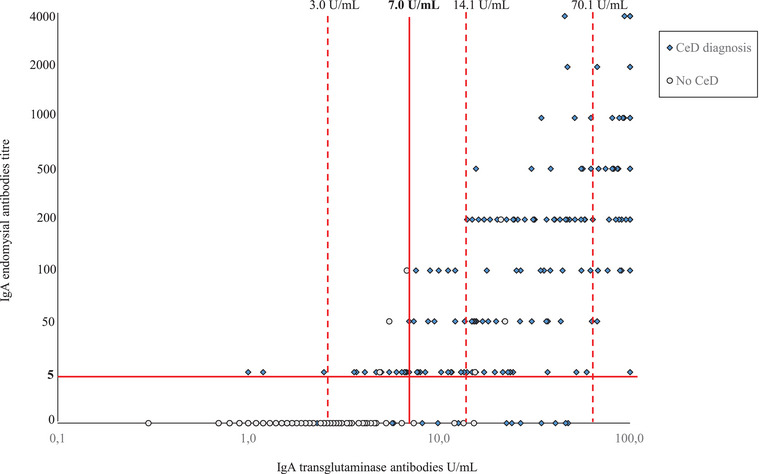 Figure 2
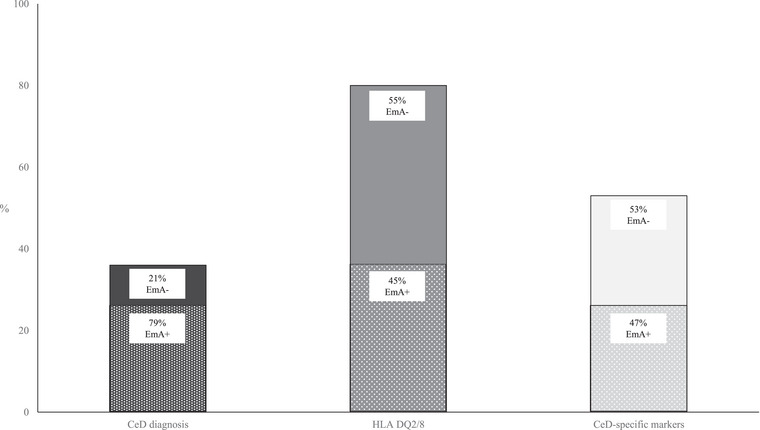 Figure 3
Peer Reviews
No public reviews on file for this paper yet. If you reviewed it on a platform where reviews are public (OpenReview, ICLR, NeurIPS, ICML), you can paste yours below so the community can read it here.
Videos
No videos yet. Explain this paper in a talk, walkthrough, or lecture? Add one.
Taxonomy
TopicsCeliac Disease Research and Management · Microscopic Colitis · Eosinophilic Esophagitis