Flash annealing–engineered wafer-scale relaxor antiferroelectrics for enhanced energy storage performance
Yizhuo Li, Kepeng Song, Meixiong Zhu, Xiaoqi Li, Zhaowei Zeng, KangMing Luo, Yuxuan Jiang, Zhe Zhang, Cuihong Li, Yujia Wang, Bing Li, Zhihong Wang, Zhidong Zhang, Weijin Hu

TL;DR
A new flash annealing method creates high-performance antiferroelectric films for better energy storage in capacitors.
Contribution
Introduces flash annealing to engineer relaxor antiferroelectric films with exceptional thermal stability and energy density.
Findings
Flash annealing produces PbZrO3 films with 36% subgrain boundary fractions and nanoscale domains.
The films achieve 63.5 joules per cubic meter energy storage density and 4800 kilovolts per centimeter breakdown strength.
Performance degrades less than 3% up to 250°C, showing excellent thermal stability.
Abstract
Dielectric capacitors are essential for energy storage systems because of their high-power density and fast operation speed. However, optimizing energy storage density with concurrent thermal stability remains a substantial challenge. Here, we develop a flash annealing process with ultrafast heating and cooling rates of 1000°C per second, which facilitates the rapid crystallization of PbZrO3 film within a mere second, while locking its high-temperature microstructure to room temperature. This produces compact films with subgrain boundary fractions of 36%, nanodomains of several nanometers, and negligible lead volatilization. These contribute to relaxor antiferroelectric film with a high breakdown strength (4800 kilovolts per centimeter) and large polarization (70 coulombs per square centimeter). Consequently, we have achieved a high energy storage density of 63.5 joules per cubic meter…
Genes, proteins, chemicals, diseases, species, mutations and cell lines named across the full text — each resolved to its canonical identifier and authoritative record.
Click any figure to enlarge with its caption.
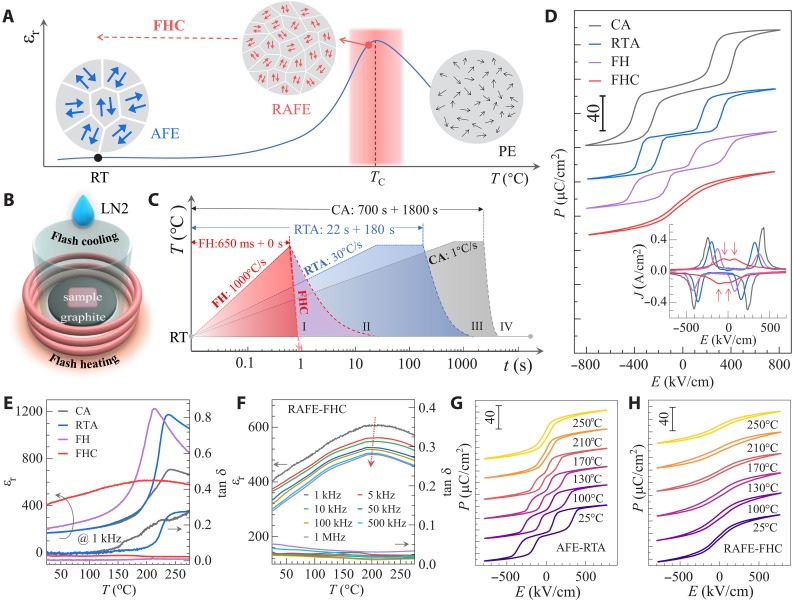 Figure 1
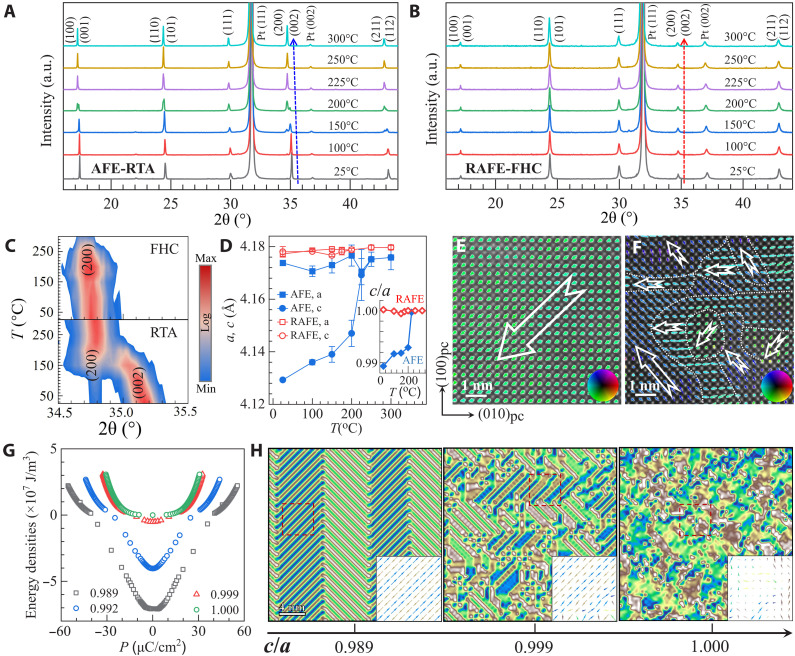 Figure 2
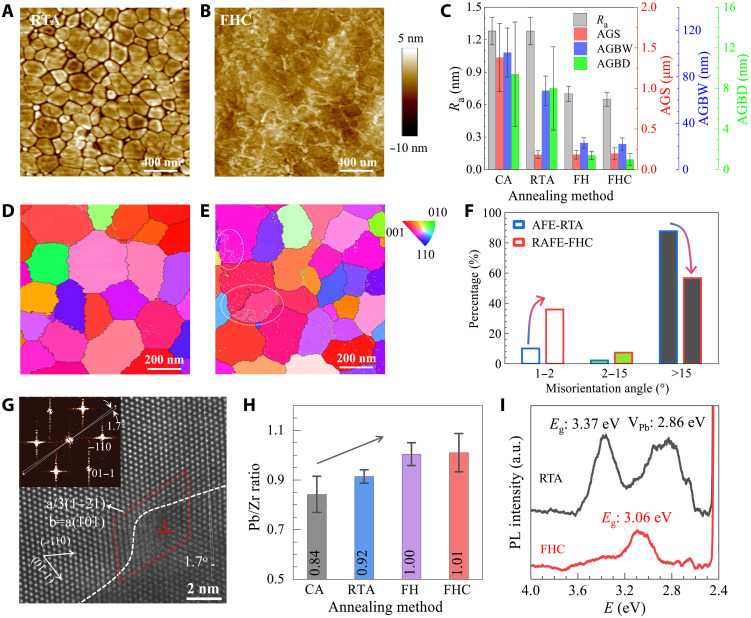 Figure 3
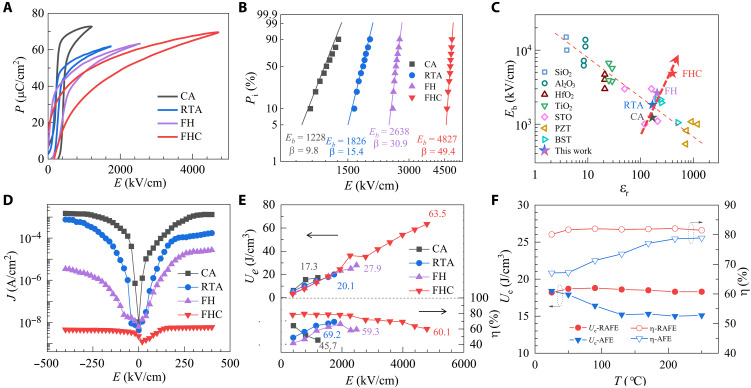 Figure 4
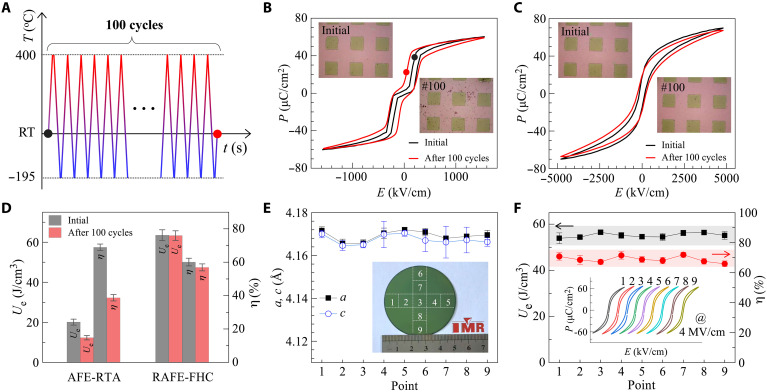 Figure 5
Peer Reviews
No public reviews on file for this paper yet. If you reviewed it on a platform where reviews are public (OpenReview, ICLR, NeurIPS, ICML), you can paste yours below so the community can read it here.
Videos
No videos yet. Explain this paper in a talk, walkthrough, or lecture? Add one.
Taxonomy
TopicsFerroelectric and Piezoelectric Materials · Ferroelectric and Negative Capacitance Devices · Multiferroics and related materials