The Development of Audio‐Tactile Spatial Integration: Unraveling Vision's Contribution
Alessia Tonelli, Irene Senna, Maria Bianca Amadeo, Walter Setti, Nicola Domenici, Sabrina Signorini, Elena Cocchi, Giuseppina Giammari, Sandra Strazzer, Francesca Tinelli, Paola Camicione, Massimiliano Serafino, Monica Gori

TL;DR
The study explores how vision influences the development of spatial perception using sound and touch, finding that sighted children reach optimal integration later than blind children.
Contribution
The paper reveals that optimal audio-tactile integration develops late in sighted children and that visual experience shapes sensory development differently.
Findings
Sighted children achieve optimal audio-tactile integration only after age 12.
Blind children show higher unimodal sensory precision from a younger age.
Tactile precision stabilizes earlier than auditory in sighted children, but the opposite is true for blind children.
Abstract
Vision is considered the dominant sense for spatial perception. Yet, how vision contributes to its refinement in other modalities remains unclear. Consequently, we investigated the development of audio‐tactile spatial integration using a localization task in which participants had to determine the position of auditory, tactile, and audio‐tactile stimuli and the influence of visual experience in this process. We tested sighted and blind children at different ages. We found that in sighted children, tactile spatial perception stabilizes earlier than the auditory one, and optimal audio‐tactile integration is achieved only after 12 years‐of‐age. Conversely, blind children showed higher uni‐sensory precisions from a younger age, although multisensory performance exhibited minimal improvement through age. Overall, our findings suggest that optimal audio‐tactile spatial integration develops…
Genes, proteins, chemicals, diseases, species, mutations and cell lines named across the full text — each resolved to its canonical identifier and authoritative record.
Click any figure to enlarge with its caption.
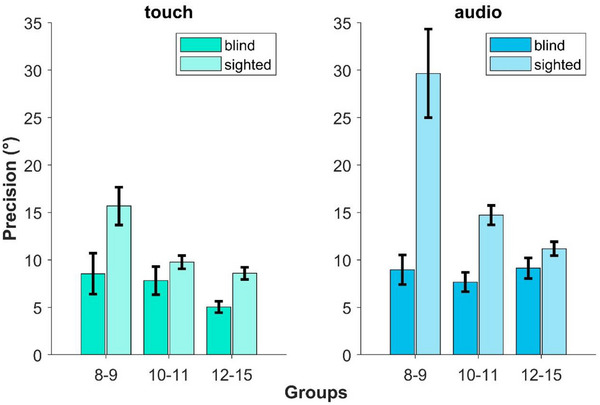 Figure 1
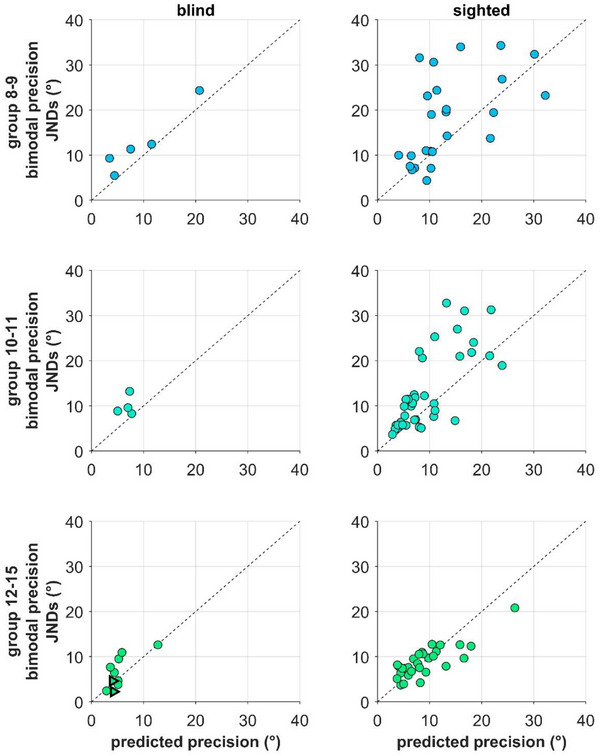 Figure 2
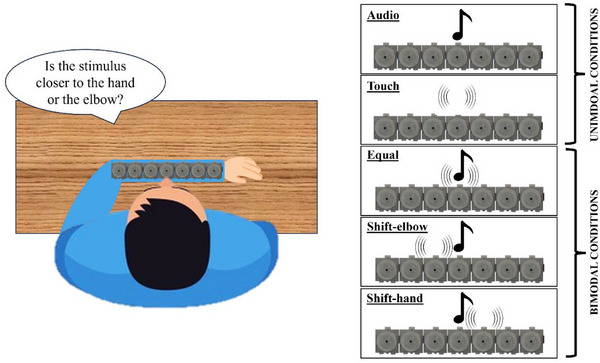 Figure 3
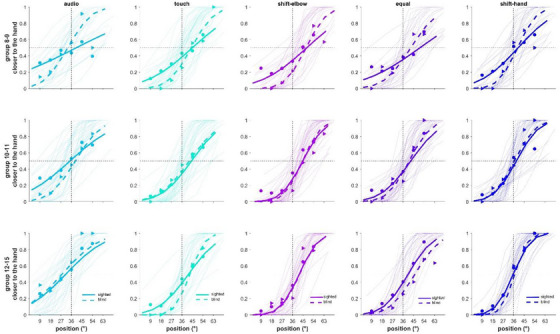 Figure 4
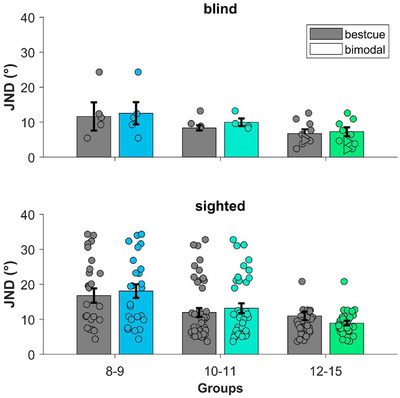 Figure 5
Peer Reviews
No public reviews on file for this paper yet. If you reviewed it on a platform where reviews are public (OpenReview, ICLR, NeurIPS, ICML), you can paste yours below so the community can read it here.
Videos
No videos yet. Explain this paper in a talk, walkthrough, or lecture? Add one.
Taxonomy
TopicsMultisensory perception and integration · Tactile and Sensory Interactions · Virtual Reality Applications and Impacts