The Reporting and Methodological Recommendations for Observational Studies Estimating the Effects of Deprescribing Medications (REMROSE‐D) ISPE‐Endorsed Guidance
Kaleen N. Hayes, Joshua D. Niznik, Danijela Gnjidic, Frank Moriarty, Dimitri Bennett, Marie‐Laure Laroche, Denis Talbot, Matthew Alcusky, Maurizio Sessa, Antoinette B. Coe, Caroline Sirois, Andrew R. Zullo, Xiaojuan Li, Sri Harsha Chalasani, Jehath Syed, Mouna Sawan

TL;DR
This paper introduces REMROSE-D, a new set of guidelines to improve the quality and reporting of observational studies on deprescribing medications.
Contribution
The paper presents REMROSE-D, a consensus-based guidance framework for methodological and reporting standards in deprescribing studies.
Findings
The REMROSE-D guidance includes 23 consensus-based recommendations for deprescribing studies.
Recommendations cover key areas like time zero definition, deprescribing definitions, and immortal time bias avoidance.
The guidance was developed through a modified Delphi process involving 55 participants in two rounds.
Abstract
Pharmacoepidemiologic studies on deprescribing are challenging to implement, yet little guidance exists on methods to avoid bias and minimum reporting for replicability and appraisal. We developed consensus recommendations for the methods and reporting of observational studies that aim to examine the effects of deprescribing. We formed candidate recommendations based on our prior systematic review that methodologically appraised observational studies on deprescribing. We then conducted a two‐round modified Delphi process with researchers working in deprescribing pharmacoepidemiology to refine, select, and reach consensus on recommendations for a checklist based on > 70% agreement of their importance. We termed this list the REMROSE‐D (Reporting and Methodological Recommendations for Observational Studies estimating the Effects of Deprescribing medications) guidance. Twenty‐three…
Genes, proteins, chemicals, diseases, species, mutations and cell lines named across the full text — each resolved to its canonical identifier and authoritative record.
Click any figure to enlarge with its caption.
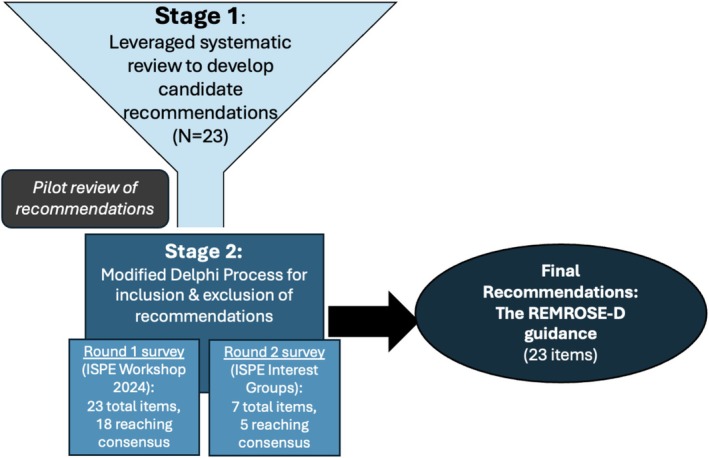 Figure 1
 Figure 2
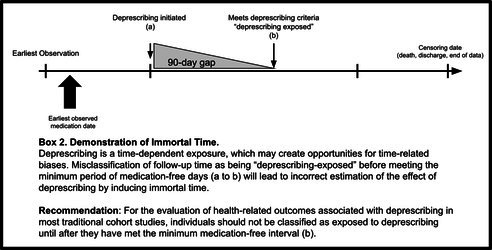 Figure 3
Peer Reviews
No public reviews on file for this paper yet. If you reviewed it on a platform where reviews are public (OpenReview, ICLR, NeurIPS, ICML), you can paste yours below so the community can read it here.
Videos
No videos yet. Explain this paper in a talk, walkthrough, or lecture? Add one.
Taxonomy
TopicsAdvanced Causal Inference Techniques · Statistical Methods in Clinical Trials · Meta-analysis and systematic reviews