Rectal Carriage of Sequence Type 307 Klebsiella pneumoniae High‐Risk Clone Harboring Multiple Carbapenemase Genes in Community Hospitals Gauteng, South Africa
Kafilat Taiwo Salvador‐Oke, Johann Pitout, Gisele Peirano, Kathy‐Anne Strydom, Chanel Kingsburgh, Marthie Ehlers, Marleen Kock

TL;DR
This study found that a high-risk strain of Klebsiella pneumoniae, ST307, is common in community hospitals in South Africa and carries multiple drug resistance genes.
Contribution
The study identifies ST307 as a significant reservoir of carbapenemase genes in community hospitals and highlights the role of IncX3 plasmids in spreading resistance.
Findings
24% of rectal screening samples were carbapenemase positive, with 25% being ST307 isolates.
45% of ST307 isolates carried the bla_OXA-181 gene on IncX3 plasmids.
ST307 isolates showed significantly higher levels of antimicrobial resistance compared to non-ST307 isolates.
Abstract
Asymptomatic rectal carriers are recognized as reservoirs of carbapenem‐resistant Klebsiella pneumoniae (CRKp), which can spread epidemic high‐risk clones [e.g., sequence types (ST)‐307] and plasmids [incompatibility group (Inc)‐X3] in hospitals, with possible transmission into the community. This study investigated the epidemiology and characteristics of CRKp high‐risk clones ST307 among rectal carriage isolates from community hospitals. A carbapenemase positivity rate of 24% was observed for all rectal screening performed during hospital admission (February to August 2021) in Gauteng, South Africa; 252 CRKp isolates were characterized. Antimicrobial susceptibility was performed using the VITEK 2 automated system, and polymerase chain reaction assays were used to detect K. pneumoniae ST307, carbapenemase genes, and associated mobile genetic elements (MGEs e.g., IncX3, IS3000). Of the…
Genes, proteins, chemicals, diseases, species, mutations and cell lines named across the full text — each resolved to its canonical identifier and authoritative record.
Click any figure to enlarge with its caption.
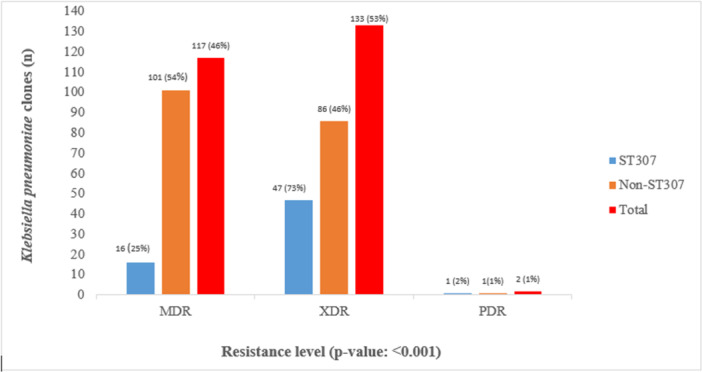 Figure 1
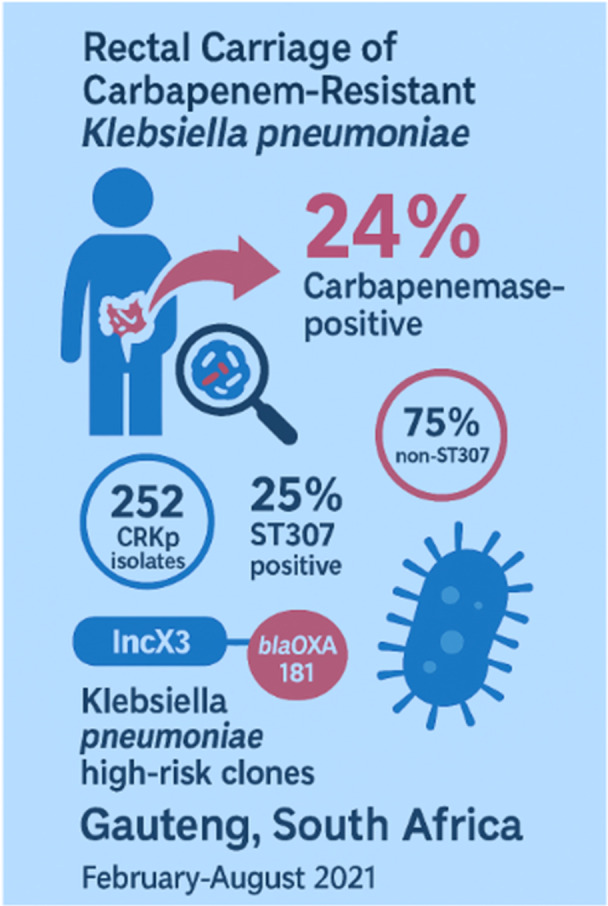 Figure 2
Peer Reviews
No public reviews on file for this paper yet. If you reviewed it on a platform where reviews are public (OpenReview, ICLR, NeurIPS, ICML), you can paste yours below so the community can read it here.
Videos
No videos yet. Explain this paper in a talk, walkthrough, or lecture? Add one.
Taxonomy
TopicsAntibiotic Resistance in Bacteria · Nosocomial Infections in ICU · Antibiotic Use and Resistance