Classifying Internet Addiction Using Machine Learning Approach: A Study Among Adolescents in Bangladesh
Akher Ali, Md. Sahadat Hosain, Md Abu Bakkar Siddik, Mahedi Hasan, Md. Ahashan Habib, Mohammad Alamgir Kabir, Mohammad Mizanur Rahman, Peal Ahamed Shanto, Nafiul Hasan, Al Mahmud

TL;DR
This study uses machine learning to identify risk factors for internet addiction among Bangladeshi adolescents, finding that depression, loneliness, and internet use time are key predictors.
Contribution
The study introduces a machine learning framework to classify internet addiction in Bangladeshi adolescents, identifying novel predictive features and achieving high classification accuracy.
Findings
30.1% of 385 adolescents reported internet addiction.
SVM linear kernel model achieved 81.9% accuracy in classifying IA.
Depression, loneliness, and internet use time were significant predictors of IA.
Abstract
Internet addiction (IA) among adolescents is growing worldwide. Online temptation is particularly strong for adolescents due to rapid physical and cognitive development. IA may impair their mental, emotional, social, and physical health. Few traditional studies were conducted in Bangladesh. Thus, this study aimed to identify adolescents’ IA risk factors using advanced machine learning (ML). A total of 385 individuals were convenience sampled and surveyed using the Patient Health Questionnaire‐9 (PHQ‐9), the UCLA Loneliness Scale (UCLA‐3), and Young's IA Test (IAT‐20) to measure the prevalence of depression, loneliness, and IA. Boruta found IA prevalence classifying factors. We evaluated decision tree (DT), support vector machine (SVM), logistic regression (LR), and random forest (RF) classification models using confusion matrix, receiver operating characteristic (ROC) curves, and…
Genes, proteins, chemicals, diseases, species, mutations and cell lines named across the full text — each resolved to its canonical identifier and authoritative record.
Click any figure to enlarge with its caption.
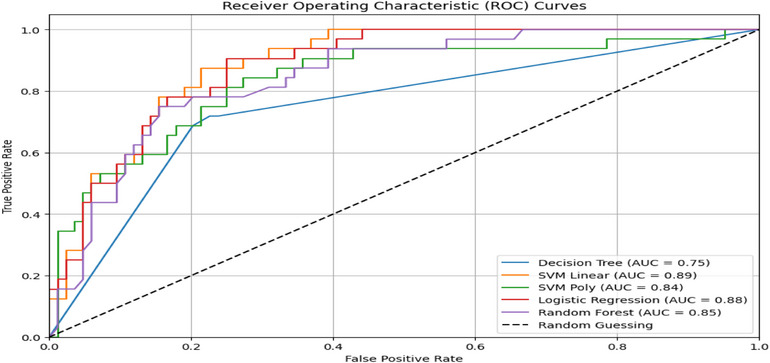 Figure 1
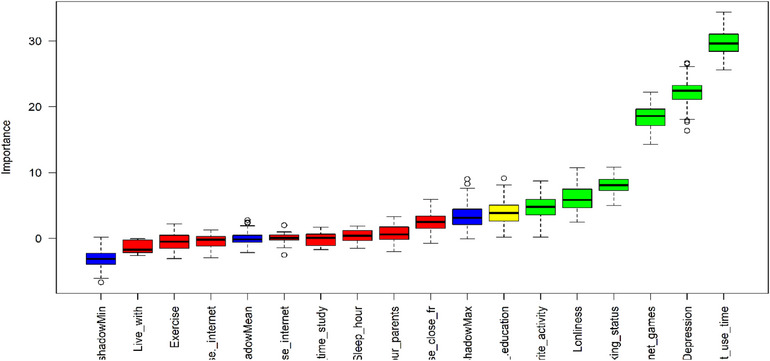 Figure 2
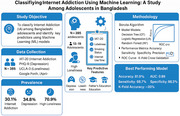 Figure 3
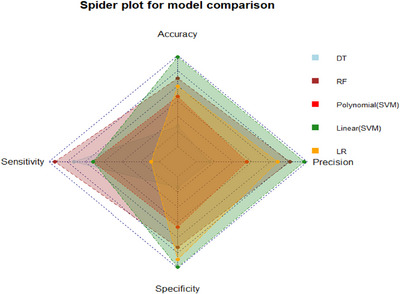 Figure 4
Peer Reviews
No public reviews on file for this paper yet. If you reviewed it on a platform where reviews are public (OpenReview, ICLR, NeurIPS, ICML), you can paste yours below so the community can read it here.
Videos
No videos yet. Explain this paper in a talk, walkthrough, or lecture? Add one.
Taxonomy
TopicsImpact of Technology on Adolescents · Digital Mental Health Interventions · Diverse Scientific Research Studies