Laparoscopic-assisted hydrostatic reduction of pediatric intussusception: a prospective study from a single tertiary center
Ahmed Abdelmhaimen Elhaddad, Youssef Youssef Aboshosha, Abdelmotaleb Effat Ebeid, Mohamed Ali Shehata

TL;DR
A new laparoscopic method successfully treats intussusception in children after initial attempts fail, with low complications and short hospital stays.
Contribution
A protocolized laparoscopic-assisted hydrostatic reduction pathway is introduced as a safe and effective escalation strategy after failed ultrasound-guided reduction.
Findings
LAHR succeeded in 84.9% of cases after failed USGHR with low complication rates.
Time to enteral feeding and length of hospital stay were significantly shorter after successful LAHR.
No early recurrences were observed following LAHR.
Abstract
After failed ultrasound-guided hydrostatic reduction (USGHR), operative options vary. We evaluated a protocolized laparoscopic-assisted hydrostatic reduction (LAHR) pathway as an escalation strategy. This prospective study included 242 children with intussusception treated at a single tertiary center between January 2023 and December 2024. All children received standardized USGHR (≤ 3 attempts in one session). Failures proceeded to LAHR under standardized hydrostatic pressure (80–100 cm H₂O); persistent non-reduction or ischemia/lead point prompted mini-laparotomy and resection. Primary outcome was LAHR success; secondary outcomes included early recurrence (≤ 48 h), complications, time to feeds, and length of stay (LOS). Discharge was milestone-based. Of 242 children, USGHR succeeded in 189 (78.1%); 53 (21.9%) underwent LAHR. LAHR succeeded in 45/53 (84.9%); 8/53 (15.1%) required…
Genes, proteins, chemicals, diseases, species, mutations and cell lines named across the full text — each resolved to its canonical identifier and authoritative record.
Click any figure to enlarge with its caption.
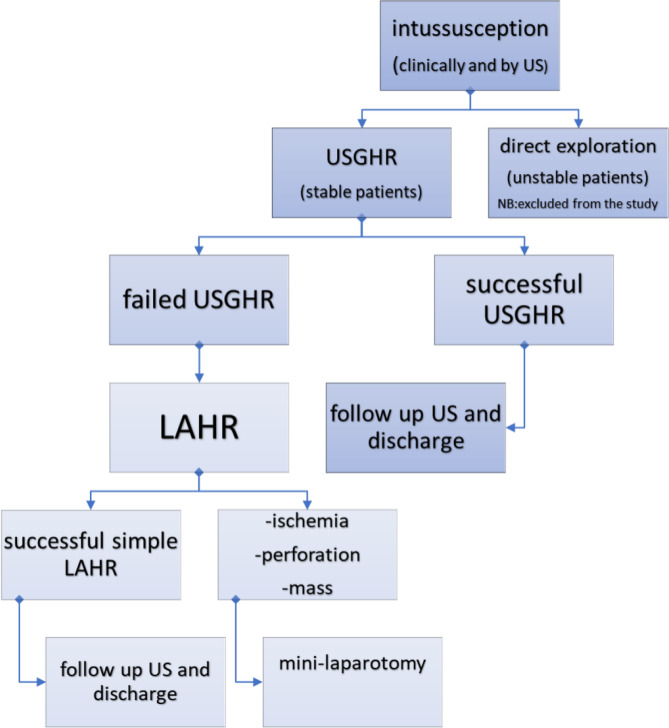 Figure 1
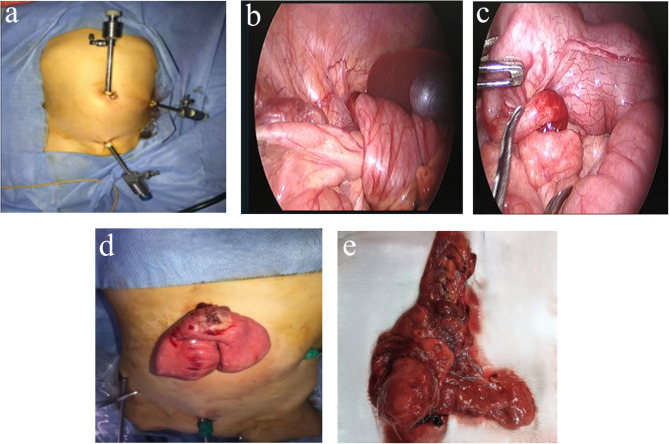 Figure 2
Peer Reviews
No public reviews on file for this paper yet. If you reviewed it on a platform where reviews are public (OpenReview, ICLR, NeurIPS, ICML), you can paste yours below so the community can read it here.
Videos
No videos yet. Explain this paper in a talk, walkthrough, or lecture? Add one.
Taxonomy
TopicsGastrointestinal disorders and treatments · Congenital gastrointestinal and neural anomalies · Gynecological conditions and treatments