Improving the reliability, quality, and maintainability of bioinformatics pipelines with nf-test
Lukas Forer, Sebastian Schönherr

TL;DR
nf-test is a new testing framework for Nextflow pipelines that improves reliability and reduces testing time by up to 80%.
Contribution
nf-test introduces a modular, automated testing framework with snapshot and smart testing for Nextflow pipelines.
Findings
nf-test reduces test execution time by up to 80% through smart testing of modified modules.
The framework enhances software quality by identifying bugs early in development.
nf-test is already adopted by multiple pipelines, improving robustness and maintainability.
Abstract
The workflow management system Nextflow, together with the nf-core community, has established an essential ecosystem in bioinformatics. However, ensuring the correctness and reliability of large and complex Nextflow pipelines remains challenging due to the lack of a unified, automated unit-testing framework. To address this gap, we present nf-test, a modular testing framework for bioinformatics workflows. It enables users to test process blocks, workflow patterns, and entire pipelines in isolation while validating their outputs. Built with a syntax similar to Nextflow DSL2, nf-test offers unique features such as snapshot testing and smart testing, which optimize resource usage by testing only modified modules. We demonstrate across multiple pipelines that these features minimize development time, reduce test execution time by up to 80%, and enhance software quality by identifying bugs…
Genes, proteins, chemicals, diseases, species, mutations and cell lines named across the full text — each resolved to its canonical identifier and authoritative record.
Click any figure to enlarge with its caption.
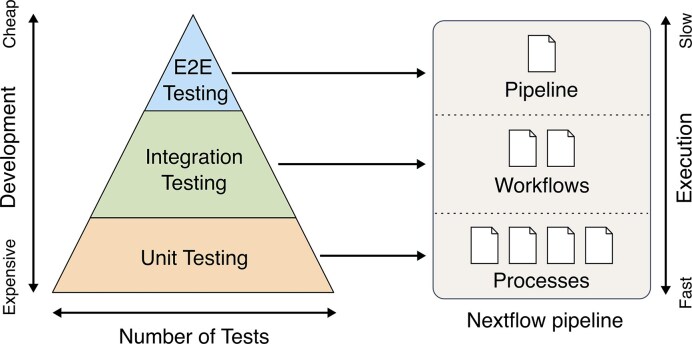 Figure 1
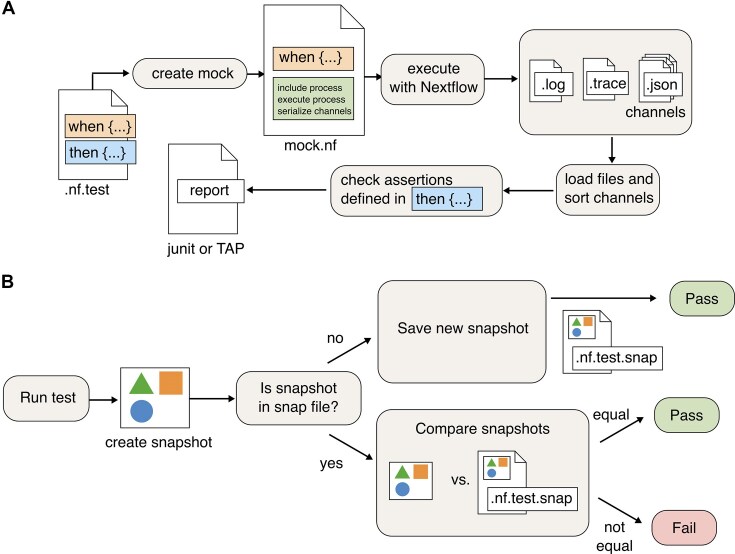 Figure 2
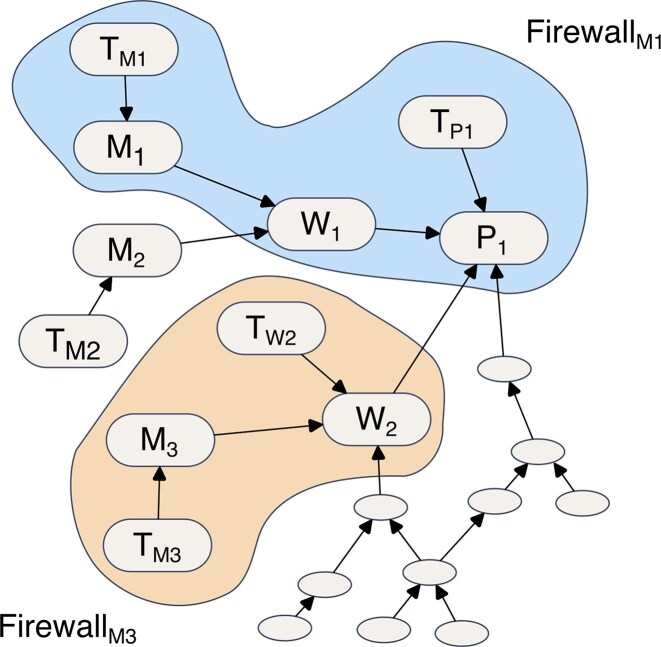 Figure 3
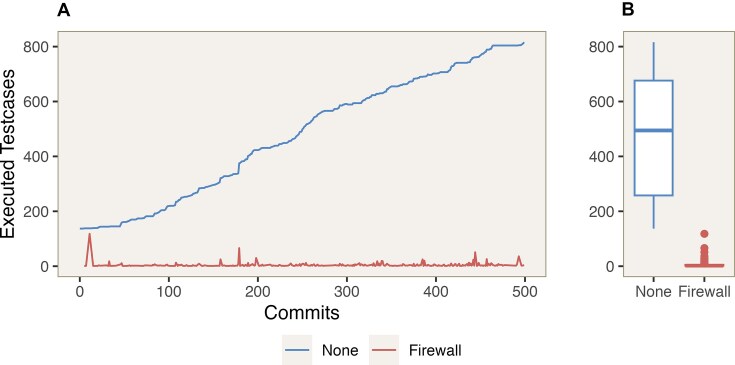 Figure 4
Peer Reviews
No public reviews on file for this paper yet. If you reviewed it on a platform where reviews are public (OpenReview, ICLR, NeurIPS, ICML), you can paste yours below so the community can read it here.
Videos
No videos yet. Explain this paper in a talk, walkthrough, or lecture? Add one.
Taxonomy
TopicsGenetics, Bioinformatics, and Biomedical Research