Candidiasis epidemiology and outcomes including emergence of Candida auris from a large, Southern US metro area: a six-year evaluation
Ricky Huynh-Phan, Ardath Plauche, William L. Musick, Kady Phe, Wesley J. Hoffman, Mayar Al Mohajer, Todd Lasco, Nicholas D. Beyda, Taryn A. Eubank, Kevin W. Garey

TL;DR
This study examines the spread and outcomes of candidiasis in a large US city over six years, highlighting the rise of the dangerous C. auris strain.
Contribution
The study provides detailed regional insights into candidiasis epidemiology and the increasing prevalence of C. auris in a Southern US metro area.
Findings
Candida auris increased significantly from 2% to 5% of cultures between 2018–20 and 2021–23.
Inpatient mortality was 17%, with hospitalization variables and Candida species predicting mortality and readmissions.
C. albicans and C. glabrata were the most common species, with 44% and 21% of cultures, respectively.
Abstract
Invasive candidiasis including candidemia is a common healthcare-associated infections with significant morbidity and mortality. The USA does not have mandatory national surveillance for mucocutaneous or invasive candidiasis which complicates estimation of epidemiology and outcomes. The aim of this project was to describe the epidemiology, mortality, and Candida-associated hospital readmissions in hospitalized patients with Candida species infections. This secondary database analysis used clinical microbiology data from adults hospitalized at three large health systems (25-hospitals) in the Greater Houston area totaling over 1.6 million hospitalization days per year from 2018 to 2023. Proportion and rates of Candida cultures per 10,000 hospitalization days were calculated. Risk factors for mortality and Candida-associated readmissions were assessed by multivariable logistic regression.…
Genes, proteins, chemicals, diseases, species, mutations and cell lines named across the full text — each resolved to its canonical identifier and authoritative record.
Click any figure to enlarge with its caption.
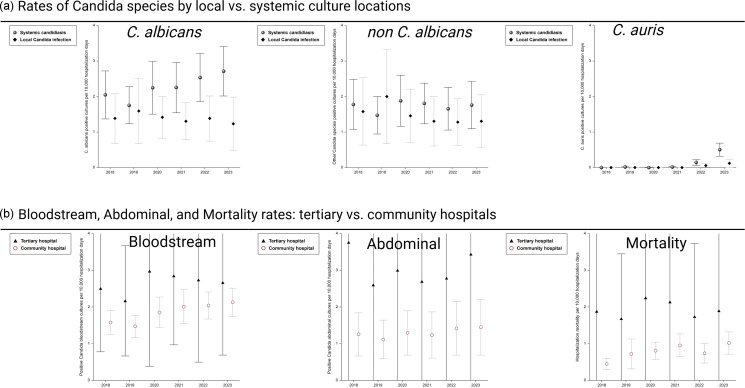 Figure 1
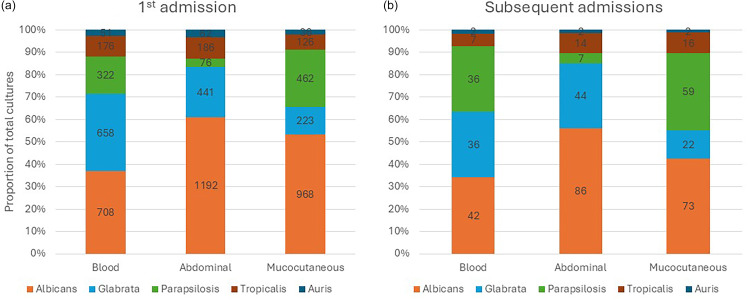 Figure 2
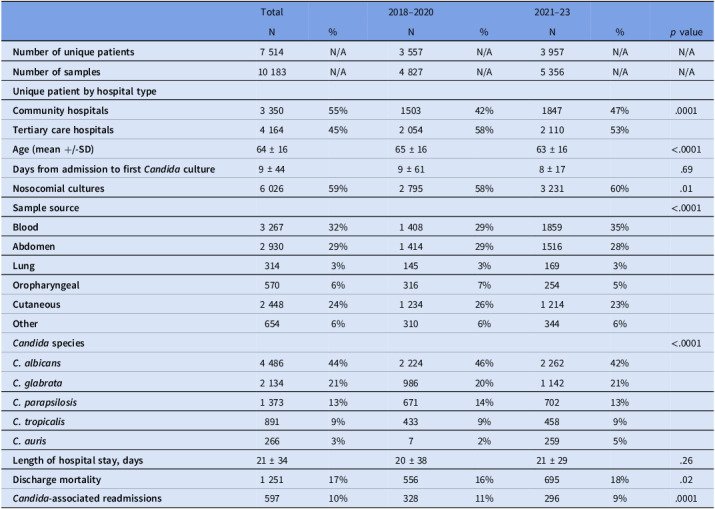 Figure 3
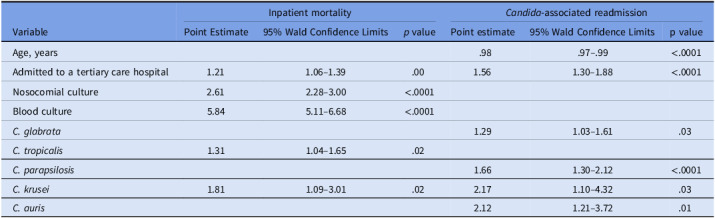 Figure 4
Peer Reviews
No public reviews on file for this paper yet. If you reviewed it on a platform where reviews are public (OpenReview, ICLR, NeurIPS, ICML), you can paste yours below so the community can read it here.
Videos
No videos yet. Explain this paper in a talk, walkthrough, or lecture? Add one.
Taxonomy
TopicsAntifungal resistance and susceptibility · Parasitic Diseases Research and Treatment · Fungal Infections and Studies