Early de-escalation of empiric antibiotic therapy in neutropenic fever: a single-center, retrospective study
Zachary Mostel, Michelle Evans, Douglas Tremblay, Meenakshi Rana, Samantha E. Jacobs, John Mascarenhas, Alla Keyzner, Daniel Park, Risa Fuller

TL;DR
A hospital study found that stopping broad-spectrum antibiotics after 48 hours of fever reduction in neutropenic patients is safe and does not increase infection or mortality risks.
Contribution
This study demonstrates the safety of early antibiotic de-escalation in neutropenic fever management.
Findings
Early de-escalation of empiric antibiotics was not linked to increased subsequent infections.
No significant increase in mortality or decompensation was observed after de-escalation.
Abstract
We implemented a policy to discontinue empiric antibiotics after 48 hours of defervescence in neutropenic fever with no identified clinical/microbiologic infection. Among patients with acute myeloid leukemia or hematopoietic stem cell transplant, early de-escalation was not associated with increased subsequent infection, decompensation, or mortality, supporting its safety and feasibility.
Genes, proteins, chemicals, diseases, species, mutations and cell lines named across the full text — each resolved to its canonical identifier and authoritative record.
Click any figure to enlarge with its caption.
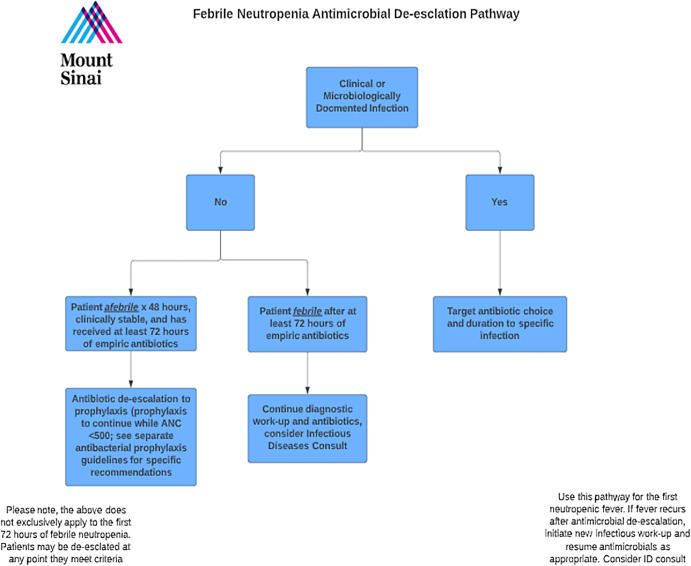 Figure 1
Peer Reviews
No public reviews on file for this paper yet. If you reviewed it on a platform where reviews are public (OpenReview, ICLR, NeurIPS, ICML), you can paste yours below so the community can read it here.
Videos
No videos yet. Explain this paper in a talk, walkthrough, or lecture? Add one.
Taxonomy
TopicsNeutropenia and Cancer Infections · Blood disorders and treatments · Sepsis Diagnosis and Treatment