Direct insertion of the posterior cruciate ligament tibial attachment and its relationship with the medial meniscus: A histological study
Akihiro Yamashita, Kosuke Tabuchi, Ryuki Hashida, Keishiro Kikuchi, Shotaro Kinouchi, Seiichi Inoue, Takashi Soejima, Akira Maeda, Shuji Horibe, Koichi Watanabe, Takahiro Okawa, Koji Hiraoka

TL;DR
This study uses histological analysis to determine the tibial attachment of the posterior cruciate ligament and its relationship with the medial meniscus, providing insights for surgical procedures.
Contribution
The study provides new histological data on the direct insertion of the posterior cruciate ligament and its anatomical relationship with the medial meniscus.
Findings
The tibial insertion of the posterior cruciate ligament is shorter than previously reported in gross anatomical studies.
Direct insertion in slice 2 correlates with medial anteroposterior length.
The medial meniscus posterior root is adjacent to the anterior edge of the PCL tibial insertion in the sagittal plane.
Abstract
In this study, we aimed to identify the direct insertion of the tibial attachment of the posterior cruciate ligament (PCL) using histological examination and evaluate its anatomical relationship with the medial meniscus (MM). Twenty‐one formalin‐fixed cadaveric knees were examined. The PCL tibial attachment was analysed in sagittal (slices 1, 2 and 3) and coronal (slices 4, 5, 6 and 7) sections. Hematoxylin and eosin and Masson's trichrome staining were used for tissue evaluation. The tibial insertion length and direct insertion length were measured using ImageJ software. The relationship between direct insertion and anatomical parameters was analysed using Spearman's correlation coefficient. The mean medial anteroposterior length was 52.1 ± 3.7 mm. The mean tibial insertion lengths of the PCL were 9.8 ± 1.7 mm (slice 1), 10.8 ± 1.1 mm (slice 2) and 8.5 ± 0.9 mm (slice 3). The mean…
Genes, proteins, chemicals, diseases, species, mutations and cell lines named across the full text — each resolved to its canonical identifier and authoritative record.
Click any figure to enlarge with its caption.
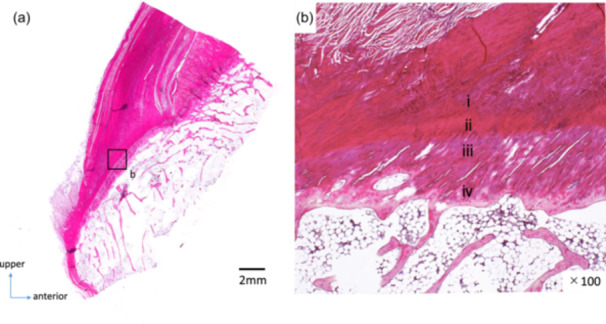 Figure 1
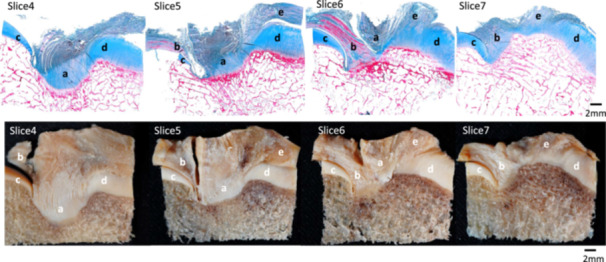 Figure 2
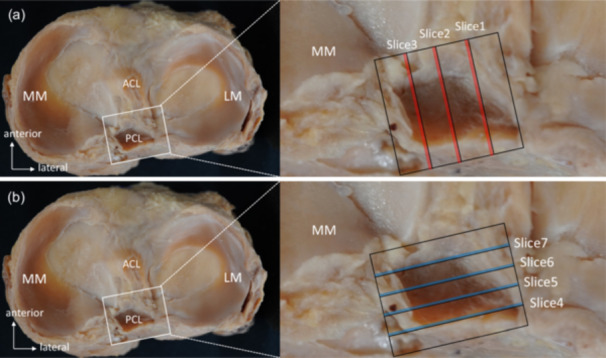 Figure 3
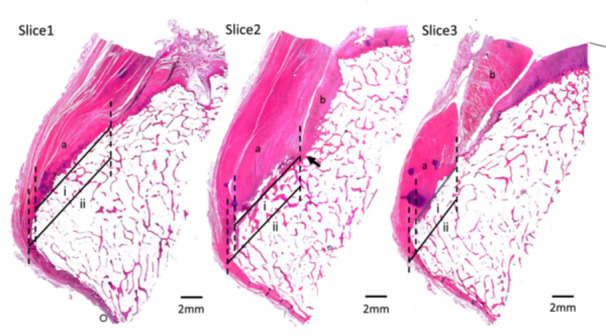 Figure 4
Peer Reviews
No public reviews on file for this paper yet. If you reviewed it on a platform where reviews are public (OpenReview, ICLR, NeurIPS, ICML), you can paste yours below so the community can read it here.
Videos
No videos yet. Explain this paper in a talk, walkthrough, or lecture? Add one.
Taxonomy
TopicsKnee injuries and reconstruction techniques · Total Knee Arthroplasty Outcomes · Osteoarthritis Treatment and Mechanisms