The application of Electrochemiluminescence Immunoassay (ECLIA) in the detection of HIV infectious markers in blood screening
Song He-Wei, Shen Xin-Tang, Hao Yi-Wei, Zuo Bin

TL;DR
This study compares ECLIA with ELISA and Western blot for detecting HIV in blood donors, showing ECLIA's superior accuracy and reliability.
Contribution
Demonstrates ECLIA's higher specificity and agreement with confirmatory tests, supporting its adoption for HIV blood screening.
Findings
ECLIA showed 81.25% sensitivity and 96.49% specificity in detecting HIV.
ECLIA had higher positive and negative predictive values compared to ELISA.
ECLIA demonstrated excellent agreement with Western blot confirmatory results.
Abstract
This study aimed to analyze ELISA, ECLIA, and Western blot (WB) confirmatory test results for HIV-reactive blood donors, compare ECLIA with fourth-generation ELISA reagents, assess the feasibility of using ECLIA for HIV screening, and provide statistical evidence supporting its adoption in blood collection and supply institutions. The cross-sectional study was conducted in the Laboratory Department of Yantai Central Blood Station, Shandong, China, from January, 2021 to December, 2023. A total of 130 HIV screening-reactive specimens with ELISA signal-to-cut-off (S/CO) ratios between 0.3 and 0.7 were subjected to ECLIA. Specimens with ELISA S/CO≥1.0, HIV RNA reactivity, or ECLIA S/CO>1 were sent to the Centers for Disease Control (CDC) for WB confirmatory testing. The results were comprehensively analyzed and compared. Among the 130 reactive specimens, 17 tested positive by ECLIA, while…
Genes, proteins, chemicals, diseases, species, mutations and cell lines named across the full text — each resolved to its canonical identifier and authoritative record.
Click any figure to enlarge with its caption.
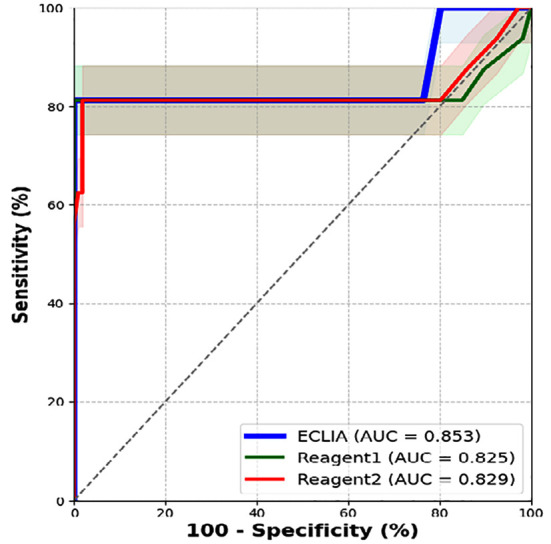 Figure 1
Peer Reviews
No public reviews on file for this paper yet. If you reviewed it on a platform where reviews are public (OpenReview, ICLR, NeurIPS, ICML), you can paste yours below so the community can read it here.
Videos
No videos yet. Explain this paper in a talk, walkthrough, or lecture? Add one.
Taxonomy
TopicsAdvanced biosensing and bioanalysis techniques · Biosensors and Analytical Detection · Advanced Biosensing Techniques and Applications