The relationship between clinical features and treatment options in sigmoid volvulus: Experience of 59 years and 1,096 patients
Enes Agirman, Rifat Peksoz, Esra Disci, Sabri Selcuk Atamanalp

TL;DR
This study examines which clinical features indicate the need for emergency surgery in patients with sigmoid volvulus, based on data from over 1,000 patients.
Contribution
The study identifies specific clinical indicators that predict the need for emergency surgery in sigmoid volvulus cases.
Findings
Nonoperative detorsion was more common in patients without a history of volvulus and with shorter symptom duration.
Gangrenous stool and rebound tenderness/muscular rigidity were absolute indicators for emergency surgery.
Hyperkinetic bowel sound and empty rectum were more common in patients treated nonoperatively.
Abstract
In sigmoid volvulus (SV), nonoperative detorsion is the first treatment option, while some complicated patients require emergency surgery. The purpose of this study was to utilize the clinical features requiring emergency surgery in SV. Among total 1,096 patients with SV, the records of 813 cases (74.2%) treated with nonoperative detorsion and 492 patients (44.9%) required emergency surgery were evaluated in a partial retrospective and prospective scanning. Previous volvulus history was more common (34.7% vs. 26.2%, respectively, p<0.005), mean symptom period was shorter (23.9 hours vs. 47.5 hours, respectively, p<0.001), the rates of vomiting (62.7% vs. 75.2%, respectively, p<0.001), hypokinetic/akinetic bowel sound (37.3% vs. 48.0%, respectively, p<0.001) and shock (1.3% vs. 22.2%, respectively, p<0.001) were lower, while the rates of hyperkinetic bowel sound (35.3% vs. 20.1%,…
Genes, proteins, chemicals, diseases, species, mutations and cell lines named across the full text — each resolved to its canonical identifier and authoritative record.
Click any figure to enlarge with its caption.
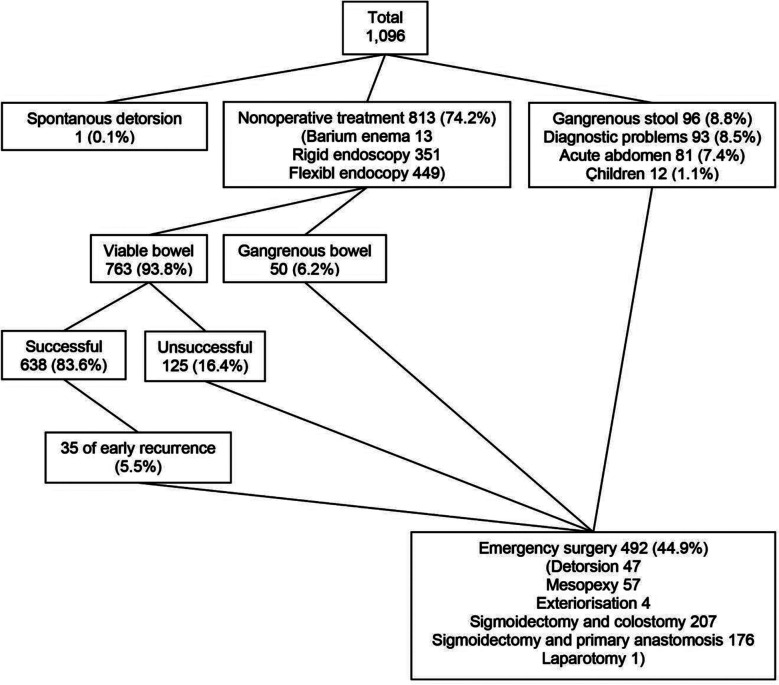 Figure 1
Peer Reviews
No public reviews on file for this paper yet. If you reviewed it on a platform where reviews are public (OpenReview, ICLR, NeurIPS, ICML), you can paste yours below so the community can read it here.
Videos
No videos yet. Explain this paper in a talk, walkthrough, or lecture? Add one.
Taxonomy
TopicsIntestinal Malrotation and Obstruction Disorders · Intestinal and Peritoneal Adhesions · Esophageal and GI Pathology