Large magnetic resonance imaging‐based medial posterior tibial slope is associated with time‐dependent worsening of rotational knee laxity after anterior cruciate ligament reconstruction
Kensaku Abe, Hiroaki Fukushima, Shunta Hanaki, Kyohei Ota, Makoto Kobayashi, Yusuke Kawanishi, Jiro Kato, Satoru Demura, Hideki Murakami, Masahiro Nozaki

TL;DR
A large medial posterior tibial slope is linked to worsening knee instability after ACL surgery, suggesting preoperative assessment could help improve surgical outcomes.
Contribution
This study identifies a specific tibial slope morphology associated with postoperative rotational knee laxity, offering a new preoperative risk factor for ACL reconstruction outcomes.
Findings
Large medial posterior tibial slope (≥9.05°) was significantly associated with increased rotational laxity postoperatively.
No significant associations were found between tibial slope and intraoperative or preoperative laxity measurements.
The findings suggest that tibial slope morphology may influence the onset of laxity after ACL reconstruction.
Abstract
To examine the relationship between posterior tibial slope (PTS) and knee laxity before, during and after anterior cruciate ligament (ACL) reconstruction, using anterior tibial translation (ATT) measured as an arthrometer‐based side‐to‐side difference and rotational laxity assessed during the pivot shift test via clinical grade and inertial sensor–based measurements of tibial acceleration and external rotational angular velocity (ERAV). This retrospective cohort study assessed patients who underwent primary ACL reconstruction with subsequent hardware removal. Medial PTS (MPTS), lateral PTS (LPTS) and slope asymmetry ( | MPTS–LPTS | ) were measured using magnetic resonance imaging. Based on a recent review, binary strata were defined as MPTS ≥ 9.05° versus <9.05° and LPTS ≥ 9.55° versus <9.55°, and comparisons were performed accordingly. Knee laxity was evaluated at three time points:…
Genes, proteins, chemicals, diseases, species, mutations and cell lines named across the full text — each resolved to its canonical identifier and authoritative record.
Click any figure to enlarge with its caption.
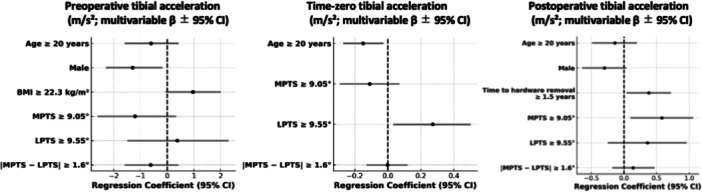 Figure 1
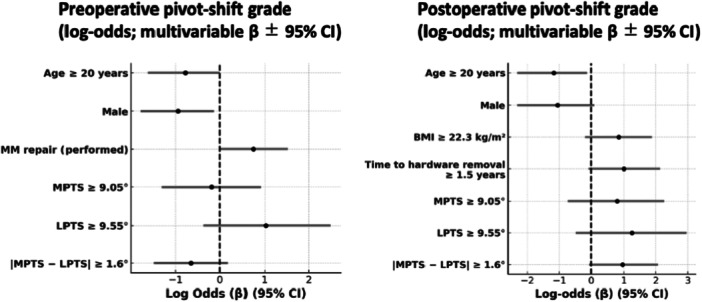 Figure 2
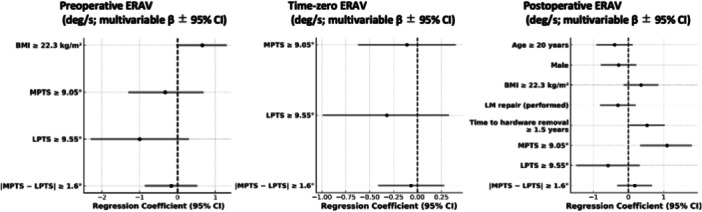 Figure 3
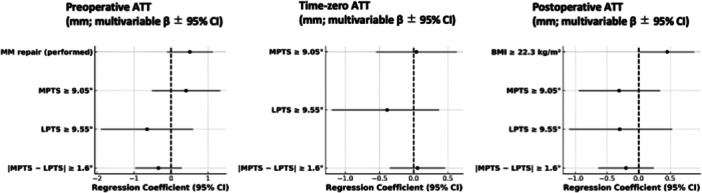 Figure 4
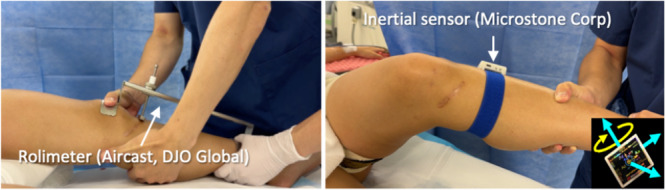 Figure 5
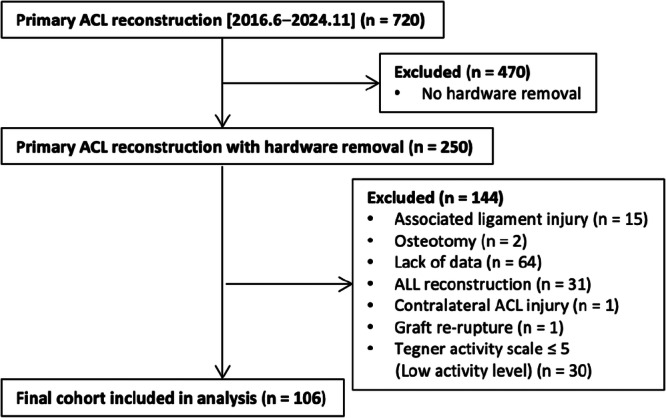 Figure 6
Peer Reviews
No public reviews on file for this paper yet. If you reviewed it on a platform where reviews are public (OpenReview, ICLR, NeurIPS, ICML), you can paste yours below so the community can read it here.
Videos
No videos yet. Explain this paper in a talk, walkthrough, or lecture? Add one.
Taxonomy
TopicsKnee injuries and reconstruction techniques · Total Knee Arthroplasty Outcomes · Lower Extremity Biomechanics and Pathologies