Low diagnostic yield of repeat urine cultures in hospitalized patients at a tertiary center in Northern California, 2023–2024
Eugenia Miranti, Mindy M. Sampson, John Shepard, Guillermo Rodriguez-Nava, Karen McIntyre, Erika Paola Viana Cardenas, Barbara W. Trautner, Jorge L. Salinas

TL;DR
Repeat urine cultures in hospitalized patients often provide little new information, regardless of initial results or timing.
Contribution
The study reveals that repeat urine cultures within six days rarely yield new diagnostic insights in hospitalized patients.
Findings
Repeat urine cultures within six days provided redundant information regardless of initial culture results.
Diagnostic yield was low even when adjusting positivity thresholds to 10,000 or 100,000 CFU/mL.
Abstract
We analyzed the diagnostic yield of repeat urine cultures in a retrospective study of adult inpatients. Most urine cultures repeated at less than 6 days provided redundant information. This was true whether the index culture was positive or negative, and whether the threshold for positivity was 10,000 or 100,000 CFU/mL.
Genes, proteins, chemicals, diseases, species, mutations and cell lines named across the full text — each resolved to its canonical identifier and authoritative record.
Click any figure to enlarge with its caption.
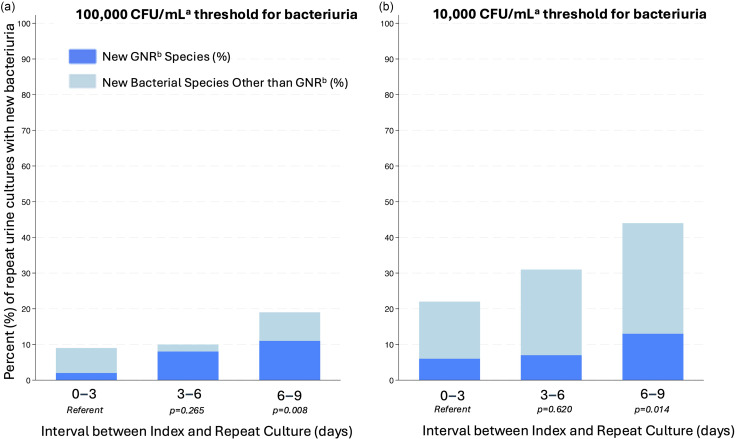 Figure 1
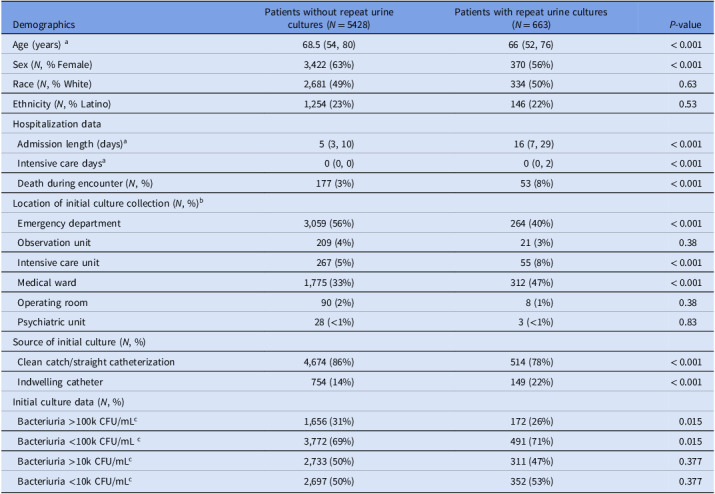 Figure 2
Peer Reviews
No public reviews on file for this paper yet. If you reviewed it on a platform where reviews are public (OpenReview, ICLR, NeurIPS, ICML), you can paste yours below so the community can read it here.
Videos
No videos yet. Explain this paper in a talk, walkthrough, or lecture? Add one.
Taxonomy
TopicsUrinary Tract Infections Management · Pediatric Urology and Nephrology Studies · Clinical Laboratory Practices and Quality Control