Large deletions in the F8 gene predict immune tolerance induction failure in people with severe hemophilia A
Ilja Oomen, Amal Abdi, Linda Broer, Ricardo M. Camelo, Fábia M.R.A. Callado, Luany E.M. Carvalho, Ilenia L. Calcaterra, Manuel Carcao, Giancarlo Castaman, Jeroen C.J. Eikenboom, Kathelijn Fischer, Vivian K.B. Franco, Judy Geissler, Taco W. Kuijpers, Frank W.G. Leebeek

TL;DR
Large deletions in the F8 gene are linked to a lower chance of successful immune tolerance induction in people with severe hemophilia A.
Contribution
This study identifies F8 large deletions as a novel genetic predictor of immune tolerance induction failure in hemophilia A patients.
Findings
F8 large deletions were negatively associated with immune tolerance induction success (odds ratio, 0.15).
No single nucleotide polymorphisms or HLA variants were found to predict ITI success.
The study included 204 participants, with 72.1% achieving successful immune tolerance induction.
Abstract
Immune tolerance induction (ITI) is the only treatment to eradicate inhibitors in people with severe hemophilia A (SHA). Successful ITI restores factor VIII (FVIII) tolerance. ITI is demanding and successful in approximately 70% of people. Identifying predictors of ITI outcome is essential to guide clinical decision making. We aimed to identify genetic predictors of ITI success in people with SHA and inhibitors who underwent ITI. This observational multicenter study included people with SHA who underwent ITI, between 2015 and 2023. Clinical and patient data, including FVIII gene (F8) mutation type, and DNA samples were collected. Successful ITI was defined by a negative inhibitor titer and an adequate response to FVIII concentrates. By employing a global screening array, the associations between ITI success and F8 genotype and 216 candidate predictors, including single nucleotide…
Genes, proteins, chemicals, diseases, species, mutations and cell lines named across the full text — each resolved to its canonical identifier and authoritative record.
Click any figure to enlarge with its caption.
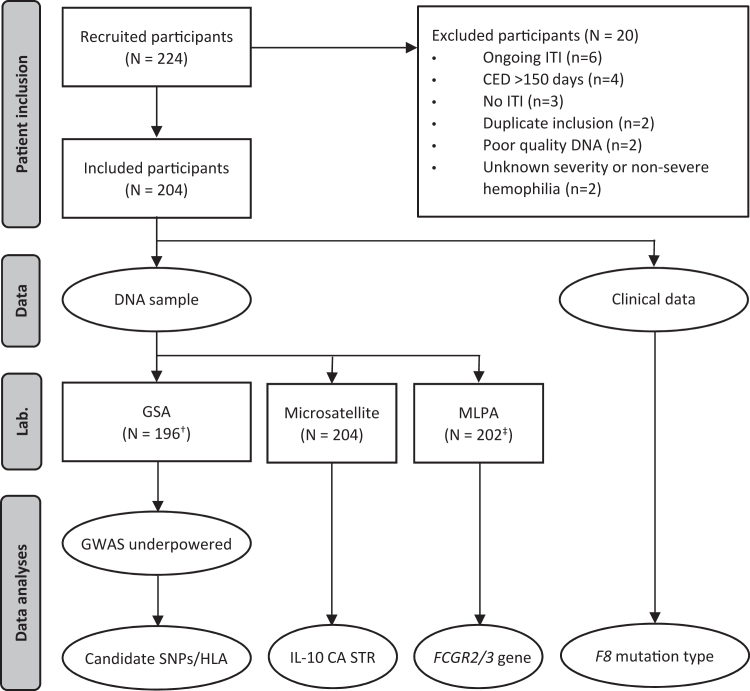 Figure 1
Peer Reviews
No public reviews on file for this paper yet. If you reviewed it on a platform where reviews are public (OpenReview, ICLR, NeurIPS, ICML), you can paste yours below so the community can read it here.
Videos
No videos yet. Explain this paper in a talk, walkthrough, or lecture? Add one.
Taxonomy
TopicsHemophilia Treatment and Research · Myeloproliferative Neoplasms: Diagnosis and Treatment · Hepatitis C virus research