Double-chirped mirrors expand the bandwidth of infrared frequency combs
Jacob B. Khurgin

TL;DR
This paper introduces a new method using double-chirped mirrors to improve the performance of infrared lasers for precise measurements.
Contribution
The use of double-chirped Bragg mirrors for dispersion compensation in quantum cascade lasers is novel.
Findings
Double-chirped mirrors enable stable and broadband frequency combs in mid-infrared lasers.
The new scheme enhances the bandwidth for high-precision spectroscopy and metrology applications.
Abstract
A novel dispersion-compensation scheme based on double-chirped Bragg mirrors is implemented in a mid-infrared quantum cascade laser. As a result, stable and broadband frequency combs are generated, which are indispensable for high-precision applications in spectroscopy and metrology.
Genes, proteins, chemicals, diseases, species, mutations and cell lines named across the full text — each resolved to its canonical identifier and authoritative record.
Click any figure to enlarge with its caption.
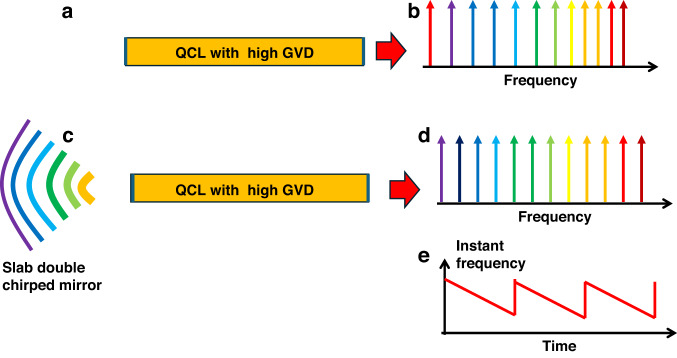 Figure 1
Peer Reviews
No public reviews on file for this paper yet. If you reviewed it on a platform where reviews are public (OpenReview, ICLR, NeurIPS, ICML), you can paste yours below so the community can read it here.
Videos
No videos yet. Explain this paper in a talk, walkthrough, or lecture? Add one.
Taxonomy
TopicsSpectroscopy and Laser Applications · Advanced Fiber Laser Technologies · Photonic Crystal and Fiber Optics