Dynamic biomarker trajectories in the first 72 h after infarct-related cardiac arrest: a novel approach to early risk stratification
Julian Mohsennia, Sophia Neschen, Joshua Boettel, Steffen Desch, Youssef Abdelwahed, Tobias Petzold, Andi Rroku, Eva-Maria Dorsch, Georg Girke, Benjamin O’Brien, Ulf Landmesser, Carsten Skurk, Tharusan Thevathasan

TL;DR
This study introduces a new method using dynamic biomarker patterns in the first 72 hours after a heart attack-related cardiac arrest to better predict patient outcomes.
Contribution
The novel approach uses serial biomarker trajectories and machine learning to improve early risk stratification after cardiac arrest.
Findings
Survivors and non-survivors showed distinct biomarker patterns by day three post-arrest.
Dynamic biomarker changes over 72 hours independently predicted mortality.
Machine learning techniques like t-SNE revealed outcome-related separations in patient profiles.
Abstract
Central Illustration. Trajectory of biomarker levels following infarct-related cardiac arrest. (A) Radar plots illustrate the relationship between biomarker levels and in-hospital outcomes from day one to day three following infarct-related cardiac arrest. The dashed black line represents the overall cohort mean (set to 0), with each concentric grey ring denoting 0.1 standard deviation increments. Biomarker values for survivors are shown as a green line, while those for non-survivors are shown in red. Deviations above the cohort mean extend beyond the dashed line, while below-average values fall within it, allowing visual comparison of multivariate biomarker profiles over time. (B) The t-distributed stochastic neighbor embedding (t-SNE) algorithm is a dimensionality reduction technique that transforms complex, high-dimensional biomarker data into a two-dimensional space for visual…
Genes, proteins, chemicals, diseases, species, mutations and cell lines named across the full text — each resolved to its canonical identifier and authoritative record.
Click any figure to enlarge with its caption.
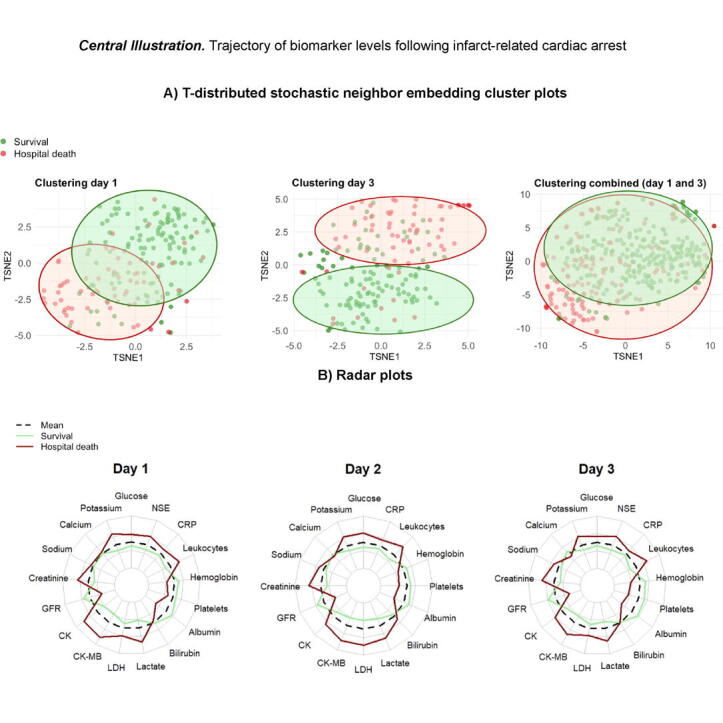 Figure 1
 Figure 2
 Figure 3
Peer Reviews
No public reviews on file for this paper yet. If you reviewed it on a platform where reviews are public (OpenReview, ICLR, NeurIPS, ICML), you can paste yours below so the community can read it here.
Videos
No videos yet. Explain this paper in a talk, walkthrough, or lecture? Add one.
Taxonomy
TopicsCardiac Arrest and Resuscitation · Acute Myocardial Infarction Research · Mechanical Circulatory Support Devices