Twin differences in the Minnesota Trust Game relate to neural mechanisms of suspiciousness
Rebecca Kazinka, Anita N. D. Kwashie, Danielle N. Pratt, Iris Vilares, William G. Iacono, Sylia Wilson, Angus W. MacDonald

TL;DR
This study explores how neural activity in the lateral OFC relates to suspiciousness and perceptions of spite in social interactions.
Contribution
The study identifies a potential causal link between lateral OFC activity, spite sensitivity, and persecutory ideation using a co-twin control design.
Findings
Higher persecutory ideation correlates with lower trust in fair partner behavior.
Increased beliefs of a partner's spitefulness are linked to higher reported persecution.
Twin differences in left lateral OFC activation are associated with spite sensitivity.
Abstract
Spite sensitivity, or the fear that a person is willing to intentionally take a loss to ensure that another person will as well, may be a key component in understanding persecutory ideation (the belief that others want to harm you). We implemented a co-twin control design to examine potentially causal relationships among persecutory ideation, spite sensitivity, and neural activity and connectivity. Sixty-nine participants (23 monozygotic twin pairs and an additional 23 unpaired monozygotic twins) completed the Minnesota Trust Game—a social decision-making game played asynchronously with an anonymous partner that targets spite sensitivity by varying the incentives of the partner. Participants with more self-reported persecutory ideation (relative to those with lower persecutory ideation) trusted less even when the partner was incentivized to be fair. Similarly, computational modeling…
Genes, proteins, chemicals, diseases, species, mutations and cell lines named across the full text — each resolved to its canonical identifier and authoritative record.
Click any figure to enlarge with its caption.
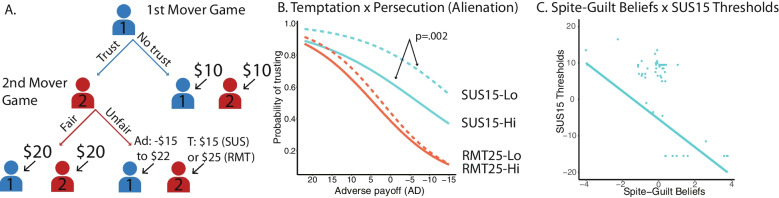 Figure 1
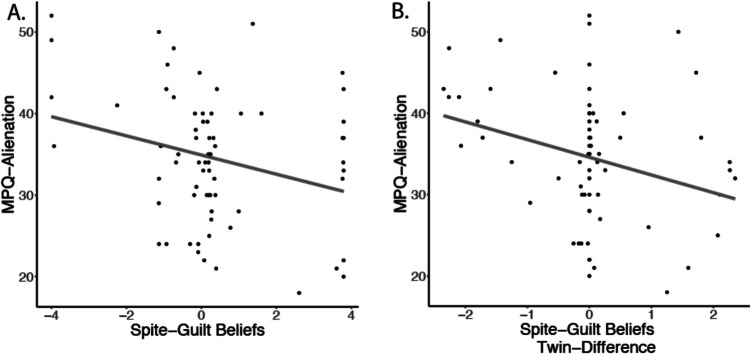 Figure 2
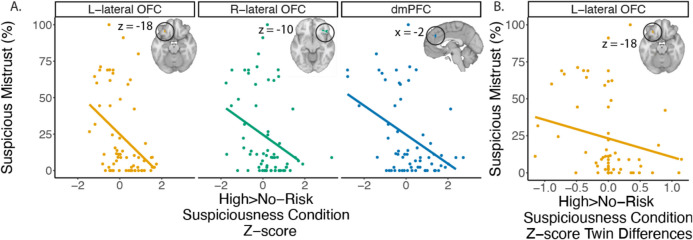 Figure 3
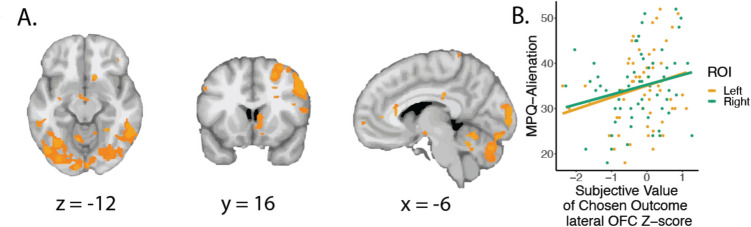 Figure 4
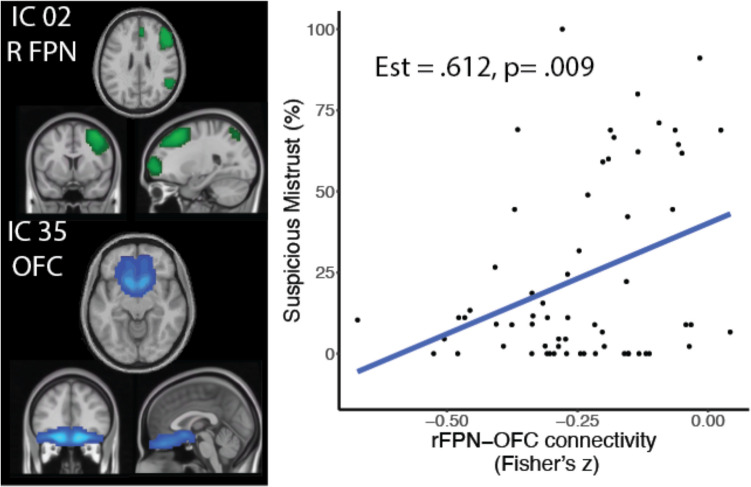 Figure 5
Peer Reviews
No public reviews on file for this paper yet. If you reviewed it on a platform where reviews are public (OpenReview, ICLR, NeurIPS, ICML), you can paste yours below so the community can read it here.
Videos
No videos yet. Explain this paper in a talk, walkthrough, or lecture? Add one.
Taxonomy
TopicsNeural and Behavioral Psychology Studies · Decision-Making and Behavioral Economics · Experimental Behavioral Economics Studies