Born to act: Deferred action and desire as active inference
Valery Krupnik

TL;DR
The paper explores how desire and deferred action can be integrated into the active inference framework, suggesting implications for understanding brain function and psychopathology.
Contribution
The paper introduces a novel hierarchical model of desire as a form of inference and connects it to brain networks and psychopathology.
Findings
Desire can be modeled as hierarchical inference involving affective charge and action policy precision.
Deferred action is central to desire and involves affect-dependent awareness across timescales.
Psychopathologies like OCD and depression may result from malfunctions in deferred action and desire.
Abstract
The active inference framework (AIF) considers the brain as a generative model guiding behavior under the imperative of minimizing the model’s variational free energy. Computationally, this is accomplished by hierarchical Bayesian inference. The theory views organisms as doxastic agents, which has drawn the criticism of being insufficient to explain conative agents motivated by desire. Specifically, it has been noted that the concept of desire is not isomorphic with belief and, therefore, fits poorly with AIF. In this paper, we build on previous work that suggests a path to integrating conation in AIF and present three arguments. First, the dichotomy between belief and desire is unnecessary. To that end, we define desire as a hierarchical inference that starts from a domain-general inference on the agent’s affective dynamics (affective charge) and descends to contextualized inference on…
Genes, proteins, chemicals, diseases, species, mutations and cell lines named across the full text — each resolved to its canonical identifier and authoritative record.
Click any figure to enlarge with its caption.
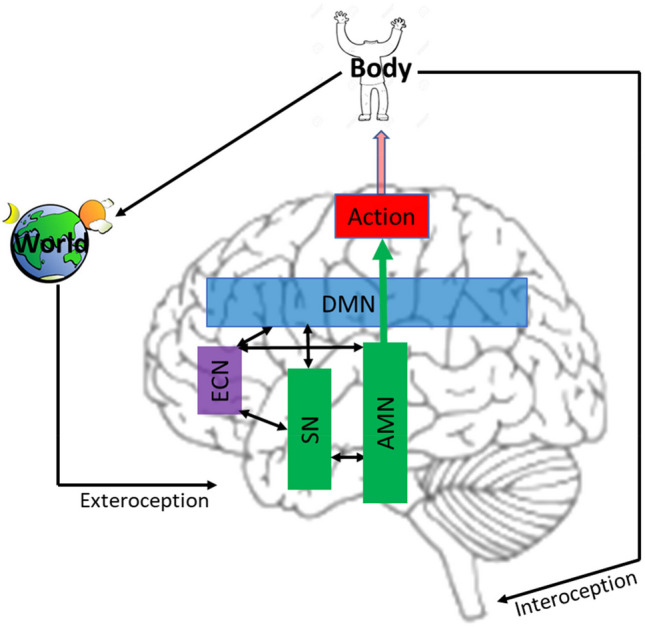 Figure 1
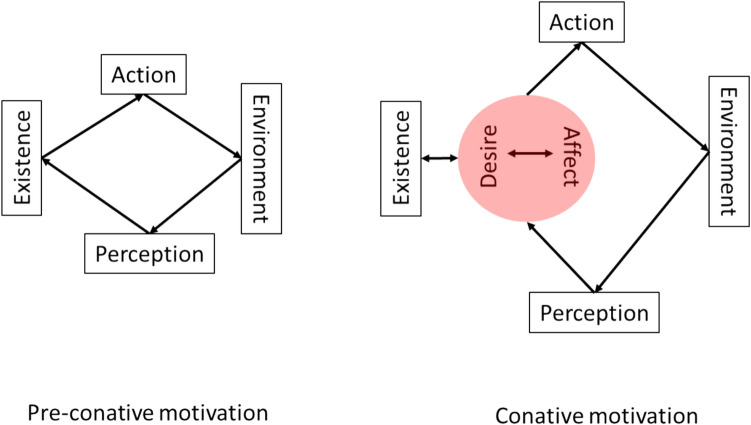 Figure 2
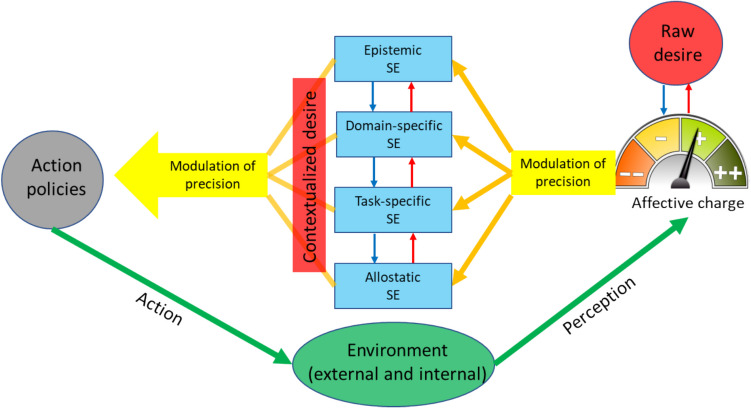 Figure 3
Peer Reviews
No public reviews on file for this paper yet. If you reviewed it on a platform where reviews are public (OpenReview, ICLR, NeurIPS, ICML), you can paste yours below so the community can read it here.
Videos
No videos yet. Explain this paper in a talk, walkthrough, or lecture? Add one.
Taxonomy
TopicsEmbodied and Extended Cognition · Mental Health and Psychiatry · Neural dynamics and brain function