Super and deepened-extinction in human predictive learning and a comparison of associative models
Ovidiu Brudan, Hedwig Eisenbarth, Steven Glautier

TL;DR
This study compares extinction techniques for reducing relapse in cue-exposure therapy and finds that super-extinction leads to more recovery than standard methods.
Contribution
The study evaluates super and deepened-extinction protocols and provides new insights into their effectiveness compared to standard extinction.
Findings
Super-extinction produced more response recovery than single-cue extinction.
Configural associative models better explain the results than elemental models.
The Pearce configural model outperformed the configural Rescorla–Wagner model.
Abstract
Cue-exposure is a treatment (e.g. for addictions and phobias) that aims to extinguish conditioned responses to target cues. However, especially in the case of addiction, relapse still occurs after cue-exposure and this may be due to recovery of conditioned responses outside of the extinction context. Super-extinction and deepened-extinction are two compound-cue extinction procedures which have been assessed for their capacity to produce more robust extinction than standard single-cue extinction procedures. We carried out further assessment of super and deepened-extinction protocols but found no evidence that they produced less response recovery compared to single-cue extinction. Contrariwise, super-extinction actually produced more recovery than the other two conditions. These results can be understood in terms of configural associative models (configural Rescorla–Wagner and Pearce…
Genes, proteins, chemicals, diseases, species, mutations and cell lines named across the full text — each resolved to its canonical identifier and authoritative record.
Click any figure to enlarge with its caption.
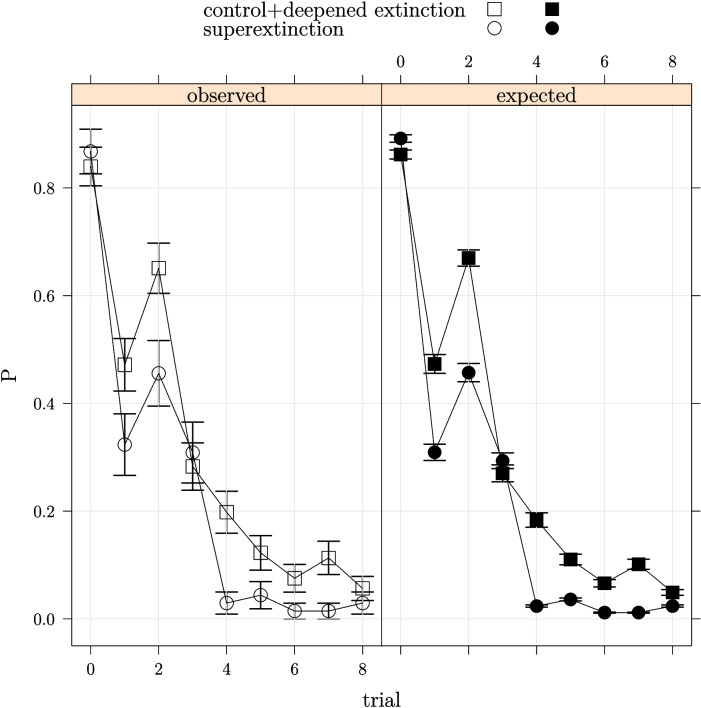 Figure 1
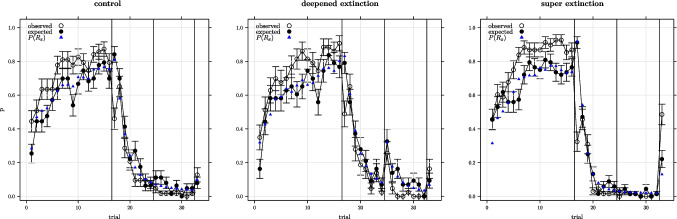 Figure 2
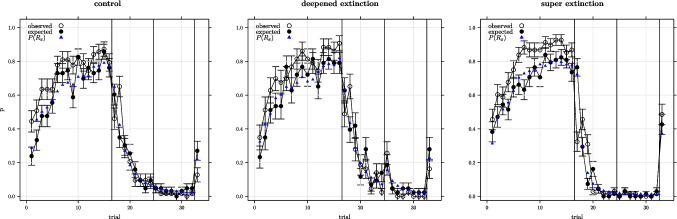 Figure 3
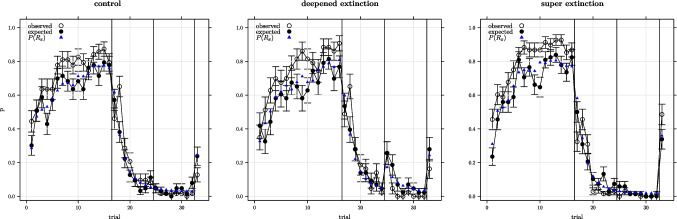 Figure 4
Peer Reviews
No public reviews on file for this paper yet. If you reviewed it on a platform where reviews are public (OpenReview, ICLR, NeurIPS, ICML), you can paste yours below so the community can read it here.
Videos
No videos yet. Explain this paper in a talk, walkthrough, or lecture? Add one.
Taxonomy
TopicsMemory and Neural Mechanisms · Mental Health Research Topics · Neurotransmitter Receptor Influence on Behavior