The impact of swimming coaches’ authentic leadership coaching on trust, self-efficacy, service quality, and relationship continuity intention
Buom Kim

TL;DR
This study shows how authentic leadership by swimming coaches in South Korea boosts trust, self-efficacy, and service quality, which helps keep adult swimmers engaged.
Contribution
The study reveals that authentic leadership indirectly affects relationship continuity intention through self-efficacy and service quality in community sports.
Findings
Authentic leadership significantly increases coach trust, self-efficacy, and service quality.
Self-efficacy and service quality mediate the relationship between trust and relationship continuity intention.
The model fit was strong, showing reliable relationships among the variables.
Abstract
This study investigates how swimming coaches’ authentic leadership influences trust, self-efficacy, service quality, and relationship continuity intention among adult recreational swimmers in South Korea. Using structural equation modeling (SEM), it aims to provide insights for enhancing leadership practices in community sports. A total of 280 adult recreational swimmers participated in the survey, using validated scales on a 5-point Likert scale. Structural equation modeling and bootstrapping with 5,000 resamples were employed to analyze the relationships among authentic leadership, trust, self-efficacy, service quality, and relationship continuity intention. The SEM analysis demonstrated excellent model fit (χ2/df = 2.41, CFI = 0.95, TLI = 0.94, RMSEA = 0.059). Authentic leadership significantly influenced coach trust, which in turn positively affected self-efficacy and service…
Genes, proteins, chemicals, diseases, species, mutations and cell lines named across the full text — each resolved to its canonical identifier and authoritative record.
Click any figure to enlarge with its caption.
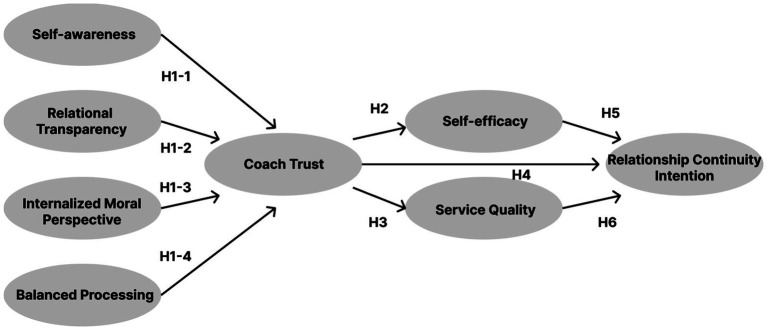 Figure 1
Peer Reviews
No public reviews on file for this paper yet. If you reviewed it on a platform where reviews are public (OpenReview, ICLR, NeurIPS, ICML), you can paste yours below so the community can read it here.
Videos
No videos yet. Explain this paper in a talk, walkthrough, or lecture? Add one.
Taxonomy
TopicsSport Psychology and Performance · Youth Development and Social Support · Athletic Training and Education