Editorial: Bioinformatics and systems biology strategies in disease management with a special emphasis on cancer, Alzheimer’s disease and aging
Tiratha Raj Singh, Brigitte Vannier, Ragini Raj Singh, Hari Om Yadav, Holger Fröhlich

TL;DR
The paper discusses how bioinformatics and systems biology can help manage diseases like cancer and Alzheimer's through advanced data and modeling techniques.
Contribution
It emphasizes the integration of multi-omics data and computational approaches for translational applications in disease management.
Findings
Multi-omics data and computational modeling are key for understanding complex diseases.
Network analysis and nanotechnology offer new diagnostic and therapeutic strategies.
A circular process between concepts and applications enhances translational research.
Abstract
Bioinformatics and systems biology strategies for managing cancer and Alzheimer's disease. Key concepts include multi-omics data, computational modeling, network analysis, and nanotechnology. Translational applications cover diagnostics, prognostics, and therapeutics. Arrows suggest a circular process between concepts and applications.
Genes, proteins, chemicals, diseases, species, mutations and cell lines named across the full text — each resolved to its canonical identifier and authoritative record.
Click any figure to enlarge with its caption.
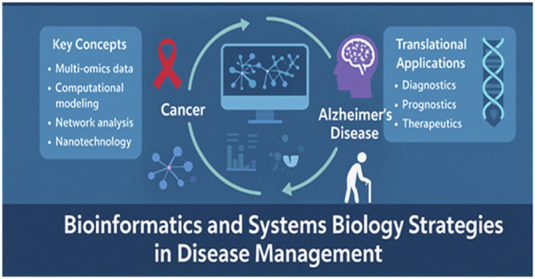 Figure 1
Peer Reviews
No public reviews on file for this paper yet. If you reviewed it on a platform where reviews are public (OpenReview, ICLR, NeurIPS, ICML), you can paste yours below so the community can read it here.
Videos
No videos yet. Explain this paper in a talk, walkthrough, or lecture? Add one.
Taxonomy
TopicsCancer-related cognitive impairment studies · GDF15 and Related Biomarkers · Biological Research and Disease Studies