Trends in healthcare-associated infections and antimicrobial-resistant organisms among adults in Canadian acute care hospitals: findings from four point prevalence surveys, 2002 to 2024
Robyn Mitchell, Diane Lee, Jessica Bartoszko, Cassandra Lybeck, Marie-Ève Benoit, Jeannette Comeau, Jennifer Ellison, Charles Frenette, Jennifer Happe, Nicole Haslam, Bonita Lee, Dominik Mertz, Stephanie W. Smith, Daniel Thirion, Alice Wong, Michelle Science, Susy Hota

TL;DR
This study tracks changes in hospital infections and antibiotic resistance in Canada from 2002 to 2024, showing some increases despite pandemic challenges.
Contribution
The study provides the first comprehensive trend analysis of HAIs and AROs in Canadian hospitals over two decades using repeated point prevalence surveys.
Findings
The prevalence of healthcare-associated infections (HAIs) increased from 10.4% in 2002 to 12.4% in 2009 but decreased to 8.4% in 2017 and stabilized at 8.1% in 2024.
There was a significant increase in central line-associated bloodstream infections (CLABSIs) and viral respiratory infections (VRIs) between 2017 and 2024.
Antimicrobial-resistant organisms (AROs) were responsible for 6.6% of infections in 2024.
Abstract
To describe trends in the prevalence of healthcare-associated infections (HAIs) and antibiotic-resistant organisms (AROs) in Canadian acute-care hospitals. Repeated point prevalence surveys. Canadian Nosocomial Infection Surveillance Program (CNISP) hospitals. Trained infection control professionals reviewed medical records of eligible adult patients and applied standardized definitions to collect demographic data and information on HAIs, AROs, and additional precautions from 39 to 62 hospitals in 2002, 2009, 2017, and 2024. The prevalence of adult patients with at least one HAI increased from 10.4% (95% CI: 9.6%–11.2%) in 2002 to 12.4% (95% CI: 11.7%–13.2%) in 2009, declined to 8.4% (95% CI: 7.8%–9.0%) in 2017, and stabilized in 2024 (8.1%, 95% CI: 7.6%–8.6%) despite 3.1% of HAIs being due to SARS-CoV-2. Between 2017 and 2024, there were increases in bloodstream infections (1.0% to…
Genes, proteins, chemicals, diseases, species, mutations and cell lines named across the full text — each resolved to its canonical identifier and authoritative record.
Click any figure to enlarge with its caption.
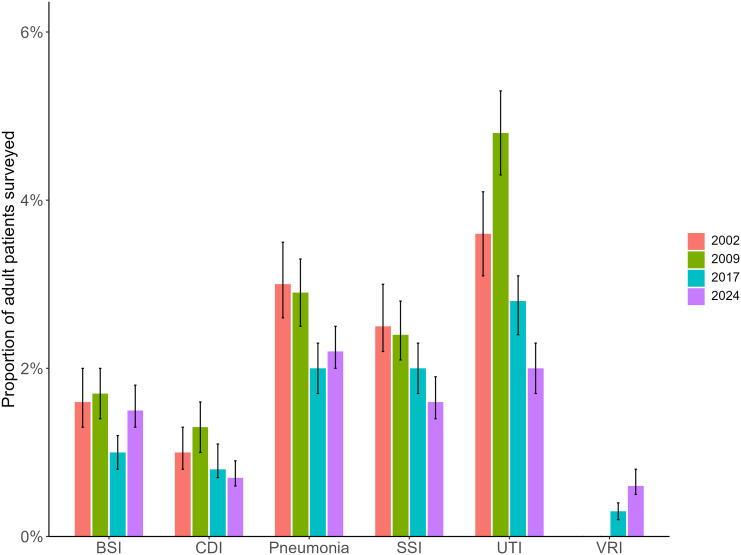 Figure 1
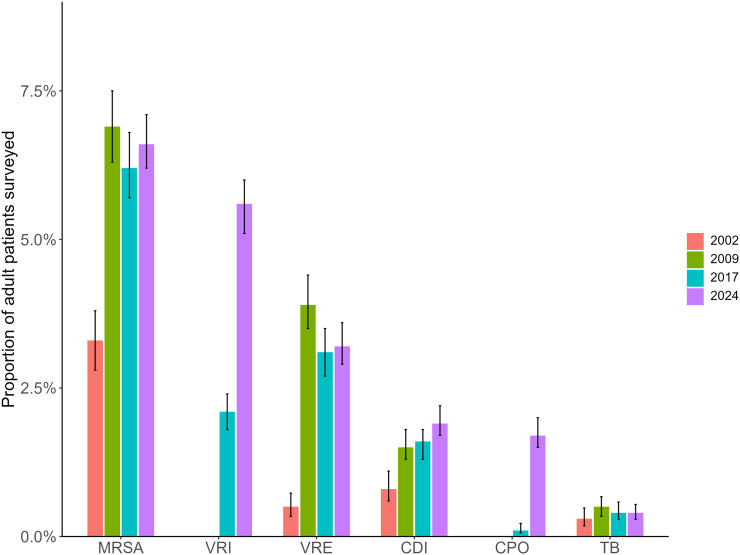 Figure 2
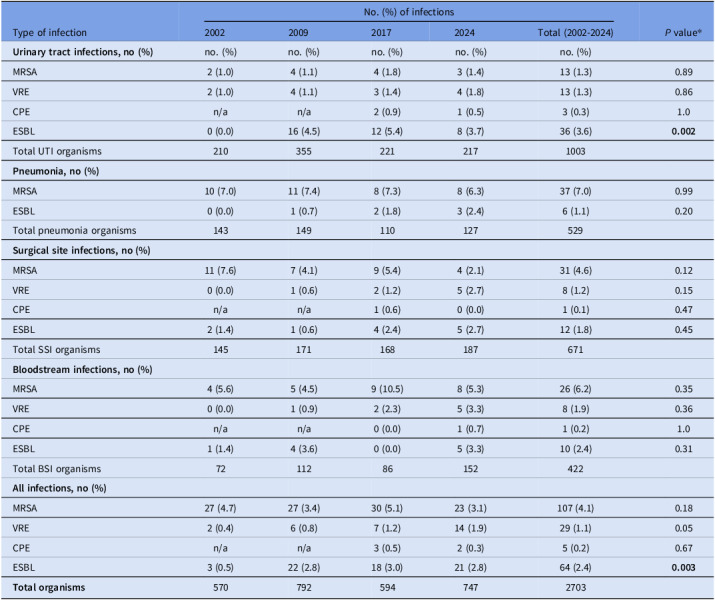 Figure 3
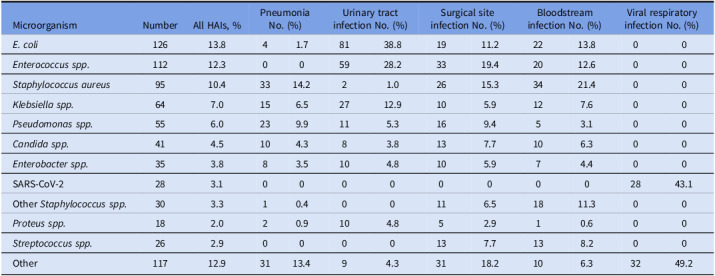 Figure 4
Peer Reviews
No public reviews on file for this paper yet. If you reviewed it on a platform where reviews are public (OpenReview, ICLR, NeurIPS, ICML), you can paste yours below so the community can read it here.
Videos
No videos yet. Explain this paper in a talk, walkthrough, or lecture? Add one.
Taxonomy
TopicsAntibiotic Use and Resistance · Antimicrobial Resistance in Staphylococcus · Bacterial Identification and Susceptibility Testing