Chronic Anaphylaxis With Indolent Systemic Mastocytosis: A Case Report
Sarah Worth, Tracy I. George, Daniel J. Shaheen, Maria Roche, Pankit Vachhani

TL;DR
A patient with a rare mast cell disease and severe anaphylaxis improved after targeted treatment following a confirmed diagnosis.
Contribution
Demonstrates successful treatment of indolent systemic mastocytosis with avapritinib, a tyrosine kinase inhibitor.
Findings
The patient's quality of life improved after treatment with avapritinib.
Diagnosis of indolent systemic mastocytosis was confirmed via bone marrow biopsy and genetic screening.
Abstract
Systemic mastocytosis is a rare, clonal mast cell disease neoplasm driven by the KIT D816V mutation in greater than 95% of cases. The complex clinical presentation of systemic mastocytosis can make diagnosis challenging. Treatment strategies often focus on management of symptoms, but many patients' symptoms are not well controlled on these regimens and have poor quality of life. We report the case of a 35-year-old Caucasian female who suffered repeated life-threatening anaphylactic episodes that greatly decreased her quality of life and that the best supportive care measures failed to control. Following extensive diagnostic evaluations including physical examination, clinical labs, hematology, and next-generation genetic screening, indolent systemic mastocytosis was confirmed by bone marrow biopsy according to World Health Organization 2016 criteria. The patient was subsequently treated…
Genes, proteins, chemicals, diseases, species, mutations and cell lines named across the full text — each resolved to its canonical identifier and authoritative record.
Click any figure to enlarge with its caption.
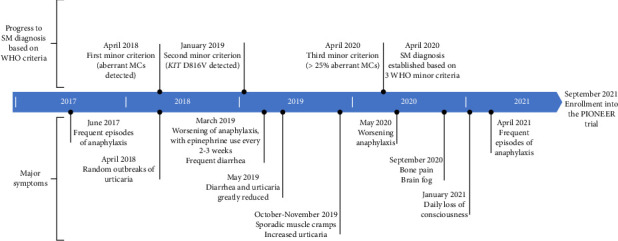 Figure 1
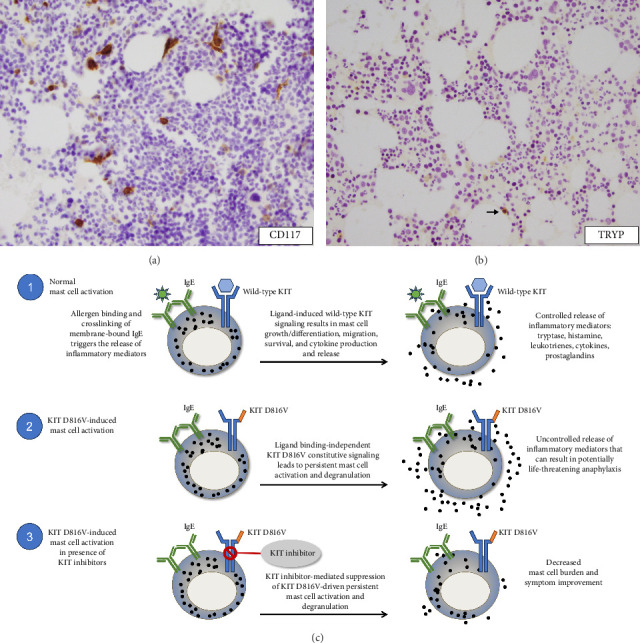 Figure 2
Peer Reviews
No public reviews on file for this paper yet. If you reviewed it on a platform where reviews are public (OpenReview, ICLR, NeurIPS, ICML), you can paste yours below so the community can read it here.
Videos
No videos yet. Explain this paper in a talk, walkthrough, or lecture? Add one.
Taxonomy
TopicsMast cells and histamine · Asthma and respiratory diseases · Dermatology and Skin Diseases