Constraints and adaptations in crocodyliform skull evolution
Ananth Srinivas, Jen A. Bright, John A. Cunningham, Sandra Aparecida Simionato Tavares, Fresia Ricardi-Branco, Ismar de Souza Carvalho, Fabiano Vidoi Iori, Emily J. Rayfield

TL;DR
This study explores how crocodile relatives evolved different skull shapes, finding that dome-shaped skulls are better at handling feeding forces when not constrained by water.
Contribution
The study provides new biomechanical evidence linking skull shape to feeding efficiency and hydrodynamic constraints in crocodyliform evolution.
Findings
Oreinirostral skulls show increased resistance to feeding-induced stresses compared to platyrostral ones.
Muscle efficiency is higher in dome-shaped skulls, supporting their functional advantage in terrestrial species.
Hydrodynamic constraints likely influenced the evolution of broad, flat snouts in modern crocodilians.
Abstract
Crocodyliforms display a diverse range of skull morphologies through their evolutionary history. Extant crocodilians possess platyrostral (broad and flat) snouts, thought to be sub-optimal for resisting feeding loads due to the conflicting demands of feeding and hydrodynamic constraints. In contrast, numerous Mesozoic crocodyliforms possessed oreinirostral (dome-shaped) skulls, were terrestrial and hence free from hydrodynamic constraint. This study aims to examine the role of function in determining skull shape in crocodyliforms and assesses the difference in stress resistance between oreinirostral and platyrostral taxa. We hypothesize that in the absence of hydrodynamic constraints, oreinirostral taxa have skulls that are better suited for resisting feeding-induced loads. Using finite element analysis, we evaluated biomechanical performance in oreinirostral notosuchian taxa…
Genes, proteins, chemicals, diseases, species, mutations and cell lines named across the full text — each resolved to its canonical identifier and authoritative record.
Click any figure to enlarge with its caption.
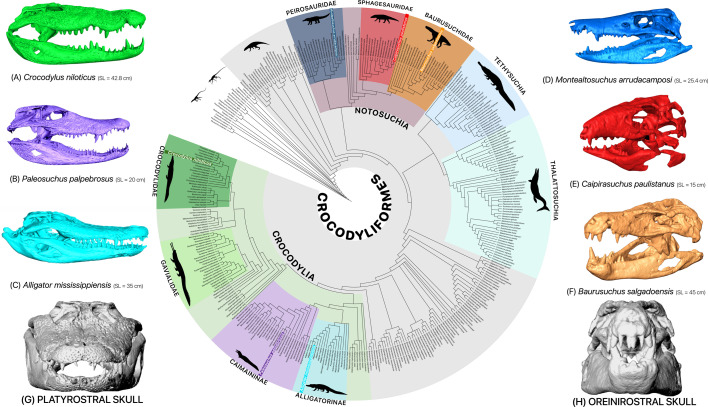 Figure 1
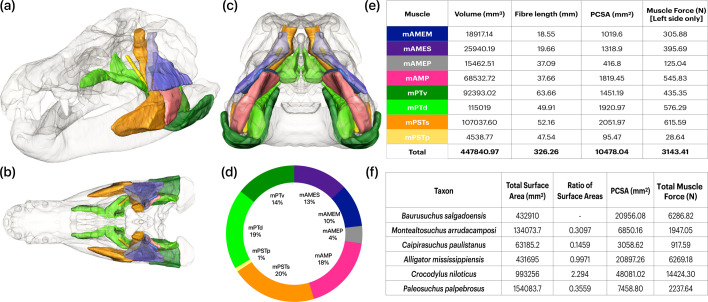 Figure 2
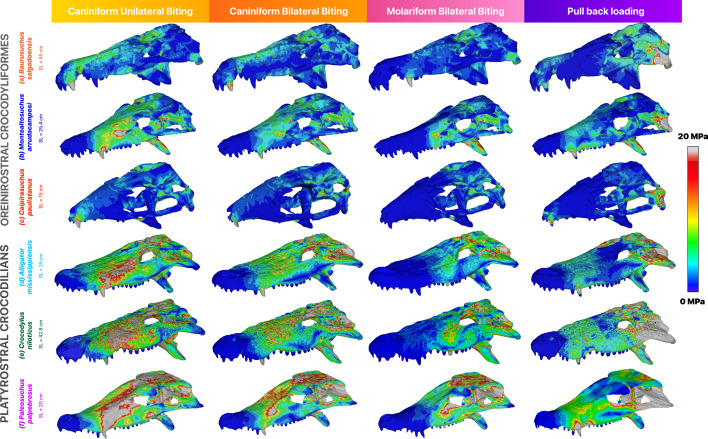 Figure 3
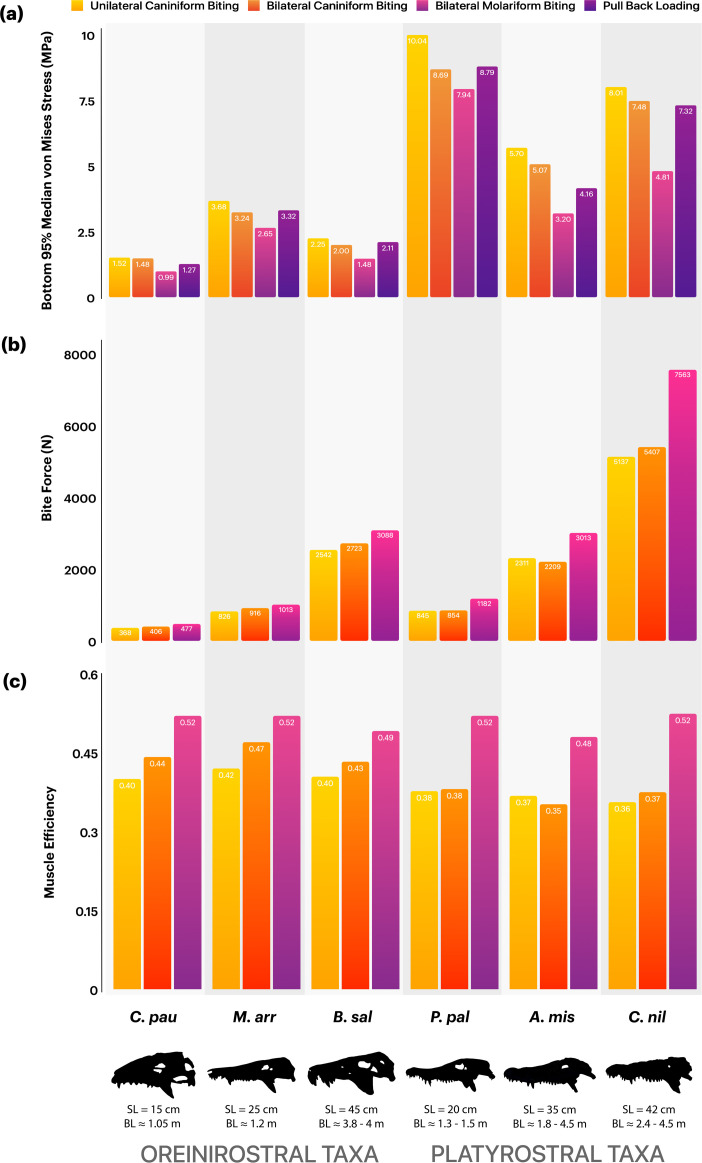 Figure 4
Peer Reviews
No public reviews on file for this paper yet. If you reviewed it on a platform where reviews are public (OpenReview, ICLR, NeurIPS, ICML), you can paste yours below so the community can read it here.
Videos
No videos yet. Explain this paper in a talk, walkthrough, or lecture? Add one.
Taxonomy
TopicsPaleontology and Evolutionary Biology · Evolution and Paleontology Studies · Paleontology and Stratigraphy of Fossils