Optimal competitors: the balance of attraction and choices of mutualists, like pollinators, drives facilitation and may promote crop pollination
Anna Dornhaus, Alasdair I. Houston

TL;DR
This paper explores how mutualists like pollinators can both compete and benefit plants, showing that wildflowers near crops can enhance pollination through careful balance of attraction and competition.
Contribution
The study introduces a mathematical framework showing facilitation occurs from imbalances between local competition and long-distance attraction of consumers.
Findings
Facilitation occurs when there is a low presence of highly attractive wildflowers near crops.
The relationship between plant density and consumer attraction determines whether facilitation or competition occurs.
The model generalizes to various contexts where local competition interacts with consumer attraction.
Abstract
When two species use the same resource, this typically leads to competition, such as when different plants aim to attract the same mutualist pollinators. However, more flowers may also attract more pollinators to an area, such that one or both ‘competitors’ actually benefit from the other’s presence. For example, it has been argued that strips of wildflowers planted next to crops may attract pollinators who ‘spill over’ into the crop. Here, we mathematically examine facilitation and competition in consumer attraction. Contrary to previous claims, no accelerating benefits of density on attraction per se are necessary for facilitation. Instead, under very general assumptions, facilitation can be generated by an imbalance between local competition and joint long-distance attraction of consumers; for example, a low presence of highly attractive ‘wildflowers’ should lead to benefits to a…
Genes, proteins, chemicals, diseases, species, mutations and cell lines named across the full text — each resolved to its canonical identifier and authoritative record.
Click any figure to enlarge with its caption.
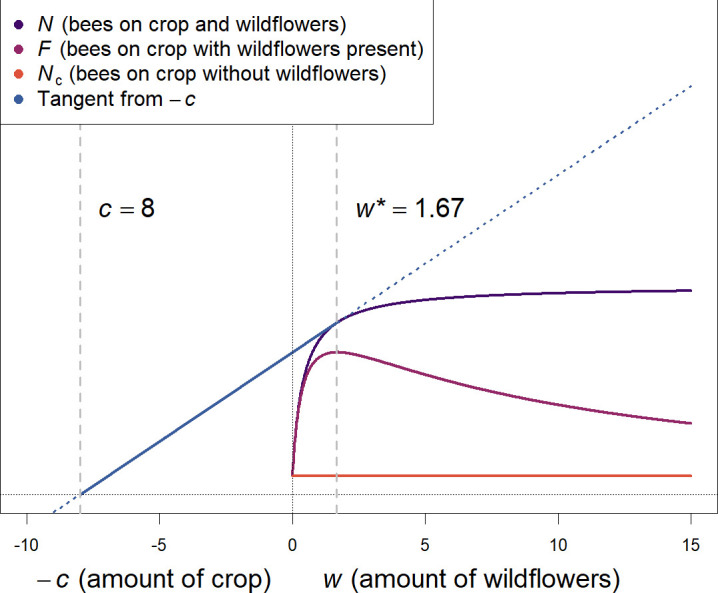 Figure 1
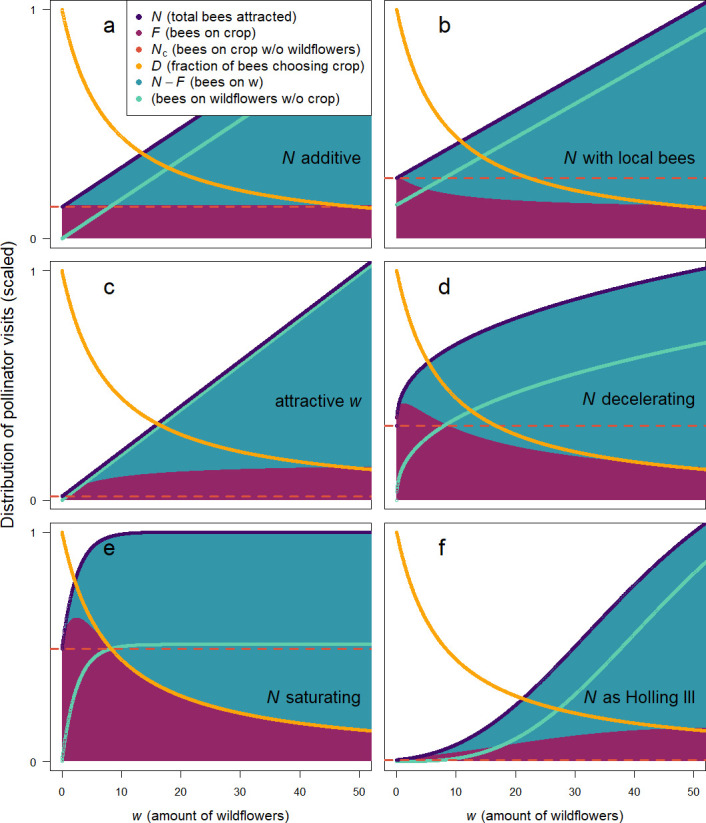 Figure 2
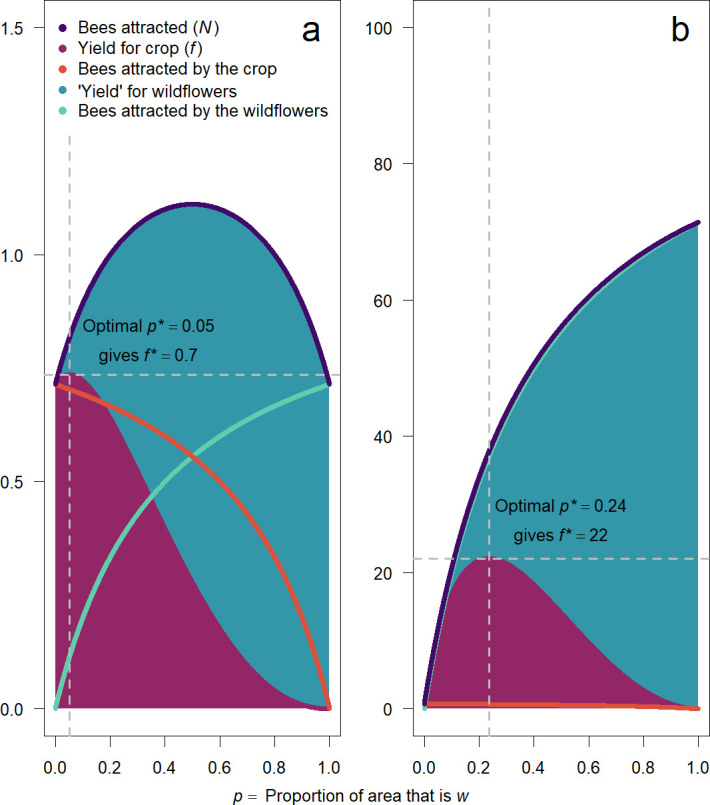 Figure 3
Peer Reviews
No public reviews on file for this paper yet. If you reviewed it on a platform where reviews are public (OpenReview, ICLR, NeurIPS, ICML), you can paste yours below so the community can read it here.
Videos
No videos yet. Explain this paper in a talk, walkthrough, or lecture? Add one.
Taxonomy
TopicsPlant and animal studies · Insect and Arachnid Ecology and Behavior · Evolutionary Game Theory and Cooperation