Does the liver talk to the brain? If so, how and why?
Young-Hwan Jo

TL;DR
The liver communicates with the brain through signals like nutrients and hormones, possibly via the vagal nerve, influencing metabolism and mood.
Contribution
This paper proposes that liver signaling via the vagal nerve is a new pathway for body-brain communication.
Findings
The liver communicates with the brain via vagal sensory neurons.
Liver signals influence metabolic homeostasis and emotional stability.
Abstract
The liver communicates with the brain by transmitting interoceptive signals, including nutrients, hormones, and cytokines, potentially via the liver-innervating vagal sensory neurons. This communication is crucial for maintaining metabolic homeostasis and emotional stability. Interoceptive signals from visceral organs, such as heart, lungs and gut, are known to influence many aspects of organismal physiology and behavior. This Perspective argues that liver signaling via the vagal nerve is another avenue of body-brain communication that shapes metabolism and mood.
Genes, proteins, chemicals, diseases, species, mutations and cell lines named across the full text — each resolved to its canonical identifier and authoritative record.
Click any figure to enlarge with its caption.
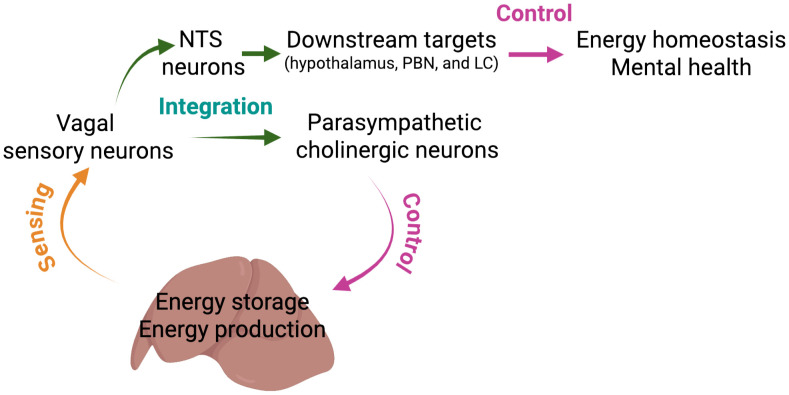 Figure 1
Peer Reviews
No public reviews on file for this paper yet. If you reviewed it on a platform where reviews are public (OpenReview, ICLR, NeurIPS, ICML), you can paste yours below so the community can read it here.
Videos
No videos yet. Explain this paper in a talk, walkthrough, or lecture? Add one.
Taxonomy
TopicsNeuroscience of respiration and sleep · Vagus Nerve Stimulation Research · Gastrointestinal motility and disorders