Large Language Models for the National Radiological Technologist Licensure Examination in Japan: Cross-Sectional Comparative Benchmarking and Evaluation of Model-Generated Items Study
Toshimune Ito, Toru Ishibashi, Tatsuya Hayashi, Shinya Kojima, Kazumi Sogabe

TL;DR
This study evaluates how well large language models can create high-quality exam questions for radiological technologists in Japan, finding that while they perform well on accuracy and coverage, wording and instructional value need improvement.
Contribution
The study introduces a benchmarking framework for LLMs in radiological licensure item generation and evaluates the educational quality of model-generated questions.
Findings
OpenAI o3 outperformed other models in accuracy for the radiological technologist exam.
Model-generated items scored highly on difficulty and content coverage but lower on wording clarity and instructional usefulness.
Expert feedback highlights the need for editorial refinement to improve explanation quality and wording.
Abstract
Mock examinations are widely used in health professional education to assess learning and prepare candidates for national licensure. However, instructor-written multiple-choice items can vary in difficulty, coverage, and clarity. Recently, large language models (LLMs) have achieved high accuracy in medical examinations, highlighting their potential for assisting item-bank development; however, their educational quality remains insufficiently characterized. This study aimed to (1) identify the most accurate LLM for the Japanese National Examination for Radiological Technologists and (2) use the top model to generate blueprint-aligned multiple-choice questions and evaluate their educational quality. Four LLMs—OpenAI o3, o4-mini, o4-mini-high (OpenAI), and Gemini 2.5 Flash (Google)—were evaluated on all 200 items of the 77th Japanese National Examination for Radiological Technologists in…
Genes, proteins, chemicals, diseases, species, mutations and cell lines named across the full text — each resolved to its canonical identifier and authoritative record.
Click any figure to enlarge with its caption.
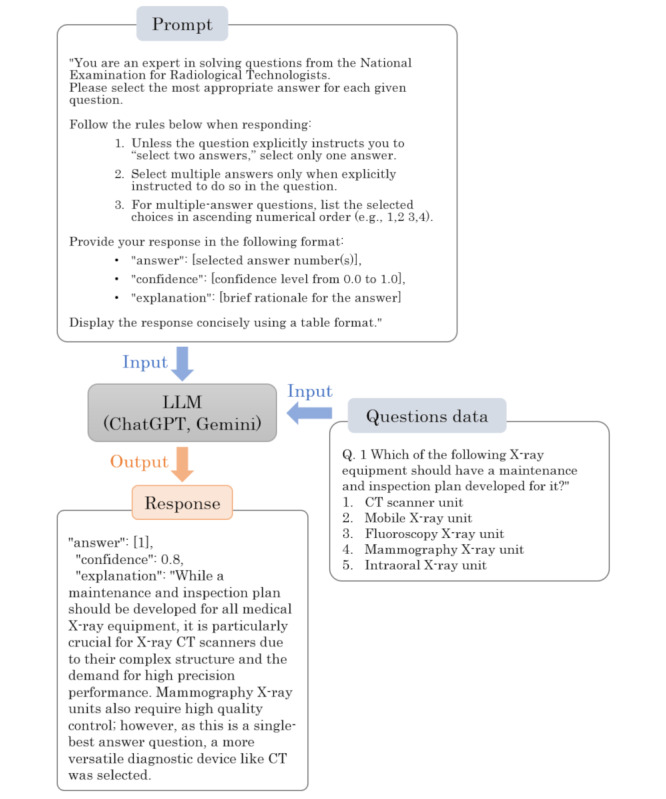 Figure 1
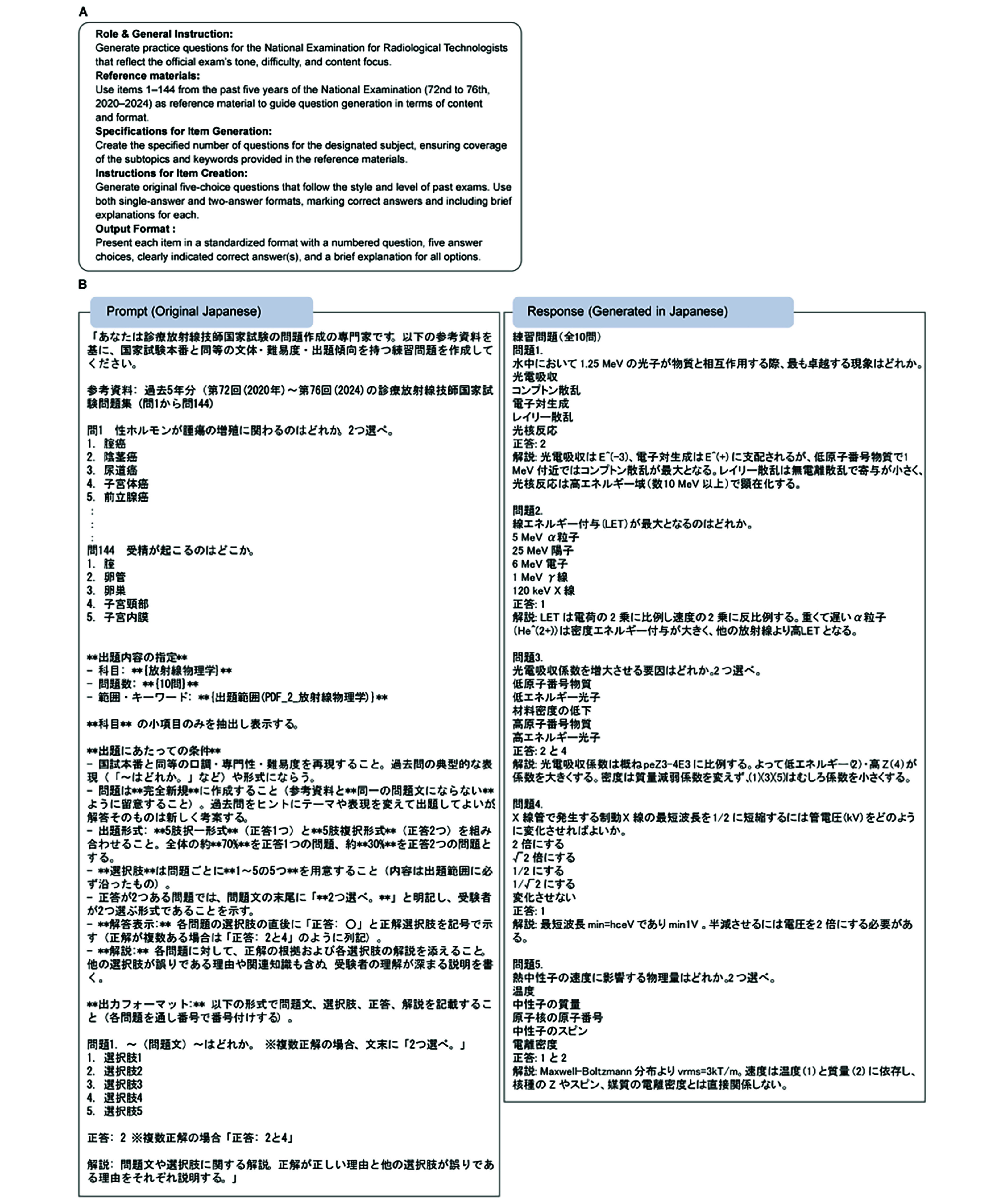 Figure 2
| Subject | Blueprint target (n=200) | Generated (n=192) |
|---|---|---|
| Diagnostic Imaging Techniques | 20 | 20 |
| Nuclear Medicine Technology | 20 | 20 |
| Radiation Therapy Technology | 20 | 20 |
| Medical Imaging Informatics | 10 | 10 |
| Basic Medical Sciences | 30 | 30 |
| Radiation Science & Engineering | 36 | 36 |
| X-ray Imaging Equipment | 20 | 20 |
| X-ray Imaging Techniques | 20 | 20 |
| Image Engineering | 6 | 6 |
| Radiation Safety Management | 10 | 10 |
| Healthcare Safety Management | 8 | 0 |
| Evaluation criterion | Rating scale |
|---|---|
| Item difficulty | 1‐5 |
| Factual accuracy | 1‐5 |
| Accuracy of content coverage | 1‐5 |
| Appropriateness of wording | 1‐5 |
| Instructional usefulness | 1‐5 |
| Variables | 200 questions | 173 nonimage questions |
|---|---|---|
| Model accuracy | ||
| OpenAI-o4-mini-high, % | 86.0 (80.5, 90.1) | 88.4 (82.8, 92.4) |
| OpenAI-o4-mini, % | 82.5 (76.6, 87.1) | 86.7 (80.8, 91.0) |
| OpenAI-o3, % | 90.0 (85.1, 93.4) | 92.5 (87.6, 95.6) |
| Gemini 2.5 Flash, % | 83.0 (77.2, 87.6) | 89.6 (84.1, 93.3) |
| Cochran Q test ( | .01 | .10 |
| Pairwise McNemar test (Bonferroni-adjusted | ||
| OpenAI-o4-mini-high versus OpenAI-o4-mini | ≥.99 | N/A |
| OpenAI-o4-mini-high versus OpenAI-o3 | .44 | N/A |
| OpenAI-o4-mini-high versus Gemini 2.5 Flash | ≥.99 | N/A |
| OpenAI-o4-mini versus OpenAI-o3 | .02 | N/A |
| OpenAI-o4-mini versus Gemini 2.5 Flash | ≥.99 | N/A |
| OpenAI-o3 versus Gemini 2.5 Flash | .06 | N/A |
| Evaluation criterion | Mean score (95% CI) | |
|---|---|---|
| Item difficulty | 4.29 (4.11, 4.46) | <.001 |
| Factual accuracy | 4.18 (3.98, 4.38) | .001 |
| Accuracy of content coverage | 4.73 (4.60, 4.86) | <.001 |
| Appropriateness of wording | 3.92 (3.73, 4.11) | .44 |
| Instructional usefulness | 3.60 (3.41, 3.80) | ≥.99 |
Peer Reviews
No public reviews on file for this paper yet. If you reviewed it on a platform where reviews are public (OpenReview, ICLR, NeurIPS, ICML), you can paste yours below so the community can read it here.
Videos
No videos yet. Explain this paper in a talk, walkthrough, or lecture? Add one.
Taxonomy
TopicsPsychometric Methodologies and Testing · Radiology practices and education · Artificial Intelligence in Healthcare and Education
Introduction
Mock examinations are a key pedagogical tool in training programs for health professionals. These are designed to consolidate the knowledge required for national licensure and to gauge students’ achievement [1-3]. In particular, multiple-choice formats are valuable because they enable the systematic, efficient appraisal of the broad foundational knowledge expected in clinical practice, making them integral to the quality of the curriculum. However, most items are written by individual instructors that draw on past examinations or personal clinical experience, and their difficulty and content validity are rarely subjected to systematic review [45]. These can result in biases in content coverage, inconsistencies in wording, and variable educational usefulness, which undermine the stability of learning outcome assessments.
Several studies have reported the high accuracy of large language models (LLMs) in health professional licensure examinations, owing to their rapid advancements [6-9]. In text-based multiple-choice questions, models have begun to match or surpass human test-takers while generating rationales and keyword-level explanations that can serve as formative feedback [10-13]. These suggest the potential utility of LLM-assisted item writing during the construction of high-quality question banks. However, most research has centered on the accuracy of LLMs in answering existing licensure items [14-16], while empirical evidence regarding the educational quality of questions authored by LLMs remains scarce [1317]. A comprehensive appraisal that includes (1) appropriate difficulty, (2) completeness and accuracy of content coverage, (3) clarity of option wording, and (4) usefulness of accompanying explanations is necessary to address this knowledge gap and clarify the practical value of artificial intelligence (AI)-supported mock examinations, as well as its limitations.
This study evaluated the quality of AI-generated multiple-choice questions based on the Japanese National Examination for Radiological Technologists. Several LLMs were used to answer the exam, then the highest-performing model was used to generate a set of mock items. These AI-generated questions were then evaluated across several aspects (ie, item-level difficulty, item-level factual accuracy, accuracy of content coverage, appropriateness of wording, and instructional usefulness) through blinded expert review and statistical analysis. By doing so, this study aims to provide empirical data on the educational soundness of AI-generated items, as well as highlight any emerging challenges.
Methods
Models and Study Period
Four LLMs released in February 2025 were evaluated: OpenAI o3, OpenAI o4-mini, OpenAI o4-mini-high (all OpenAI), and Gemini 2.5 Flash (Google). The evaluations were conducted from March 14 to May 8, 2025, using the publicly accessible browser interfaces, with the desired engine explicitly selected in each platform’s menu. The browser access was chosen to mirror typical educational use and to simplify image I/O (upload, preview, and per-item attachment). The item-generation study was conducted from May 15 to June 28, 2025, using OpenAI o3, the model with the highest answer accuracy. To ensure consistency, we used an identical Japanese prompt template across models. To avoid carryover effects, we started a new session for each 50-item batch with the OpenAI models and used per-item input with Gemini; image files (PNG) were attached when required by an item. As browsing and memory features were disabled, outputs relied solely on pretrained parameters and the provided materials.
Answer Accuracy
Answer accuracy was assessed based on all 200 items of the 77th National Examination for Radiological Technologists, administered on February 20, 2025. All items were multiple-choice, and question stems containing images were presented unchanged. Each model was given the question stem and options in Japanese, then instructed to select the correct answers in single-best or multiple-select format. Multimedia Appendix 1 lists the subjects and the number of items per subject. Due to the differences in each model, the input procedures were adapted accordingly. For OpenAI models, stems and options were pasted from four text files (items 1‐50, 51‐100, 101‐150, and 151‐200) into separate sessions. PNG files were attached for each image item, with the filenames labeled to match the corresponding item numbers. However, since Gemini permits only one file upload, the stems and options were pasted directly into the prompt while attaching an image file as needed. All inputs were entered manually. A concrete workflow is shown in Figure 1.
Representative interaction with a large language model (LLM). This diagram illustrates the workflow used to evaluate the answer accuracy of large language models. The LLMs were given prompts to answer each question (including text and images when applicable) in Japanese, with specific instructions for answer selection and formatting. The output included the selected answer, a confidence score, and a brief explanation. All actual prompts and inputs were entered in Japanese, but this example is shown in English for illustration purposes. CT: computed tomography.
The outputs of the model were compared to the official answer key issued by the Ministry of Health, Labor and Welfare. The correct and incorrect responses were counted overall for 200 items and separately for the 173 items that did not require image interpretation (ie, nonimage items). Statistical significance was tested across models.
Item Generation
Generation Procedure
The mock items were generated using OpenAI o3, since it had the highest accuracy among all four models. Image-based stems were excluded since all models performed poorly on these. Using the same examination as a blueprint, OpenAI o3 was used to produce 192 questions across 14 subjects (Table 1), matching the same distribution of items. The model was supplied with text files containing the past 5 years of examination items and the official test specifications, ensuring its alignment with test objectives. Browsing remained disabled. Since Healthcare Safety Management is a new domain introduced in 2025, thereby lacking any historical reference items, it was excluded from the mock item generation. Items were generated separately for each subject in Japanese, and each output included the stem, five options, the key, and a brief rationale.
Evaluation of Generated Items
All 192 generated questions were reviewed by experts of the subject matter; these were faculty members with at least 5 years of experience as subject coordinators in radiological technology programs and who routinely author mock examinations. Items were assigned to reviewers by discipline, and each question was evaluated by one expert. The reviewers rated each item on a five-point scale: (1) unacceptable; (2) major revision needed; (3) revisable; (4) minor revision; and (5) adoptable across five criteria including, item difficulty, factual accuracy, accuracy of content coverage, appropriateness of wording, and instructional usefulness.
For each criterion, we calculated the median score and tested the statistical significance of the proportion of high ratings (≥4). The evaluation framework, which is based on faculty experience with national examination item writing, is presented in Table 2.
Statistical Analysis
Statistical analysis was performed using JMP (version 18; JMP Statistical Discovery LLC). Cochran Q test was initially used to examine overall differences in answer accuracy; when significant, pairwise differences were probed with McNemar test using Bonferroni correction. The item generation study used a one-sided Wilcoxon signed-rank test (H₀: median ≤4). Statistical significance was set at P<.05 for all analyses.
Ethical Considerations
This study did not involve human participants or patient-identifiable data. The Ethics Committee of Teikyo University reviewed the project and determined that formal ethical approval was not required because the work evaluated the quality of test items and did not constitute human medical research. Accordingly, informed consent was not applicable.
Results
Answer Accuracy
The accuracy of the LLMs on the full 200-item set and the nonimage 173-item set is shown in Table 3. All models consistently scored lower in the full set versus the nonimage set, with OpenAI o3 achieving the best results at 90% and 92.5%, respectively. A significant difference was seen between OpenAI o3 and OpenAI o4-mini on the full set, whereas no significant differences were seen among models on the nonimage set.
Item Generation
Table 4 presents the scores and statistics for all 192 questions, while Figure 2 illustrates the prompt template and sample outputs. Among item difficulty, factual accuracy, and accuracy of content coverage, the medians and the proportions of scores ≥4 did not differ significantly, although accuracy of content coverage had the highest score. Meanwhile, instructional usefulness had a significantly lower score than appropriateness of wording. The evaluation criteria and evaluation examples of items that scored 1‐2 for the lower-scoring criteria—appropriateness of wording and instructional usefulness—are detailed in Multimedia Appendix 2.
Prompt summary and representative example of item generation. (A) Summary of the prompts used to instruct the language model to generate original mock questions aligned with the National Examination for Radiological Technologists. The summary outlines the role of the model, input references, specifications of generation, item-creation rules, and output format. (B) The actual prompt and representative response generated by the model. The prompt included specific formatting and content-generation instructions written in Japanese. The response shows the generated item, correct answers, and explanation in Japanese.
Discussion
Principal Findings
This study compared four LLMs in terms of answer accuracy on the Japanese National Examination for Radiological Technologists. The top performer, OpenAI o3, was used to generate the mock test, which was then evaluated by experts in terms of educational quality. As shown in Table 3, on the full set of items, only the comparison between the OpenAI o3 and OpenAI-o4-mini variant reached statistical significance; when image-based items were excluded, no model differences were observed.
To contextualize the observed accuracy differences, we briefly summarize the multimodal architectures and vision–language pipelines of the evaluated models as they pertain to radiologic image questions. Built on a GPT-4 lineage, OpenAI o3 integrates a high-resolution visual encoder with unified attention over linguistic and visual tokens [1819], likely enhancing sensitivity to low-contrast findings and subtle anatomical cues typical of radiography and CT. In contrast, OpenAI o4-mini is a lightweight variant with reduced-resolution patch embeddings [2021], which can yield coarser visual representations and miss subtle image cues. OpenAI o4-mini-high supplements the mini architecture with targeted medical-image fine-tuning and partial recovery of high-resolution inputs [2223], consistent with improved mapping of relevant visual patterns. Lastly, Gemini 2.5 Flash uses a two-tower design in which an external vision encoder converts images to tags prior to language processing [2425]; such pipelines may incur information loss for domain-specific anatomical details. In line with these architectural differences, performance gaps emerged on image-based questions but not on text-only items.
The pronounced performance spread on image-based questions could be mainly attributed to the aggressive parameter reduction in OpenAI o4-mini and the information loss inherent in the image-to-tag pipeline in Gemini, both of which weaken visual feature representation. Thus, current systems may not fully capture clinically grounded context and the knowledge required for radiologic image interpretation. This finding is consistent with the results of previous studies reporting similar limitations in specialty radiology examinations [2627]. However, OpenAI o3 and o4-mini-high have higher resolution encoders and benefit from medical-specific fine-tuning. However, due to the limited sample sizes and proprietary nature of the detailed model architectures, these explanations remain partly hypothetical. Nevertheless, these findings highlight the importance of the visual module scale and the presence of medical-domain training when selecting an LLM for the development of -generated questions in this field.
Building on these findings, the 192 items generated by the top model were reviewed across five educational criteria. Item difficulty, factual accuracy, and content coverage were rated favorably, indicating alignment with national expectations and the official blueprint [26]. By contrast, appropriateness of wording and instructional usefulness were comparatively weaker, with reviewers noting ambiguous phrasing and explanations that did not consistently link stem cues to the correct answer or to distractor misconceptions. These strengths and weaknesses are consistent with observations from related medical-education settings [28-30] and underscore the need for editorial refinement prior to instructional deployment.
This study has several limitations. First, the image-based items were excluded from expert review, thus precluding the assessment of visual tasks. Second, each question was evaluated by a single expert, and thus inter-rater reliability could not be assessed. Third, reproducibility is limited by the use of publicly accessible browser interfaces. All evaluations were conducted through browser UIs with visible labels: OpenAI o3, OpenAI o4-mini, OpenAI o4-mini-high, and Gemini 2.5 Flash. Although this choice mirrors typical educational use and simplifies image I/O, it limits control over versioning and decoding parameters. Prompt delivery also varied across platforms due to UI constraints: OpenAI models received items in 50-question batches per session, whereas Gemini required per-item input, with a single image upload when applicable. Such differences in prompt granularity, context priming, and file-attachment workflows may have influenced outputs and should be considered when interpreting the comparable performance of Gemini Flash and o3. To mitigate these effects, we used an identical Japanese prompt template, disabled memory features, initiated new sessions for each batch, preserved the original exam order, and performed a single pass per item without retries. Input handling is detailed in the Methods section. These input structures reflected platform UI constraints (OpenAI allowed 50-question batches per session, whereas Gemini required per-item prompts and a single image attachment when applicable); although memory features were disabled and each batch began in a new session, processing the OpenAI items in batches could still introduce minor within-session priming; therefore, residual order effects cannot be fully excluded. Application-level temperature settings were not user-configurable. Moreover, because decoding remained stochastic and we performed a single pass per item without retries, run-to-run response variability cannot be fully excluded even with identical prompts. Given that browser-based services can update without notice, outputs may drift over time even when identical prompts and labels are used [31-33]. Thus, to strengthen version control and reproducibility, future studies should standardize prompt injection through Application Programming Interface endpoints with pinned model snapshots, identical per-item wrappers, and fully logged metadata (prompt templates, model identifiers, timestamps, and decoding parameters). In the future, visual encoders are expected to operate at a higher resolution and undergo additional tuning for medical domains. This could enable LLMs to automatically generate image-based items across modalities (eg, computed tomography, magnetic resonance imaging, and ultrasound), thus bringing mock exams closer to clinical reality. Further improvements in the feedback system could also be seen. By delivering adaptive feedback that varies in depth according to each learner’s proficiency, students can be provided with on-demand, targeted remediation material. LLMs could also be used to map items to the national blueprint in real time, enabling the detection and correction of domain imbalances while reducing faculty workload. Lastly, aligning these models with overseas licensure frameworks could expand their use to ultimately support a multilingual, multi-profession, international mock-exam bank.
Conclusions
This study demonstrated that an LLM (OpenAI o3) can attain high accuracy on national radiological technology examination, as well as generate new multiple-choice items with appropriate difficulty, factual correctness, and syllabus coverage, as evaluated by experts. Although the AI-generated questions fell short in terms of wording clarity and pedagogical feedback, these can be mitigated through targeted editorial review. Practically speaking, LLMs can be used to draft content that is eventually refined by the faculty. This workflow could enable the more efficient development of mock examinations and reinforce curriculum alignment without imposing additional burden on instructors. However, performance gaps on image-based items, the absence of inter-rater reliability data, and the inherent volatility of cloud-hosted models underscore the need for cautious implementation and transparent reporting of model metadata. Nevertheless, future advancements in high-resolution visual encoders and medical-specific tuning can close this multimodal gap, while adaptive feedback functions and automated blueprint mapping can further extend the educational value of AI-generated assessments. After overcoming these barriers in terms of technical improvements and reproducibility safeguards, LLMs can be a strong asset in radiological technology education, which can even extend to the licensure preparations of other allied health professionals worldwide.
Supplementary material
10.2196/81807Multimedia Appendix 1Breakdown of the 2025 Japanese National Exam Questions by Subject.
10.2196/81807Multimedia Appendix 2Operational definitions and decision rules for item evaluation.
The reference list from the paper itself. Each links out to its DOI / PubMed record.
- 1Al-Sheikh MH Albaker W Ayub MZ Do mock medical licensure exams improve performance of graduates? Experience from a Saudi Medical College Saudi J Med Sci 2022102157161 doi 10.4103/sjmms.sjmms_173_21 · doi ↗
- 2Scott NP Martin TW Schmidt AM Shanks AL Impact of an online question bank on Resident In-Training exam performance J Med Educ Curric Dev 20231023821205231206221 doi 10.1177/23821205231206221 Medline 37822782 PMC 10563493 · doi ↗ · pubmed ↗
- 3Siab F Morrissey H Ball P Pharmacy students’ opinions of using mock questions to prepare for summative examinations Int J Curr Pharm Sci 0720201245865 doi 10.22159/ijcpr.2020 v 12i 4.39079 · doi ↗
- 4Alawgali SM An evaluation of a final year multiple choice questions examination at Faculty of medicine-university of Benghazi Open Access Maced J Med Sci 20241280111 doi 10.37376/jsh.vi 80.6626 · doi ↗
- 5Karthikeyan S O’Connor E Hu W Barriers and facilitators to writing quality items for medical school assessments – a scoping review BMC Med Educ Dec 2019191123 doi 10.1186/s 12909-019-1544-831046744 PMC 6498649 · doi ↗ · pubmed ↗
- 6Kung TH Cheatham M Medenilla A et al Performance of Chat GPT on USMLE: potential for AI-assisted medical education using large language models PLOS Digit Health Feb 202322 e 0000198 doi 10.1371/journal.pdig.0000198 Medline 36812645 PMC 9931230 · doi ↗ · pubmed ↗
- 7Tanaka Y Nakata T Aiga K et al Performance of generative pretrained transformer on the National Medical Licensing Examination in Japan PLOS Digit Health 01202431 e 0000433 doi 10.1371/journal.pdig.0000433 Medline 38261580 PMC 10805303 · doi ↗ · pubmed ↗
- 8Saowaprut P Wabina RS Yang J Siriwat L Performance of large language models on Thailand’s National Medical Licensing Examination: a cross-sectional study J Educ Eval Health Prof 20252216 doi 10.3352/jeehp.2025.22.16Medline 40354784 · doi ↗ · pubmed ↗